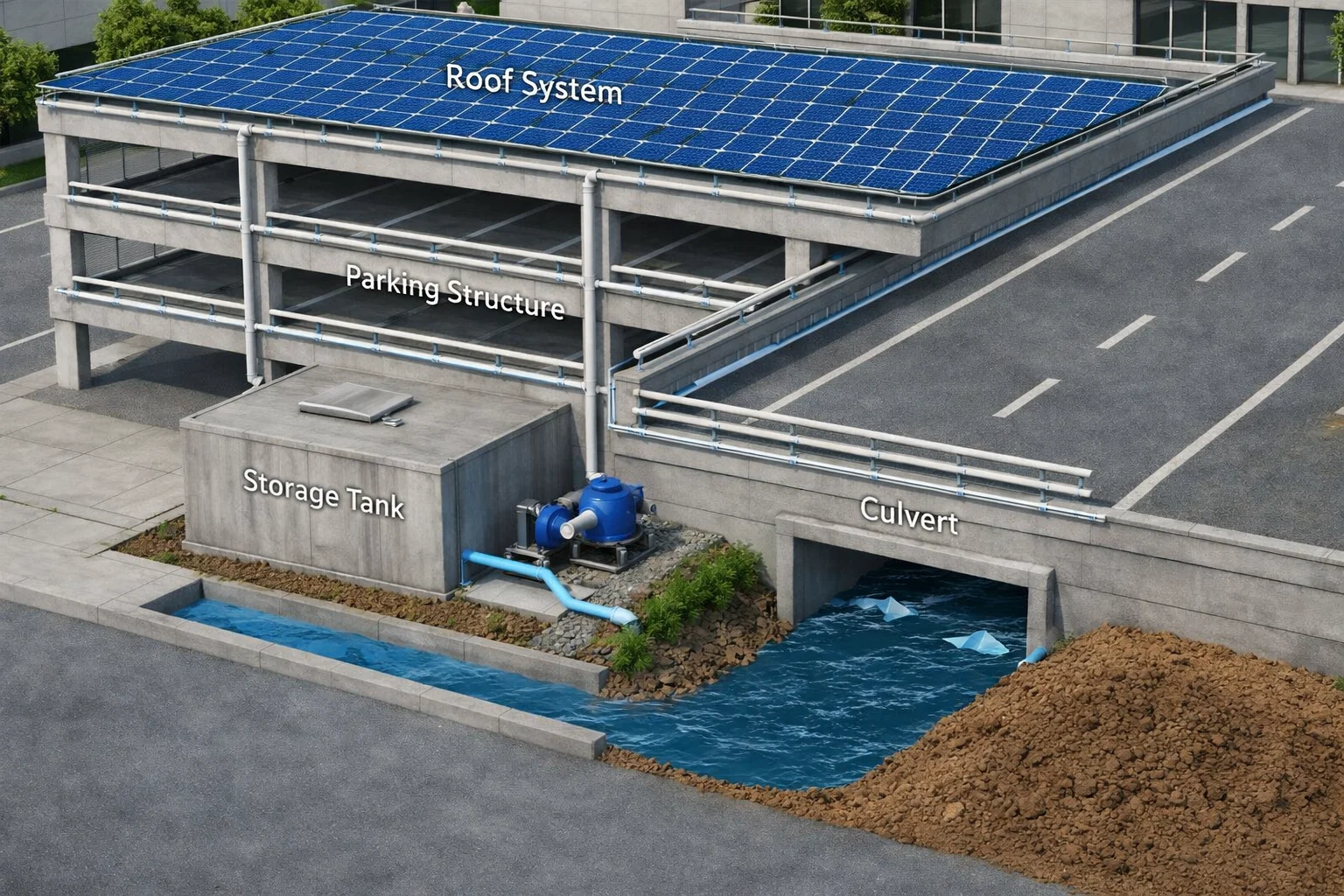
The integration context for this project is an open multi-storey parking structure located in an urban environment subject to variable and occasionally high-intensity rainfall. The parking structure acts as the primary physical host and spatial framework within which the other systems are embedded. Due to its open configuration, both the roof and the parking decks are directly exposed to precipitation, making surface water management a dominant functional requirement alongside structural performance and energy provision.
Within this context, the roof system serves a dual role. Structurally, it provides protection and load transfer for the parking structure. Functionally, it acts as a primary catchment surface for rainfall and as the mounting interface for the solar photovoltaic (PV) system. The PV system is not treated as an isolated energy asset; instead, it is integrated as a dependent subsystem whose size and capacity are constrained by the operational needs of the drainage system, specifically the power demand of the pump used for water transfer. This creates a direct dependency between hydrological behavior and energy generation.
Added systems:
Surface water management system forms the core integrative mechanism between the systems. Rainfall collected on the roof and parking decks is conveyed through internal drainage channels and gutter pipes into a closed storage basin. Under normal rainfall conditions, stored water is managed through controlled pumping, powered by the PV system, toward downstream treatment or discharge. The design of these components is unified and stable across operating conditions, ensuring predictable system behavior during typical rainfall events.
The culvert system represents the interface between the parking infrastructure and the surrounding urban drainage network. It is not continuously active but becomes functionally relevant under extreme rainfall scenarios when storage capacity is exceeded. In such cases, excess water is first routed through an open overflow channel and then discharged into the culvert, allowing safe transfer away from the site without overloading the primary system. This layered integration strategy ensures that safety components protect the system during peak events while preserving the integrity and simplicity of the core configuration.
Main | Introduction | Individual Systems | Integration Context | Combined Ontology | Combined Parametric Model | Analysis and Conclusions | References