This project investigates the environmental performance of four alternative structural floor systems by applying an integrated Life-Cycle Assessment (LCA) and multi-criteria decision-making framework. The assessed systems include a reinforced concrete slab, joist–block slab, steel–concrete composite slab, and steel deck slab. All options are evaluated per 1 m² of floor area over a 100-year service life to ensure comparability [3,4].
The LCA is conducted within a cradle-to-use system boundary, accounting for material production, construction, inspection, maintenance, and replacement phases [1]. Environmental indicators include embodied energy and emissions of CO₂, NOₓ, and SO₂, calculated based on material quantities and predefined maintenance scenarios [2,8]. The results show that environmental impacts are highly dependent on both material intensity and intervention frequency over time [5].
The reinforced concrete slab exhibits the highest environmental impacts across all indicators due to its high cement content and large material mass [2,3]. The joist–block slab performs moderately, benefiting from reduced concrete usage but still requiring significant material input. The steel–concrete composite slab shows improved performance, while the steel deck slab achieves the lowest impacts, primarily because of its lightweight structure and reduced material demand.[3,7].
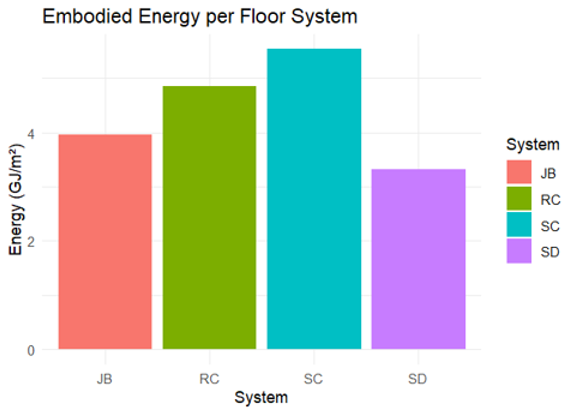
Figure 1. Comparison of embodied energy for the four floor systems (per m² over 100 years).
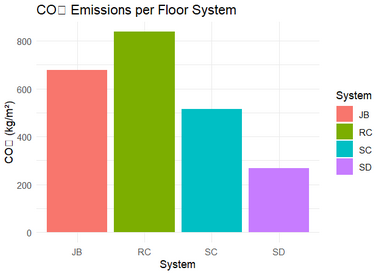
Figure 2. Comparison of total CO₂ emissions of the floor systems across the life cycle.
To support decision-making, the Analytic Hierarchy Process (AHP) is employed using environmental criteria as weighting factors [6]. The final ranking confirms the LCA findings, identifying the steel deck slab as the most environmentally sustainable option among the alternatives. Overall, the project demonstrates that combining LCA with multi-criteria evaluation provides a robust and transparent basis for sustainability-oriented structural design [4,6].
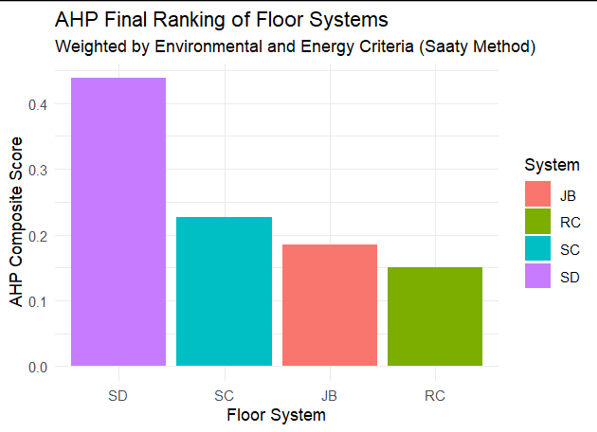
Figure 3. AHP Final Ranking Bar Chart
Reference
[1] ISO 14040:2006. Environmental Management – Life-Cycle Assessment – Principles and Framework.
[2] Marceau, M. L., Nisbet, M. A., & Van Geem, M. G. (2007). Life-Cycle Inventory of Portland Cement Concrete. Portland Cement Association.
[3] Ortiz, O., Castells, F., & Sonnemann, G. (2009). Sustainability in the Construction Industry: A Review of Recent Developments Based on LCA. Construction and Building Materials, 23(1), 28–39.
[4] Zuo, J., & Zhao, Z.-Y. (2014). Green Building Research: Current Status and Future Agenda. Renewable and Sustainable Energy Reviews, 30, 271–281.
[5] Bocchini, P., & Frangopol, D. M. (2012). Life-Cycle Reliability and Maintenance Optimization of Structural Systems. Structure and Infrastructure Engineering, 8(5), 341–356.
[6] Mardani, A., et al. (2015). A Review of Multi-Criteria Decision-Making and Its Applications in Sustainable Energy Systems. Renewable and Sustainable Energy Reviews, 42, 161–173.
[7] Zhou, W., Ding, L., & Chen, L. (2019). Ontology-Based Representation and Integration of Building Information for Life Cycle Assessment. Automation in Construction, 107, 102919.
[8] Ecoinvent Database v3.9 (2023). Swiss Centre for Life Cycle Inventories.
Home | introdaction | Integration Context | Maintenance Strategies | Life-cycle Analysis | Multi-Objective Optimizatin