This project evaluates the environmental and economic performance of interior partition wall systems using an integrated Life Cycle Assessment (LCA) and Multi-Criteria Decision Analysis (MCDA) approach. Interior partitions are often excluded from sustainability assessments despite contributing significantly to embodied impacts and long-term maintenance burdens [1].
Three partition wall systems are assessed: Standard Drywall, Acoustic Double-Layer, and Timber–Wood Fiber. All options are analysed for a functional unit of 500 m² over a 60-year service life, following ISO 14040/44 guidelines [2]. The system boundary covers cradle-to-grave stages, including material production, transport, installation, maintenance, and end-of-life treatment [3], [4].
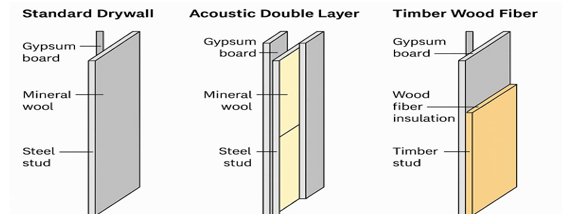
Figure 1: Interior partition wall systems assessed in the study: Standard Drywall, Acoustic Double-Layer, and Timber–Wood Fiber.
Environmental impacts are quantified using Life Cycle Inventory (LCI) data derived from the Inventory of Carbon and Energy (ICE v3.0) database [5] and Environmental Product Declarations (EPDs) sourced from the International EPD® System [6]. The assessed environmental indicators include embodied energy, carbon dioxide (CO₂) emissions, nitrogen oxides (NOₓ) emissions, sulphur dioxide (SO₂) emissions, as well as life-cycle cost. Maintenance activities, including repainting and partial board replacement, are explicitly modelled based on predefined intervention intervals, consistent with good practice recommendations for building LCA studies [4].
The LCA results indicate that the Acoustic Double-Layer partition system exhibits the highest embodied energy demand and pollutant emissions, primarily due to its increased material intensity, particularly gypsum boards and steel framing [5]. The Standard Drywall system demonstrates moderate environmental performance; however, it requires more frequent maintenance interventions over the service life, increasing cumulative impacts. In contrast, the Timber–Wood Fiber system consistently shows the lowest embodied energy and emissions, benefiting from lightweight, bio-based materials with lower carbon intensity [5], [6].
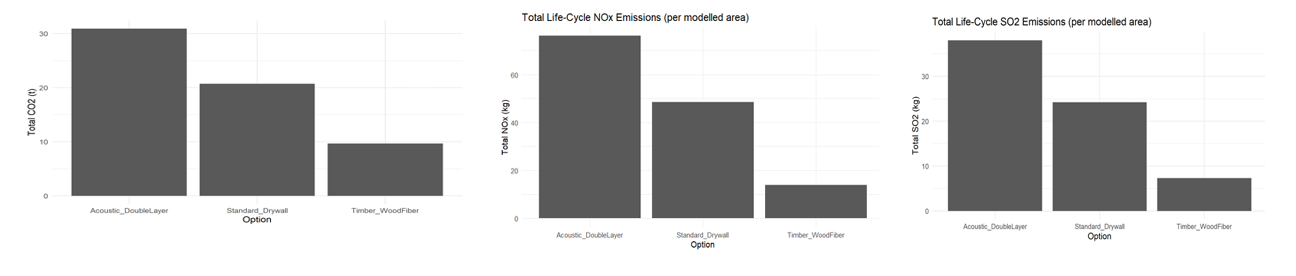
Figure 2: Comparison of total life-cycle CO₂,NOx,SO2 emissions for the three partition wall systems.
From an economic perspective, the Standard Drywall system represents the lowest life-cycle cost option, while the Acoustic Double-Layer system results in the highest total cost due to increased material use and installation complexity. The Timber–Wood Fiber system lies between the two alternatives, offering substantial environmental benefits at a moderate additional cost.
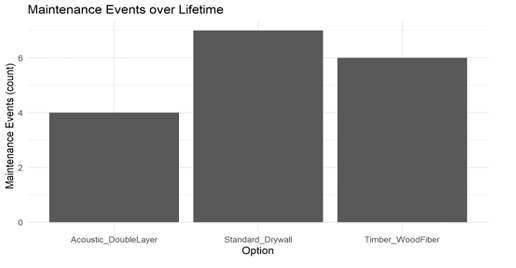
Figure 3: Number of maintenance interventions required over the system lifespan for each partition wall system.
To support integrated decision-making, an Analytic Hierarchy Process (AHP) is applied using weighted environmental criteria (energy, CO₂, NOₓ, and SO₂). The AHP results identify the Acoustic Double-Layer partition as the highest-ranked option when all criteria are aggregated, despite its higher absolute environmental impacts [7].

Figure 4: Final ranking of partition wall systems based on the Analytic Hierarchy Process (AHP).
Overall, the study highlights important trade-offs between material intensity, environmental performance, durability, and cost. It demonstrates that combining LCA with MCDA provides a transparent and robust framework for sustainable material selection in building design.
References
[1] United Nations Environment Programme (UNEP), 2020 Global Status Report for Buildings and Construction, Nairobi, Kenya, 2020.
[2] International Organization for Standardization, ISO 14040: Environmental Management — Life Cycle Assessment — Principles and Framework, Geneva, Switzerland, 2006.
[3] European Commission, Joint Research Centre (JRC), ILCD Handbook: General Guide for Life Cycle Assessment — Detailed Guidance, Luxembourg: Publications Office of the European Union, 2010.
[4] United Nations Environment Programme (UNEP), Life Cycle Assessment: A Guide to Good Practice, Nairobi, Kenya, 2011.
[5] G. Hammond and C. Jones, Inventory of Carbon & Energy (ICE), Version 3.0, University of Bath, Bath, UK, 2019.
[6] The International EPD® System, Environmental Product Declarations – Construction Products Database.
[7] T. L. Saaty, The Analytic Hierarchy Process, New York, NY, USA: McGraw-Hill, 1980.
Home | introdaction | Integration Context | Maintenance Strategies | Life-cycle Analysis | Multi-Objective Optimizatin