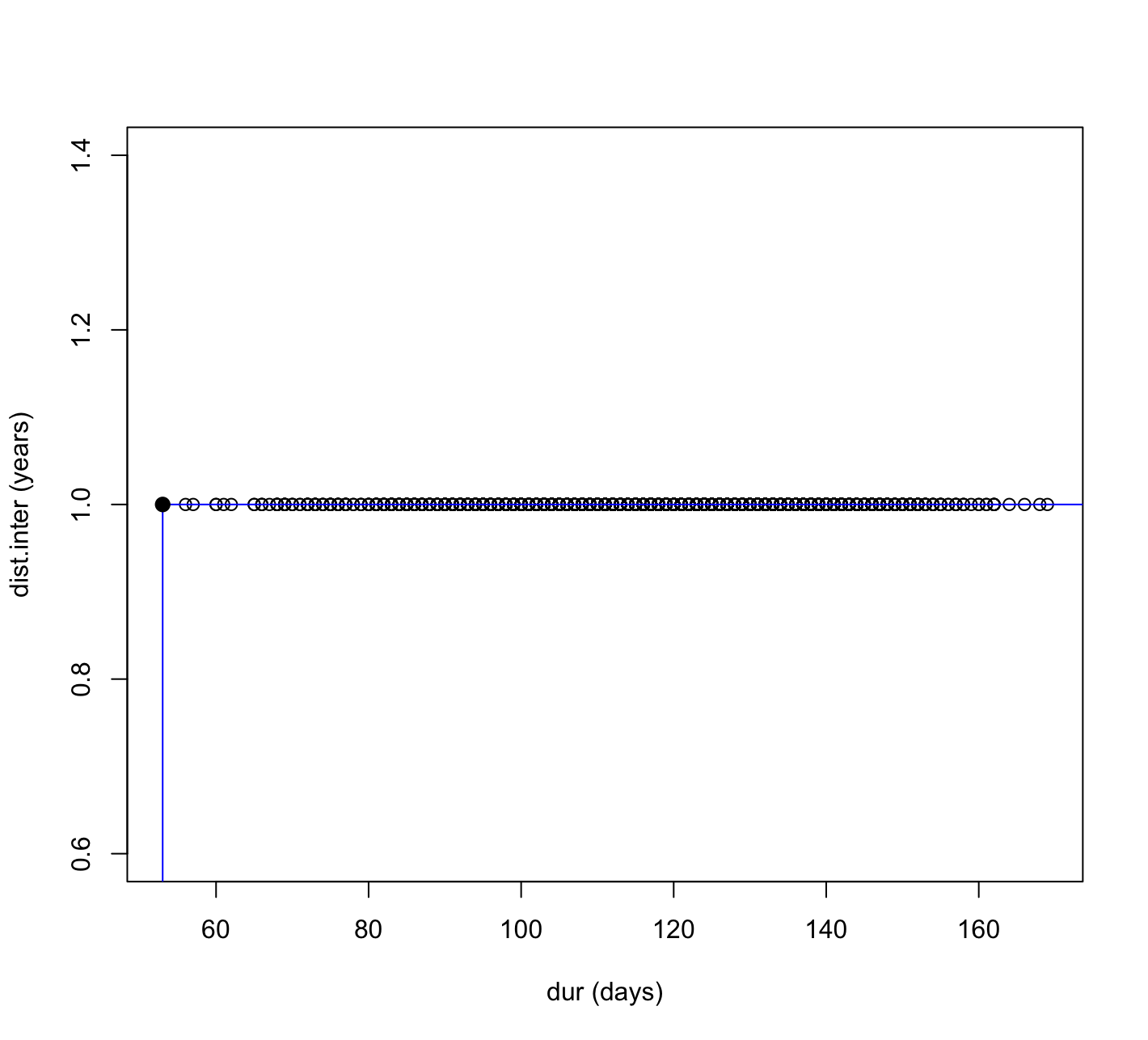
The figure shows the duration–spacing relationship obtained for Strategy 4, based on 108 feasible maintenance scenarios. Each point represents one valid system-level maintenance configuration that respects fixed retaining wall schedules and allowable timing adjustments for non-critical subsystems.
The most striking feature of the figure is the near-constant spacing value across the entire range of cumulative maintenance durations. Almost all scenarios collapse onto a single horizontal line at a spacing of approximately 1 year, indicating that the minimum achievable spacing between maintenance events is effectively fixed.
This behavior reflects the dominant influence of retaining wall interventions. Because inspection, surface repair, and major rehabilitation actions for the gravity and cantilever retaining walls occur at regular and non-adjustable intervals, they repeatedly reintroduce system-level maintenance events. As a result, even when the duration of maintenance activities varies—ranging roughly from 60 to 165 days—the spacing between interventions cannot increase beyond this structural limit.
The vertical clustering of points shows that variations in total maintenance duration are primarily driven by non-critical subsystems. Adjustments to RCFS, ETICS, and PCF affect how long maintenance lasts when it occurs, but they do not alter the frequency at which system-level interventions are triggered. Spacing therefore remains controlled by the retaining walls, while duration absorbs most of the variability.
The figure 4.b demonstrates that Strategy 4 produces a highly constrained solution space. Unlike strategies that allow for spacing improvements through coordination or consolidation, the duration–spacing trade off here is governed by structural necessity. The result is a predictable maintenance rhythm with limited flexibility in spacing, confirming that structural safety requirements dominate system-level maintenance behavior.
The reported total system interruption of 257 days represents the cumulative number of days over the 100-year service life during which system functionality is affected by maintenance activities across all subsystems. The maintenance episode duration of 68 days indicates the typical length of a combined maintenance event once interventions from multiple subsystems are integrated, while the minimum spacing between maintenance events of 1 year reflects the fixed recurrence imposed by the retaining wall maintenance schedule. These results confirm that, under Strategy 4, overall interruption levels are governed by structural safety requirements rather than by coordination of flexibility.
As a result, the plot shows no meaningful duration–spacing trade-off. Increasing spacing is not feasible without violating the fixed retaining wall schedules, and reducing spacing is unnecessary because it is already constrained by structural requirements. The solution space collapses into a narrow band where spacing is effectively constant, and duration absorbs all remaining variability.
From a system-planning perspective, this outcome confirms that Strategy 4 is constraint-dominated rather than optimization-driven. The integrated maintenance behavior is governed by structural necessity, not by coordination of choices. Optimal solutions under Strategy 4 are therefore selected based on acceptable interruption duration within a predetermined spacing regime, rather than by balancing spacing against disruption.
LCA & Multi-Objective Analysis >>
Home | System Definition | Scenario 1 | Scenario 2 | Scenario 3 | Scenario 4 | Discussion | Appendix