Introduction
This type of flat roof is widely used in residential and office buildings due to its high load-bearing capacity, long service life, and adaptability to different climatic and architectural conditions [3]. Structurally, it consists of four primary layers: a structural layer (reinforced concrete), a thermal insulation layer, a waterproofing layer, and a finishing layer on top.
The main goal of this work is to develop a parametric model of a flat reinforced concrete roof using Dynamo BIM (by REVIT), enabling the exploration of how geometric and material variations influence the roof’s overall performance [4]. The model is designed to allow controlled manipulation of geometric parameters (such as the dimensions and thicknesses of the layers) and material properties (including density, thermal conductivity, cost, and recyclability) to assess their combined effects on the system’s efficiency.
Four key performance criteria are considered for evaluation:
1. Total Weight – to analyze the impact of material composition and layer thickness on dead load.
2. Thermal Resistance – to assess the effectiveness of insulation in improving energy efficiency.
3. Total Cost – to compare the economic feasibility of alternative roof configurations.
4. Recyclability Index – to evaluate the environmental sustainability and end-of-life potential of materials [5].
All material properties, including density, conductivity, cost, and recyclability, were obtained from reliable scientific and industrial sources [3–5]. The overall objective of this project is to establish a clear yet flexible modeling framework that allows the comparison of different design alternatives from structural, economic, and environmental perspectives.
Study Objectives and Parameters
This study aims to quantitatively assess how variations in geometry and material composition influence the performance of a flat reinforced concrete roof system. The model developed in Dynamo BIM allows parametric control over key inputs such as layer thickness, density, thermal conductivity, cost, and recyclability.
The objective is to establish direct relationships between these design parameters and the resulting performance criteria—total weight, thermal resistance, total cost, and recyclability index—to understand how design choices affect both efficiency and sustainability.
The following table summarizes the parameters and their representative ranges, which form the input basis for the parametric simulation.

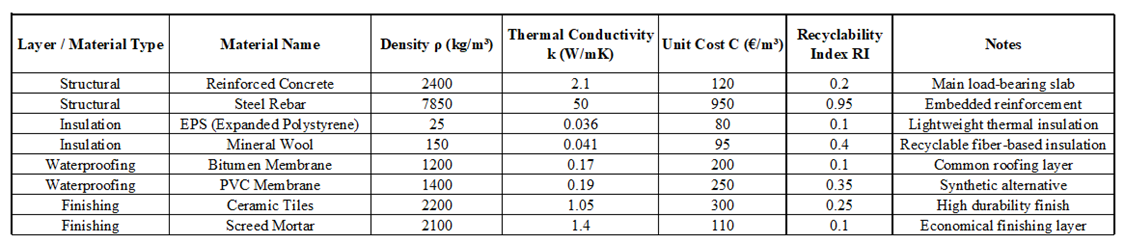
Performance Criteria
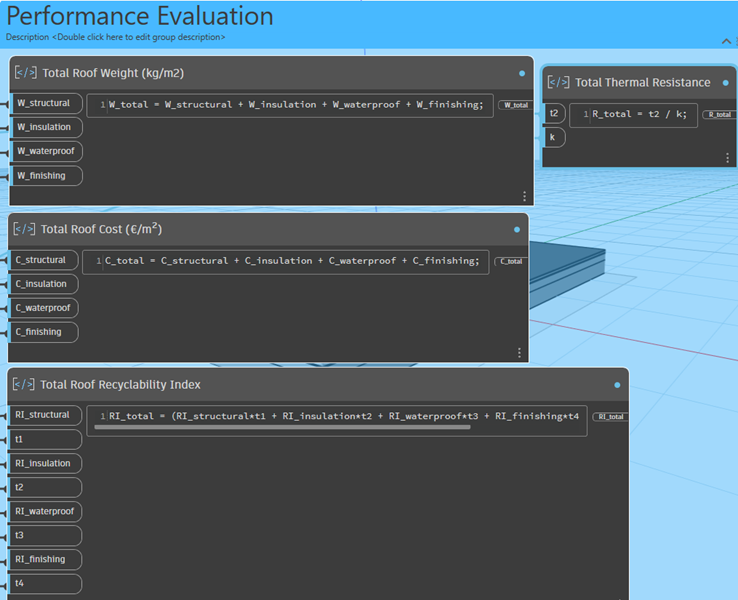
Four analytical relationships were used to quantify the performance of the roof system. These equations form the computational core of the parametric model in Dynamo BIM, where each variable dynamically updates as parameters are adjusted.
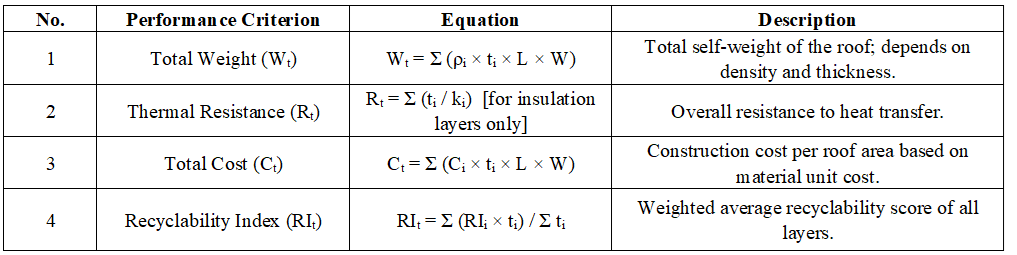
Modeling
Geometric Modelling
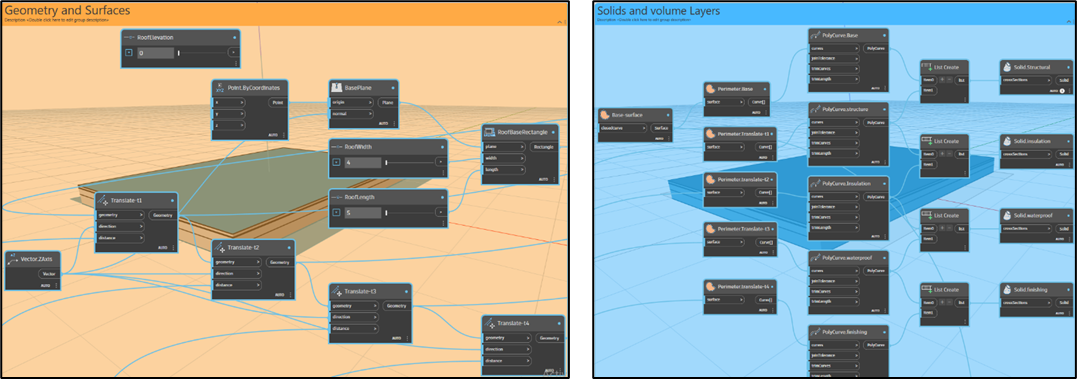
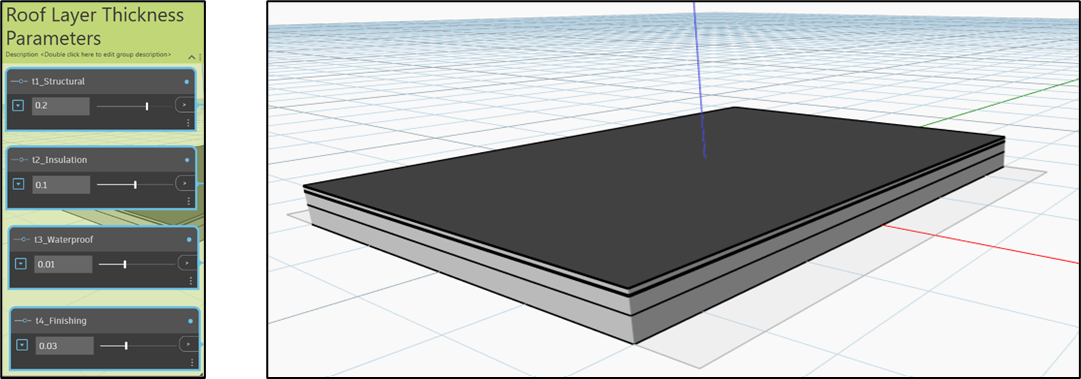
In this part of the project, the roof geometry was parametrically modeled in Dynamo based on the geometric parameters listed in Table 1. Using the Roof Layer Thickness Parameters group, the thickness of each layer was defined with Number Sliders to allow flexible adjustment. The Geometry and Surfaces group then generated the roof’s base surface using its length, width, and elevation, and created translated copies along the Z-axis for each layer. Finally, in the Solids and Volume Layers group, these surfaces were lofted into 3D solids, forming four distinct, adjustable roof layers that serve as the geometric foundation for further analysis.
Data Input Modeling
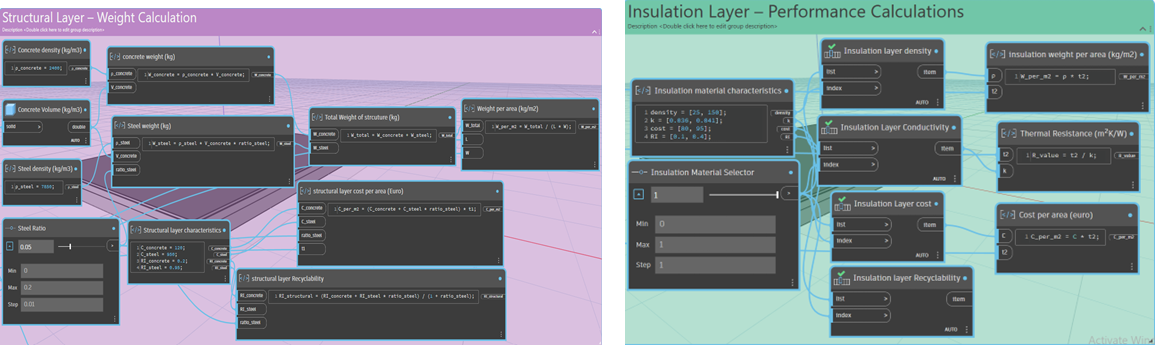
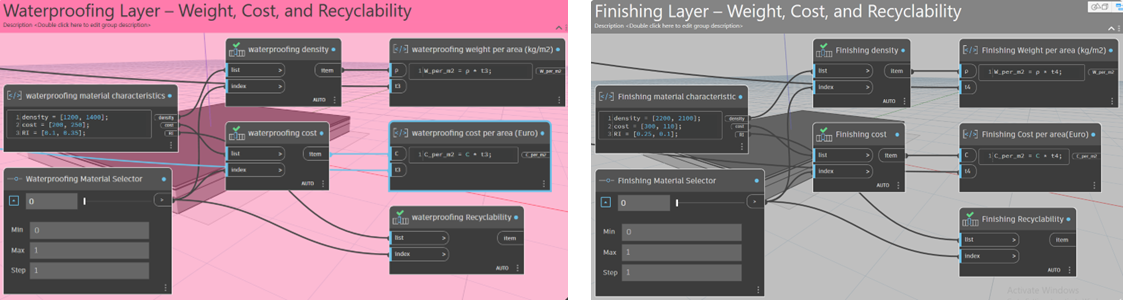
Performance Evaluation and Results
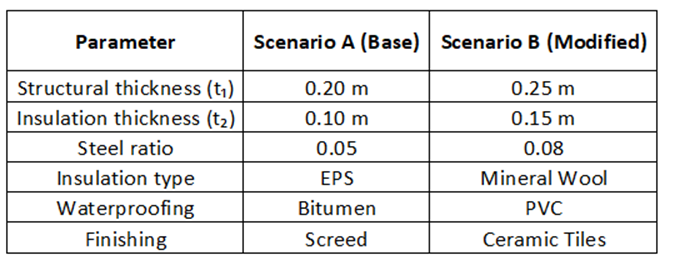
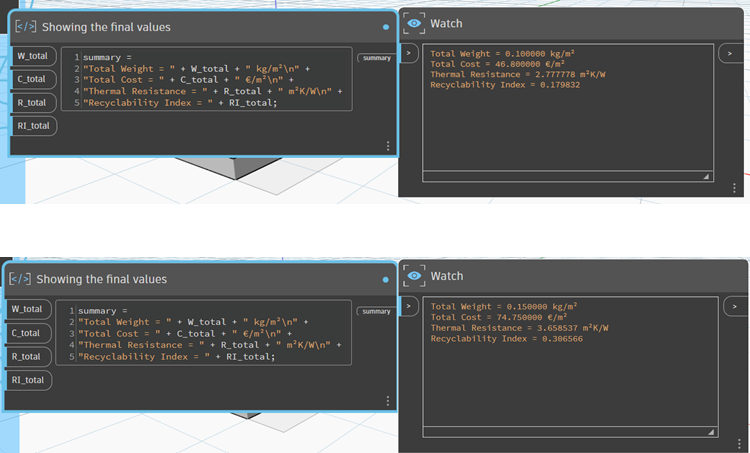
Finally, two scenarios (as illustrated in table 4) with different layer thicknesses and materials were tested to verify the model’s parametric behavior. These cases illustrate the model’s ability to generate multiple design alternatives and automatically update overall performance results.
References
[1] B. A. Awwad and M. O. Suliman, Study on Flat Roofing Systems, Journal of Advanced Sciences and Engineering Technologies, Vol. 1, No. 2, 2018.
[2] M. Botejara-Antúnez et al., Comparative analysis of flat roof systems using life-cycle assessment, ScienceDirect, 2022.
[3] F. Chudley and R. Greeno, Building Construction Handbook, 12th Edition, Routledge, 2020.
[4] ASHRAE Handbook, Fundamentals: Thermal Properties of Building Materials, ASHRAE, 2017.
[5] M. Botejara-Antúnez et al., Comparative Analysis of Flat Roof Systems Using Life-Cycle Assessment, Journal of Building Engineering, 2022.
Main | Introduction | Individual Systems | Integration Context | Combined Ontology | Combined Parametric Model | Analysis and Conclusions | References