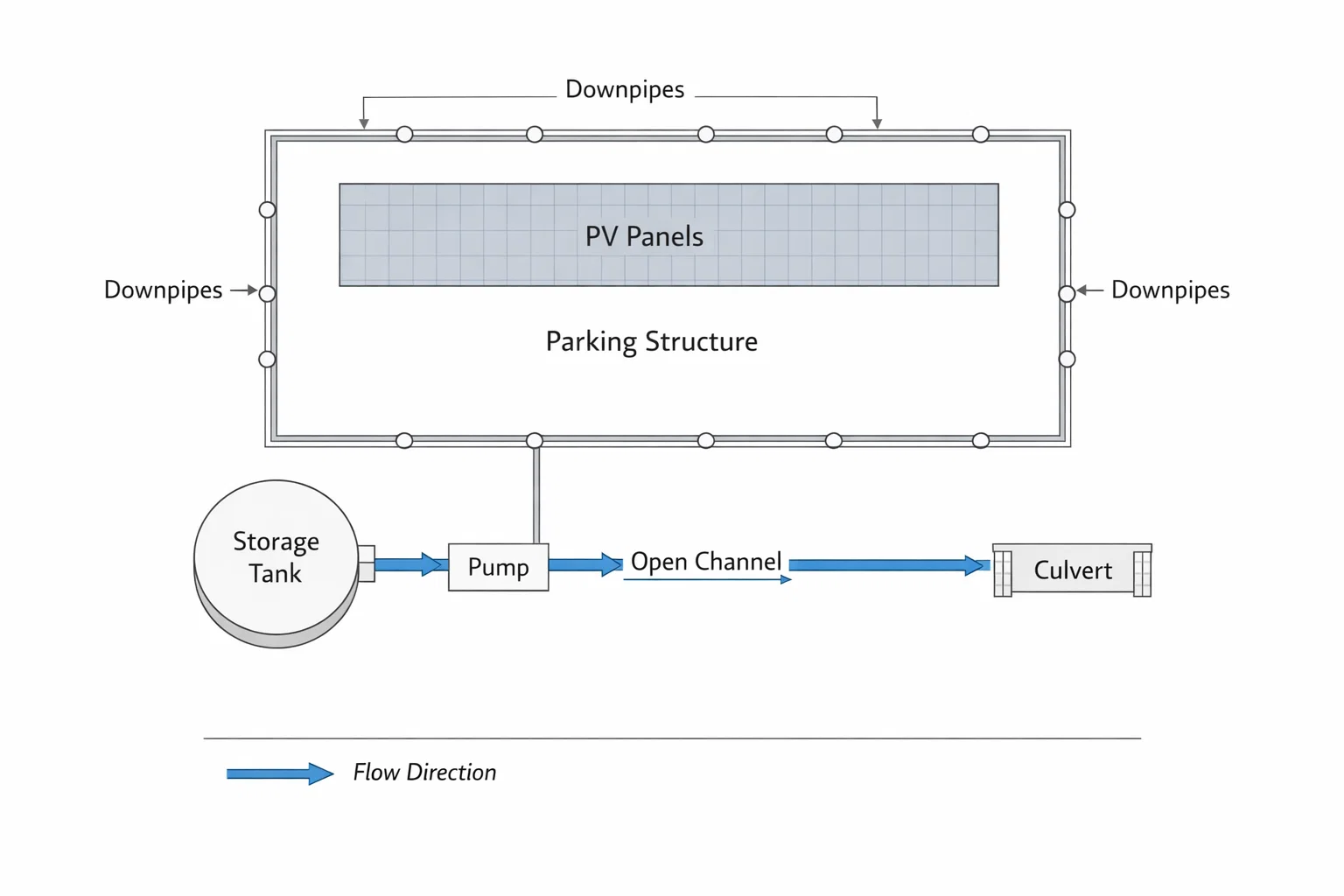
Urban parking garage structures are increasingly being subjected to intense rainfall events, characterized by short-duration storms that produce significant surface runoff amounts. Precipitation plays a vital role in influencing open multi-story parking garage structures, creating a strong interdependency among architectural configurations and surface water management systems’ capacities to safely discharge surface waters to the external environment.
As such, surface water management systems must be able to function efficiently to accommodate moderate rainfall conditions as well as extreme rainfall conditions without constant redesign of the system to accommodate peak demands. The surface water management system for an open multi-story parking garage structure is designed to satisfy the needs of the system by representing the design dependencies among system components rather than performing hydrologic or hydraulic computations. The focus is on how system components interact and influence each other throughout the design process. The designed ontology captures the relationships among system components by identifying the fundamental components of the system, such as internal floor drainage channels, gutter pipes, a closed storage basin, a pumping system, roof photovoltaic systems, and safety components for the system. The relationships among system components are explicitly stated to articulate the function of each component and the interdependencies of each component’s design on other components of the system.
The system is designed to function as a single and strong configuration. The fundamental components of the system that are primarily responsible for the collection, conveyance, storage, and pumping of surface waters remain constant throughout the system’s design and function to accommodate moderate rainfall conditions. However, extreme rainfall conditions are handled by safety components such as an overflow open channel and a culvert that safely discharge surface waters to the external environment.
Explore the integrated systems:
Main | Introduction | Individual Systems | Integration Context | Combined Ontology | Combined Parametric Model | Analysis and Conclusions | References