In this fourth test scenario, the synchronization logic is pushed to its extreme. All maintenance interventions across the four subsystems are assigned their minimum feasible intervals, meaning that each type of intervention is performed as frequently as reasonably allowed from a technical standpoint.
At first glance, this strategy appears highly inefficient. Reducing all intervals inevitably increases the number of individual maintenance operations over the 80-year service life. From the perspective of a single subsystem, this would normally be associated with higher workload, more frequent shutdowns, and increased operational constraints.
| Intervention | Initial Interval (years) | Modified Interval (years) |
| VI.s | 3 | 3 (unchanged) |
| VI.n | 4 | 3 |
| VI.t | 5 | 3 |
| VI.p | 6 | 3 |
| Intervention | Initial Interval (years) | Modified Interval (years) |
| SR.s | 10 | 10 |
| SR.n | 11 | 10 |
| SR.t | 10 | 10 |
| SR.p | 12 | 10 |
| Intervention | Initial Interval (years) | Modified Interval (years) |
| DR.s | 20 | 20 |
| DR.n | 26 | 20 |
| DR.t | 25 | 20 |
| DR.p | 20 | 20 |
However, the objective here is to explore the maximum possible alignment of maintenance activities across systems. By making interventions more frequent, the probability that several of them occur in the same years becomes much higher. This creates extensive opportunities for bundling, where multiple maintenance tasks are carried out during the same planned outage rather than during separate shutdown periods.
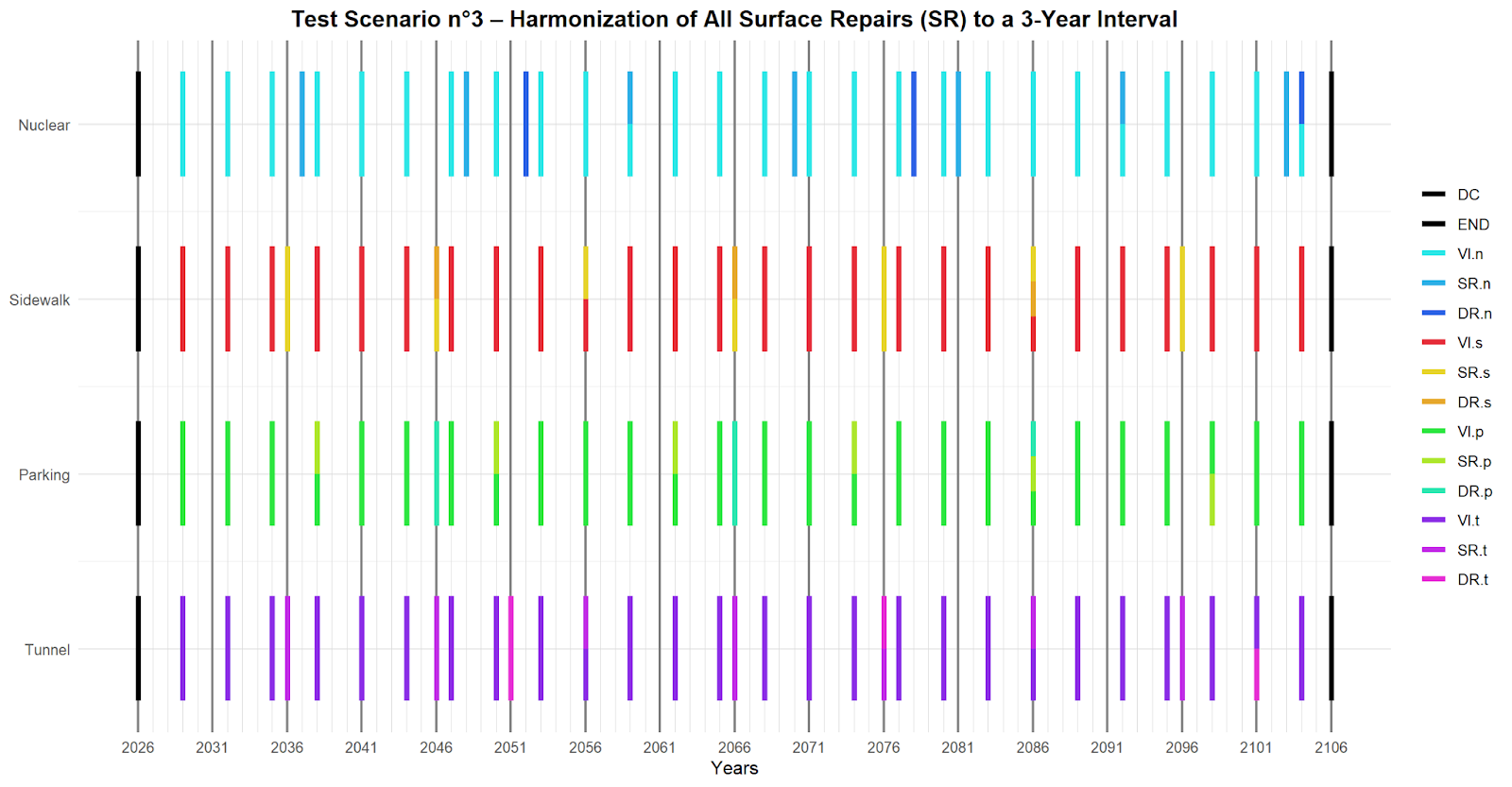
After applying this extreme synchronization strategy, the total number of maintenance intervention days over the 80-year service life decreases dramatically to 387 days, compared to 550 days in the initial uncoordinated strategy. This corresponds to 163 fewer maintenance days, representing a reduction of nearly 30% in total downtime.
This result is highly counterintuitive: although the total number of maintenance actions increases, the overall plant downtime is drastically reduced. The reason lies in the strong concentration of interventions within shared shutdown windows, which minimizes the number of separate plant stoppages.
This scenario clearly demonstrates a fundamental principle of integrated maintenance planning in complex systems: global efficiency is not driven by the number of interventions, but by how well they are synchronized. Maximizing coordination between subsystems can therefore outweigh the apparent inefficiency of more frequent maintenance at the local level.
It should be noted, however, that the last two scenarios, although they significantly reduce the total number of maintenance days, also lead to an increase in the total number of maintenance interventions. This implies additional direct maintenance costs, increased use of resources, and potentially higher cumulative wear associated with repeated access and handling. These economic and logistical aspects have not yet been included in the present analysis, which has so far focused primarily on minimizing plant downtime. A more comprehensive evaluation integrating both availability and lifecycle costs will therefore be introduced later in order to assess the overall optimality of the proposed maintenance strategies.
Main | Introduction | Integration Context | Maintenance Strategies | Life-Cycle Analysis | Multi-Objective Optimization | Conclusion