Introduction
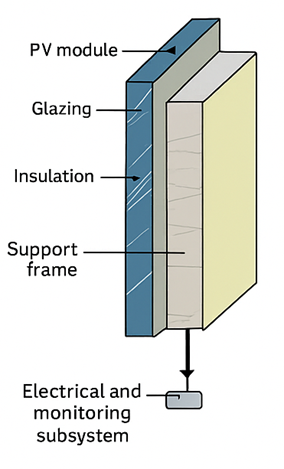
A solar façade system, also known as a Building-Integrated Photovoltaic (BIPV) façade, integrates photovoltaic modules into the building envelope. It generates electricity while serving as a protective and architectural component.
Main Functions:
1. Electricity Generation
2. Building Protection
3. Solar and Light Control
4. Monitoring and Maintenance
5. Architectural Integration
Main Components:
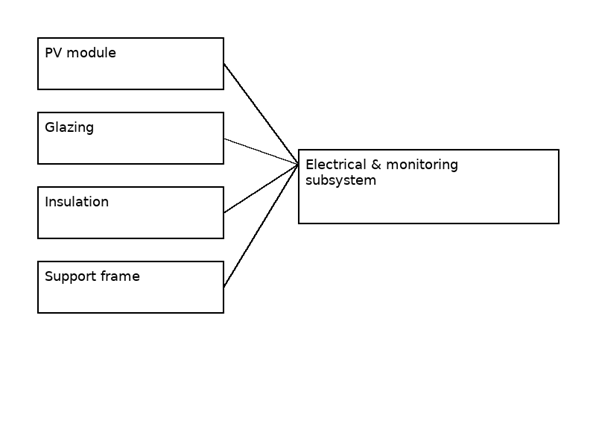
- PV Module Layer
- Support Structure
- Electrical System
- Control & Monitoring
- Thermal / Insulation Layer
- Maintenance & Access
System Decomposition:
– Physical: PV modules, support structure, insulation, wiring, monitoring.
– Functional: Energy generation, protection, solar control, monitoring.
– Logical: Concepts like SolarFacadeSystem, PVModule, Sensor, Inverter, and relations such as hasComponent and monitoredBy.
The ontology development followed Noy & McGuinness (2001) steps: define scope, list terms, structure classes, define properties, create instances, and test with a reasoner.
| Logical Axiom | Concrete examples |
| SubClassOf (A ⊑ B) | AC_Cabeling ⊑ Wiring_and_Cabling |
| SubClassOf (A ⊑ B) | Acoustic_Insulation ⊑ Insulation_Layer |
| SubClassOf (A ⊑ B) | Acoustic_Performance ⊑ Performance_Attribute |
| SubClassOf (A ⊑ B) | Adhesives ⊑ Fastener_and_Connectors |
| SubClassOf (A ⊑ B) | Air_Gap ⊑ Sub_Structure |
| SubClassOf (A ⊑ B) | Aluminium ⊑ SolarSystemMainMaterial |
| SubClassOf (A ⊑ B) | Anchorage_Points ⊑ Support_Frame |
| SubClassOf (A ⊑ B) | Arid ⊑ Climate_Zone |
| SubClassOf (A ⊑ B) | Backing_Sheet ⊑ Super_Structure |
| SubClassOf (A ⊑ B) | Bolts ⊑ Fastener_and_Connectors |
| SubClassOf (A ⊑ B) | Brackets ⊑ Support_Frame |
| SubClassOf (A ⊑ B) | Building_Type ⊑ Enviromental_Context |
| SubClassOf (A ⊑ B) | Bypass_Diode ⊑ Super_Structure |
| SubClassOf (A ⊑ B) | Clamps ⊑ Fastener_and_Connectors |
| SubClassOf (A ⊑ B) | Climate_Zone ⊑ Enviromental_Context |
| SubClassOf (A ⊑ B) | Cold ⊑ Climate_Zone |
| SubClassOf (A ⊑ B) | Commercial ⊑ Building_Type |
| SubClassOf (A ⊑ B) | Composite_Material ⊑ SolarSystemMainMaterial |
| SubClassOf (A ⊑ B) | Connectors ⊑ Wiring_and_Cabling |
| SubClassOf (A ⊑ B) | Control_Electronics ⊑ Super_Structure |
| ObjectPropertyDomain | ConnectedTo domain = SolarSystemDomain |
| ObjectPropertyDomain | SuppliesPowerTo domain = SolarSystemDomain |
| ObjectPropertyDomain | hasInsulationLayer domain = Sub_Structure |
| ObjectPropertyDomain | hasMainMaterial domain = SolarFacadeSystem |
| ObjectPropertyDomain | hasSubStructure domain = SolarFacadeSystem |
| ObjectPropertyDomain | hasSuperStructure domain = SolarFacadeSystem |
| ObjectPropertyDomain | hasSupportFrame domain = SolarFacadeSystem |
| ObjectPropertyDomain | hasSystemType domain = SolarFacadeSystem |
| ObjectPropertyDomain | hasUse domain = SolarFacadeSystem |
| ObjectPropertyDomain | isMadeof domain = SolarFacadeSystem |
| ObjectPropertyDomain | isMainMaterialOf domain = SolarSystemMainMaterial |
| ObjectPropertyDomain | isSubStructureOf domain = Sub_Structure |
| ObjectPropertyDomain | isSuperStructureOf domain = Super_Structure |
| ObjectPropertyDomain | isUseOf domain = SolarSystemUsage |
| ObjectPropertyRange | ConnectedTo range = SolarSystemDomain |
| ObjectPropertyRange | SuppliesPowerTo range = SolarSystemDomain |
| ObjectPropertyRange | hasInsulationLayer range = Insulation_Layer |
| ObjectPropertyRange | hasMainMaterial range = SolarSystemMainMaterial |
| ObjectPropertyRange | hasSubStructure range = Sub_Structure |
| ObjectPropertyRange | hasSuperStructure range = Super_Structure |
| ObjectPropertyRange | hasSupportFrame range = Support_Frame |
| ObjectPropertyRange | hasUse range = SolarSystemUsage |
Engineering Examples
Three Engineering Examples for the Solar Facade System Ontology
1) Electrical Behavior Analysis
Engineers designing photovoltaic (PV) façade systems can use the ontology to represent and analyze the electrical structure of modules, including solar cells, bypass diodes, and string connections, to assess how shading or temperature affects performance.
Ontology use:
- Models the modules, cells, diodes, connections and their relationships.
- Describes conditions like shading events and electrical parameters.
- Enables simulation tools to use the ontology data for predicting electrical behavior.
Importance:
Provides a standardized way to describe and simulate electrical configurations, helping identify risks like hot spots and ensuring safer, more efficient façade designs.
2) Condition Monitoring to predict the Maintenance
Facility managers can represent sensors, measurements, and detected faults to automate performance monitoring of PV façades and trigger maintenance activities.
Ontology use:
- Defines sensors, measurement types and performance issues.
- Links monitoring data to specific facade elements or modules.
- Supports rule-based reasoning to identify faults and schedule maintenance tasks.
Importance:
Enables consistent monitoring across systems and early detection of degradation or failures, reducing downtime and maintenance costs.
3) Energy Optimization
Architects and engineers compare designs to optimize energy yield and thermal behavior in early stage design.
Ontology use:
- Represents façade elements, materials, orientations, and energy outputs.
- Integrates with simulation tools to evaluate performance of multiple design variants.
- Stores simulation and evaluation results in a structured, querable form.
Importance:
Allows seamless comparison of design options, improving decision-making on energy efficiency and aesthetic tradeoffs early in the project lifecycle.
References
Frontini, F., & Kapsis, K. (2021). BIPV products and systems: From prototype to market uptake. IEA Photovoltaic Power Systems Program (IEA-PVPS).
International Electrotechnical Commission (IEC). (2020). IEC 63092-1:2020 Photovoltaics in buildings Part 1: BIPV modules. Geneva: IEC.
International Energy Agency – Photovoltaic Power Systems Programme (IEA-PVPS). (2024). Building-integrated photovoltaics: A technical guidebook. IEA Publications.
Krötzsch, M., Simancik, F., & Horridge, M. (2012). Foundations of semantic web technologies. Chapman and Hall/CRC.
Martín-Chivelet, N., Olivieri, L., & Frontini, F. (2022). Building-integrated photovoltaics (BIPV): Technologies and applications. Elsevier.
National Renewable Energy Laboratory (NREL). (2023). BIPV designs for commercial buildings: Performance and integration strategies. U.S. Department of Energy.
Noy, N. F., & McGuinness, D. L. (2001). Ontology development 101: A guide to creating your first ontology. Stanford Knowledge Systems Laboratory Technical Report KSL-01-05.
Pillai, D. S., Agrawal, B., & Singh, S. (2022). Review on building-integrated photovoltaic (BIPV) systems: Current status and future prospects. Renewable and Sustainable Energy Reviews, 156, 111 972.
Main | Introduction | Individual Systems | Integration Context | Combined Ontology | Combined Parametric Model | Analysis and Conclusions | References