In order to conduct a parametric study of the influence of geometry on mechanical and material performance, we model the enclosure as consisting of:
- a cylinder with height h1, h1 [10 m ; 58 m] ∈ ;
- a spherical dome with height h2, h2=h-h1 = 59 – h1 ;
- an inner radius r, r [10 m ; 25 m] ∈ ;
- a uniform thickness t, t [0.5 m ; 1.5 m]. ∈
The dome is obtained by intersecting a sphere and a clip box, which guarantees the geometric constraint: the dome cannot exceed a half-sphere, which naturally limits h2≤r.
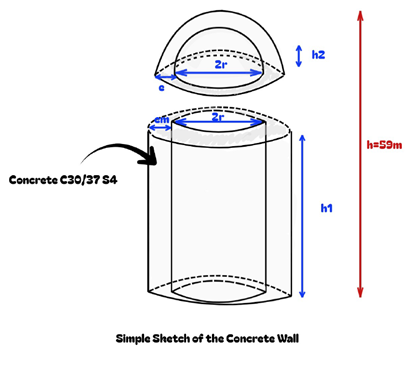
We propose to analyze how these three parameters—radius r, thickness t, and height ratio h1/h2—influence:
- the volume of concrete,
- the useful internal volume of the enclosure,
- the compressive strength,
- the buckling stability
The enclosure must be able to withstand an accidental internal pressure of 600 kPa, a value consistent with French regulatory requirements (5.5 bar ) . For the mechanical evaluation of concrete, we adopt a Young’s modulus of E=30,000 MPa, a typical value for solid, uncracked concrete, and a Poisson’s ratio ν=0.20, corresponding to the usual properties of containment concrete.
Compressive strength is evaluated using structural concrete with a design strength of fcd=20 MPa, representative of common concrete used for massive containment structures.
The design challenge therefore consists of finding an optimal compromise between:
1. Minimizing the volume of concrete (cost, embodied energy, CO₂ emissions),
2. Maximizing the usable interior volume required for the reactor equipment,
3. Complying with mechanical compression and buckling limits.
A parametric model in Dynamo makes it possible to quickly generate geometric variants that are compatible with safety constraints and to efficiently compare their quantitative performance. This framework thus provides a systematic methodology for exploring the design space defined by the three parameters and identifying geometries that simultaneously satisfy functional and safety objectives.
1. Required concrete volume – minimization
The total amount of concrete is a key indicator in terms of:
• economic cost (civil engineering),
• environmental impact (cement production ≈ 600–900 kg CO₂/m³),
• gray energy used for construction,
• logistical complexity on site.
Minimizing this volume is therefore a major objective.
The volume is calculated directly in Dynamo from the 3D geometry of the enclosure using the built-in Solid.Volume function. This criterion expresses the compromise between mechanical stability and material efficiency: an enclosure that is too thin can become unstable, while an enclosure that is too massive leads to considerable additional costs.
2. Useful internal volume – maximization
The enclosure must offer sufficient volume to accommodate:
• the reactor vessel and its well, • maintenance tools,
• the steam generators, • ventilation and filtration systems.
• the primary and auxiliary circuits,
Insufficient internal volume limits layout options, increases operational complexity, and may compromise operational safety margins. This internal volume is obtained using the Solid.Volume function applied to the internal cavity of the containment building. Each parametric configuration thus allows the amount of available space to be evaluated instantly. This criterion partially contradicts the previous one: increasing the thickness or reducing the radius decreases the usable volume.
3 Mechanical stresses : compression and buckling
Thick shell behavior
When the D/t ratio is less than 20, the behavior follows Lamé’s theory for thick shells. The circumferential, radial, and vertical stresses are calculated directly from the script. Then we verify that the circumferential, radial, and vertical stresses are less than fcd.
Thin shell behavior
If D/t>20, the enclosure is treated as a thin shell, susceptible to buckling. The critical pressure of a thin sphere:
pcr=2E(t/R) 2 /(3(1−ν 2 )) 1/2
We verify that buckling FS = pcr/pint>1.
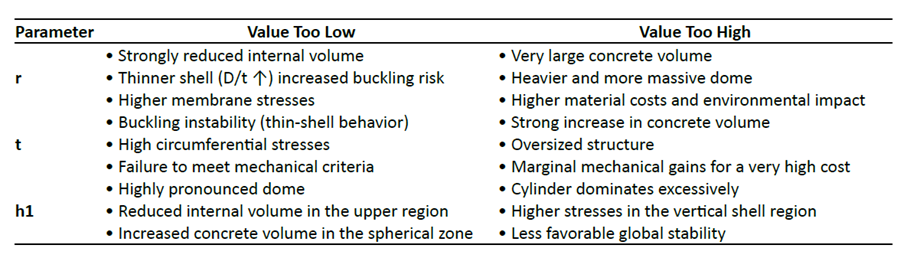
4. Discussion of the Design Space
The observations have been summarized in a table:
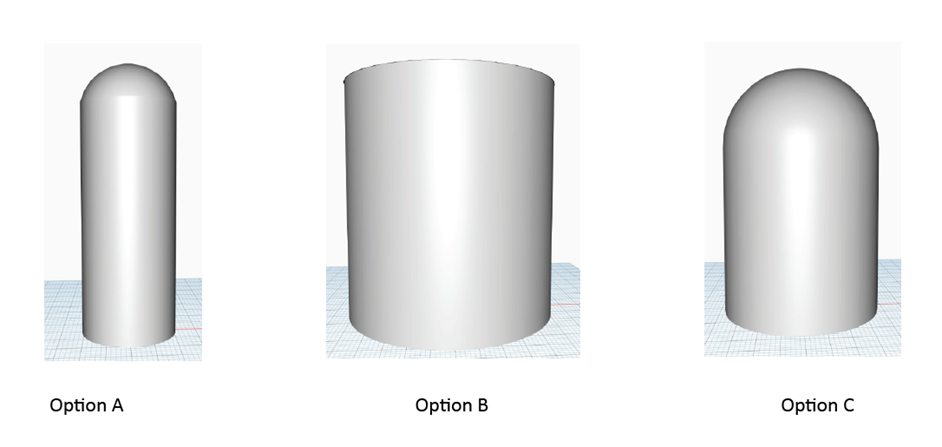
Analysis of the three “optimal” alternatives
Parametric exploration leads to three representative configurations, each illustrating a different compromise between concrete volume, useful volume, and mechanical performance. Each one meets the compression and buckling constraints.

References:
1.Confinement. Containment Structures, Techniques de l’Ingénieur, 1997
2.Control of the safety and security of nuclear facilities, National Assembly, 2003
3.Modeling of Containment Buildings, Nuclear Energy Agency, 2005[4] Concrete Material Properties for Containment Structures, IAEA, 2023