Introduction:
A perpetual pavement is a high-performance, multi-layered asphalt structure designed for a service life of >= 50 years. It uses a “bottom-up” design philosophy where fatigue and rutting are prevented in the base layers, limiting wear only to the surface.
Purpose:
The project aims to represent the composition and logic of long-life pavement to support valid design variants, consistency checking, and parametric thickness/material analysis in digital twin environments.
Scope:
The scope is fixed around the physical and functional aspects of the HMA (Hot Mix Asphalt) layers, Surface, Intermediate/Binder, and Fatigue-Resistant Bottom, as well as the supporting foundation (Subbase and Subgrade).
Intended Users & Intended Use:
Users: Pavement engineers, transportation researchers, and digital-twin design teams.
Use: Knowledge representation and reasoning to ensure structural completeness and support “what-if” material changes.
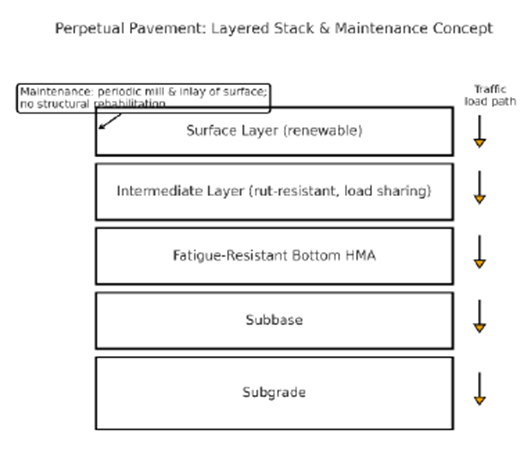
Figure01: Perpetual pavement built up of layered stack and surface-renewal concept
Class Hierarchy:
The hierarchy follows a physical decomposition modeled after the engineering stack. Key classes include PerpetualPavementSystem, PavementLayer, Material, Function, and DesignProperty.
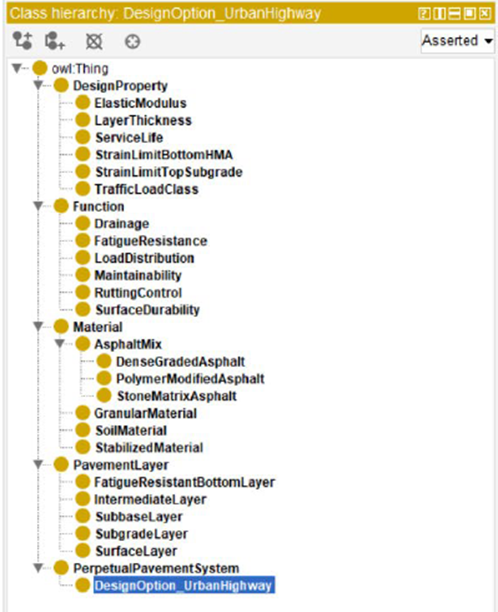
Figure 02: Class Hierarchy
Ontograf:
The Ontograf visualization displays the network of relationships, such as how specific layers “restOn” others and how materials like AsphaltMix are linked to specific functional roles like RuttingControl.
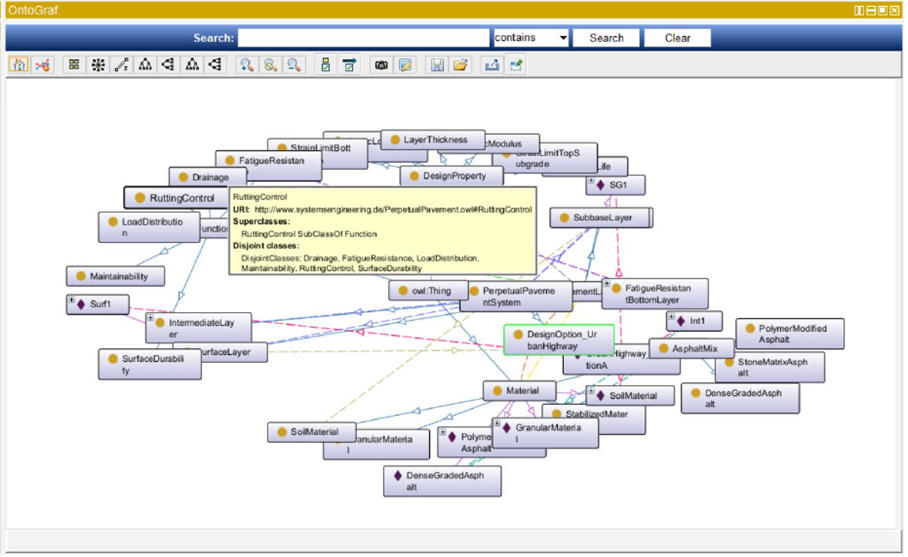
Figure 03: Visual Ontology Network
Engineering Example:
- Maintenance Planning: Identifying surface layers that require periodic renewal.
- Material Optimization: Using restrictions to ensure only AsphaltMix is used for heavy-traffic surface layers.
- Lifecycle Evaluation: Comparing design options based on the hasServiceLife_years data property.
References:
1.Pavement Interactive. “Perpetual Pavements”. https://pavementinteractive.org/reference-desk/design/structural-design/perpetual-pavements/
2.Krötzsch, Simancík, Horrocks. “A Description Logic Primer.” (formal semantics; inference/reasoning in DL/OWL).
3.Noy & McGuinness. “Ontology Development 101: A Guide to Creating Your First Ontology.” (iterative process; no single correct ontology).
4.Pahl & Beitz. Engineering Design: A Systematic Approach, Ch. 6. (function-structure → subfunctions; flows).