Gravity sewer pipelines form a fundamental part of urban wastewater management systems, enabling the safe and reliable conveyance of domestic and industrial wastewater. As cities continue to expand and infrastructure systems age, the long-term performance of sewer networks has become increasingly important for public health protection, environmental preservation, and economic efficiency. Material selection for sewer pipelines plays a decisive role in determining structural durability, maintenance requirements, and overall system reliability over time.
Sewer pipeline materials differ significantly in terms of energy demand, emissions, longevity, and life-cycle costs, which can influence both environmental outcomes and operational performance. These long-term implications require a broader interpretation to aid the development of sustainable urban infrastructures and inform engineering decisions.
Design Options
Option 1 Reinforced Concrete Pipe represents the traditional choice for gravity sewer applications, combining structural strength with relatively low material costs.
Option 2 PVC pipe represents modern thermoplastic technology, offering lightweight construction and chemical resistance. The design employs SDR 35 (Standard Dimension Ratio) classification, appropriate for gravity sewer applications with standard burial depths.
Option 3 Vitrified Clay Pipe is a proven ceramic technology that is incredibly durable and resistant to chemicals. A glass-like surface that is resistant to corrosion from acidic wastewater and harsh soil conditions is produced by high-temperature firing.
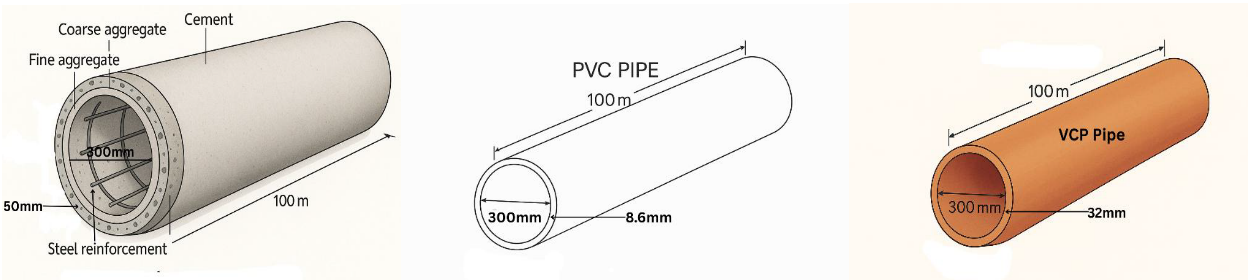
Figure1 : Three Design Options
Life cycle assessment results
Over the 80-year service life, VCP demonstrates the best overall performance, consuming 25% less energy than RCP and 44% less than PVC, primarily due to its efficient fabrication phase despite similar material masses, reflecting the lower energy intensity of clay vitrification compared to cement and steel in RCP. VCP also has the lowest carbon footprint, emitting about 48.9% less CO₂ than RCP and 17.7% less than PVC, with RCP’s high emissions largely driven by steel reinforcement and PVC showing moderate emissions from its petrochemical base. In terms of air pollutants, RCP produces the highest NOx and SO₂ emissions, VCP shows moderate levels due to high-temperature vitrification but avoids steel-related impacts, and PVC performs best. Consistently, VCP achieves the lowest life-cycle cost ($8,800), slightly outperforming PVC ($11,800) and dramatically undercutting RCP ($41,300), mainly because of reduced operation and maintenance requirements.
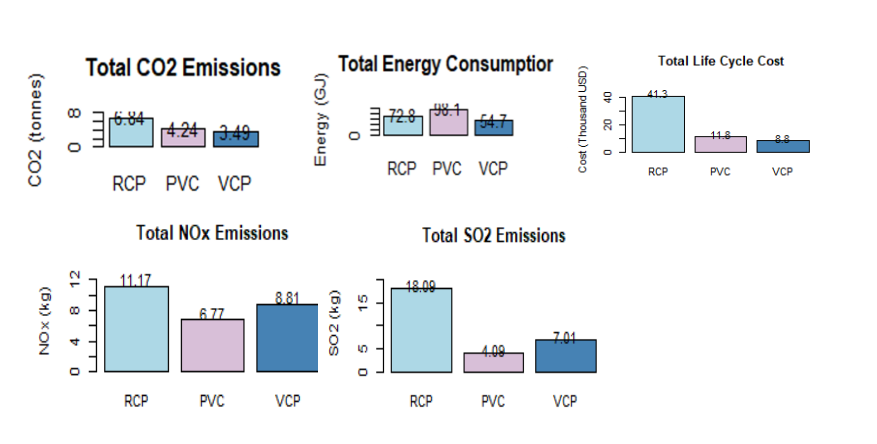
Figure2 : LCA Results
AHP Results and Ranking
- VCP: 0.448 (44.8%) – Rank 1
- PVC: 0.342 (34.2%) – Rank 2
- RCP: 0.210 (21.0%) – Rank 3
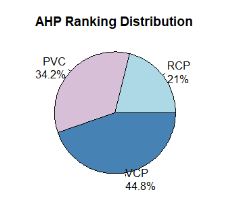
Figure3 : AHP Ranking Distributions HP Results and Ranking
VCP emerges as the preferred alternative with a substantial 31% score advantage over second-place PVC and 113% advantage over third-place RCP. This clear preference reflects VCP’s consistent strong performance across all criteria, never ranking worse than second in any individual category.
The AHP scores can be interpreted as relative desirability: VCP is approximately 2.1 times as desirable as RCP and 1.3 times as desirable as PVC when all criteria are weighted according to the established priority structure.
References
[1] Marceau, M., Nisbet, M.A., and Van Geem, M.G. (2007). Life Cycle Inventory of Portland CementConcrete. Portland Cement Association. Skokie, IL.
[2] Hammond, G. and Jones, C. (2019). Inventory of Carbon and Energy (ICE) Version 3.0. University of Bath,Circular Ecology.
[3] PlasticsEurope (2022). Eco-profiles and Environmental Product Declarations of the European PlasticsManufacturers. Brussels, Belgium.
[4] American Society of Civil Engineers (2020). ASCE Manual of Practice No. 77: Design and Construction of Urban Stormwater Management Systems. Reston, VA.
[5] National Clay Pipe Institute (2021). Environmental Product Declaration for Vitrified Clay Pipe. LakeGeneva, WI.
[6] ISO 14040:2006. Environmental Management – Life Cycle Assessment – Principles and Framework.International Organization for Standardization.
[7] Saaty, T.L. (1980). The Analytic Hierarchy Process. McGraw-Hill, New York.
World Steel Association (2021). Life Cycle Assessment Methodology Report. Brussels, Belgium.
Home | Roads | Sewer Pipeline | RCC Tank | Warehouse | Residential Home Foundation