Introduction
We are general Contractors asked to bid on a design-bid-build project renovating an old historical building and a nuclear containment facility near it. Building a nuclear containment facility on a constrained site is not just a “plant design” and “bid” task. It becomes an integration problem the moment the site geometry is fixed by a river and an existing historical masonry building that must be retained and upgraded. In our project, the containment structure is located on the clear land across the river to support isolation and safety, while the historical building is renovated to function as a maintenance and service facility.
The city awards the site through a competitive tender focused on a constraint on the strict total CO₂ cap (2,070,000 kg), so the quality of our proposal depends on how well we manage CO₂ and cost across the entire combined system, not within a single component.
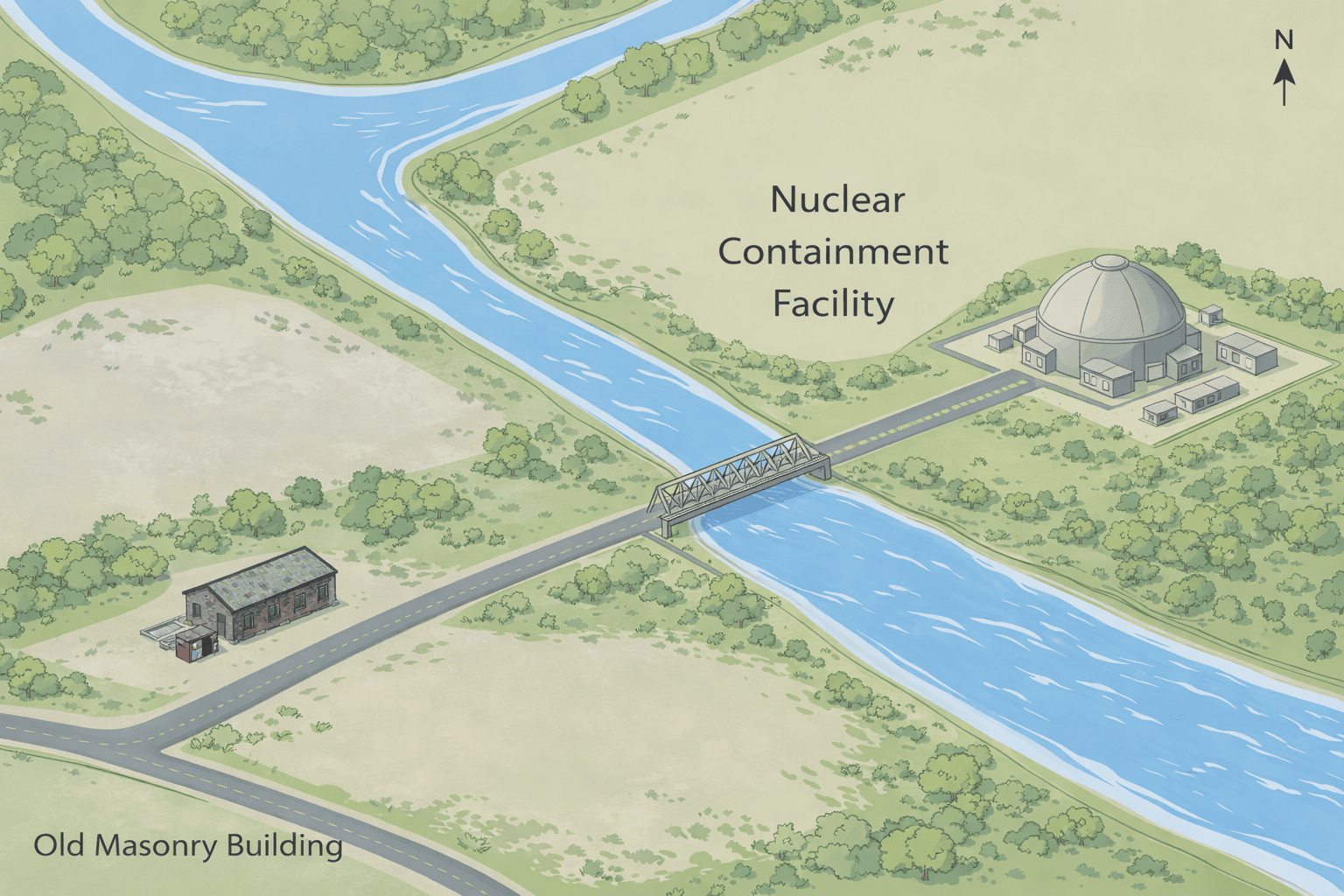
Fig. A depiction of the simplest possibility of the Combined System
To make this integration measurable, we model the project as six linked subsystems and define a small set of parametric inputs that drive the overall outcomes. On the infrastructure side, the bridge length/position determines the steel truss quantity and directly sets the connected pavement length, which together influence embodied CO₂ and cost. On the containment side, the radius of the concrete wall and the height of the cylindrical part scale concrete volume and therefore strongly affect emissions and cost. On the retrofit side, the roof is modeled through deck thickness, substrate thickness, and green roof coverage (meeting at least the 10% requirement), while the timber truss material influences the roof’s structural system and embodied impacts. Finally, the historical masonry behavior is captured through wall bay length, which affects how loads are distributed and where strengthening may be required.
We developed a combined parametric model and ontology for a tender-driven infrastructure proposal where CO₂ is the hard constraint, and ROI is the decision metric. By connecting these inputs through a single integrated logic, we can compare design variants consistently and select a solution that performs best against the municipality’s CO₂ objective while remaining economically viable.
Our Six Individual Systems are: