Introduction & Purpose:
The ontology is designed to represent core concepts for the conceptual design and comparison of truss systems, specifically focusing on timber and steel-timber hybrid structures in structural engineering.
Scope:
The scope includes physical truss components (chords, diagonals, verticals), geometric arrangements (web patterns), and analytical entities (materials, profiles, performance data). It focuses strictly on the truss as a load-bearing subsystem, excluding the broader global building context like roof layouts.
Intended Users & Use:
Users: Designers, structural engineers, and researchers.
Use: Decoupling topology, geometry, and material definitions to allow for automated reasoning across different configurations, facilitating CAD/FEM workflows.
Class Hierarchy:
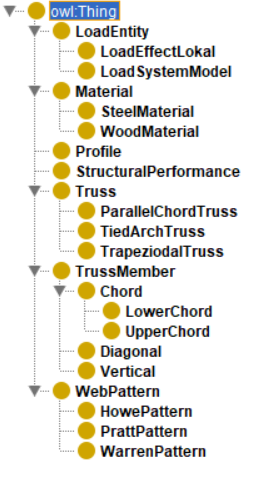
The ontology follows a structured taxonomy:
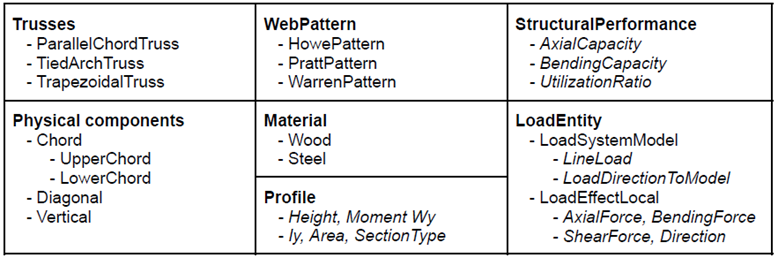
1.Trusses: Subclassed by geometry (Parallel, Tied Arch, Trapezoidal)
2.Physical Components: Chords (Upper/Lower), Diagonals, and Verticals.
The truss is modeled via its physical members: chords, verticals, diagonals, where Chord splits into disjoint Upper/LowerChord.
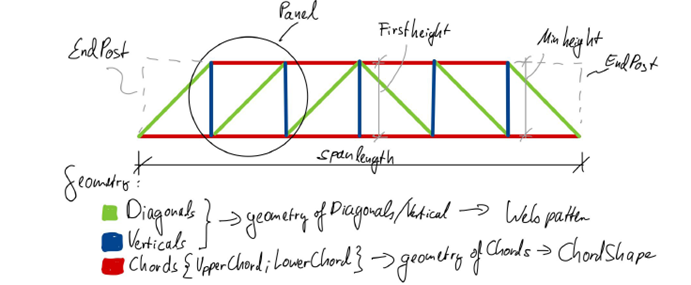
3.WebPattern: Abstract topology
A. Arrangement – Outer/Chord-Geometry:
After surveying common truss families, the outer shape is governed by the geometry of the chords and can be categorized into: straight, curved and pitched: Following Noy & McGuinness’s guidance to avoid redundancy, this is modeled locally on the chords via the data property hasChordShape ∈ {straight, pitched, curved}, rather than as a global truss attribute (e.g., a hasOverallShape data property).
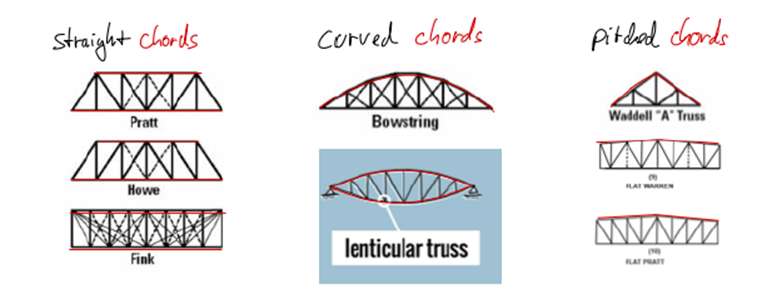
B. Arrangement – Inner/Web-Geometry:
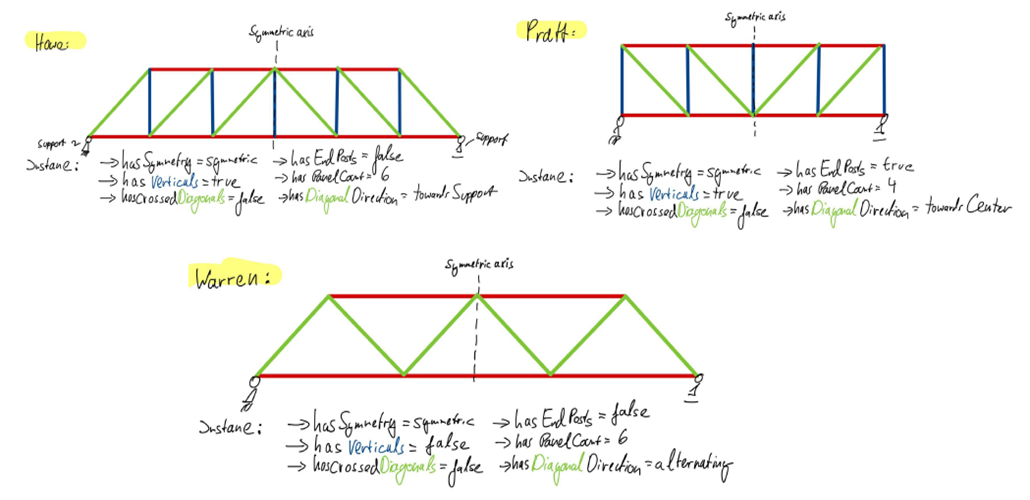
The WebPattern class represents abstract topology (not physical members), separating conceptual layout from domain objects (Noy & McGuinness). Each pattern defines symmetry and diagonal orientation via hasVerticals, hasDiagonalDirection, and panelCount. This allows patterns like Warren, Pratt/Howe, or Vertical-Only to be formally described without having to instantiate individual bars.
4.Material (Wood, Steel), Profile (Dimensions), LoadEntity (System/Local loads), and StructuralPerformance (Capacity/Utilization).
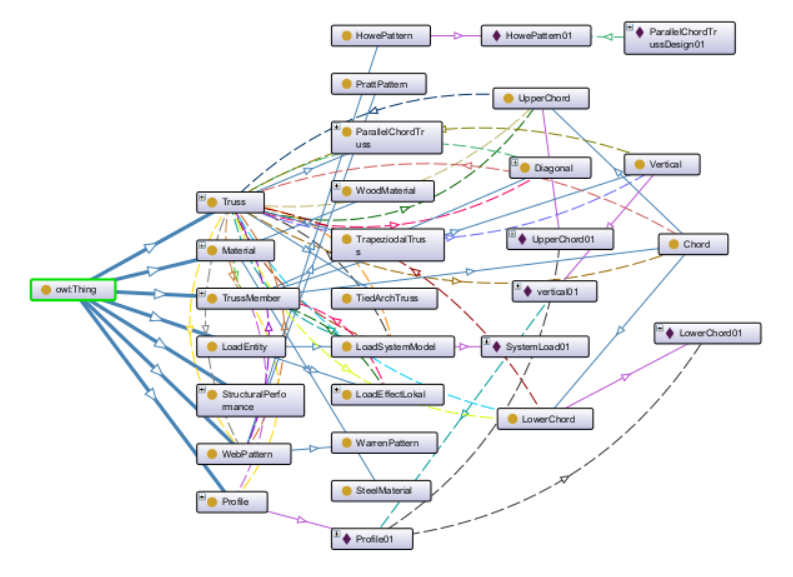
Ontograf:
Engineering Examples:
- Concept Selection: Filtering truss types and patterns for a 32m long-span hall.
- Material Substitution: Swapping timber lower chords for steel to address fatigue while keeping the web pattern fixed.
- Logistics Check: Prefiltering designs based on a 12m maximum element length for transport and fabrication.
Conclusion & Limitations:
The ontology successfully enables automated design comparison and “what-if” scenarios. However, it currently lacks explicit node/joint localization, meaning it cannot yet support full structural analysis (boundary conditions and load paths) without further development.
References:
1.N. F. Noy and D. L. McGuinness, Ontology Development 101: A Guide to Creating Your First Ontology. Stanford KSL Tech. Rep. KSL-01-05, 2001. [Online]. Available: https://protege.stanford.edu/publications/ontology_development/ontology101-noy-mcguinness.html. Accessed: Nov. 10, 2025.
2.AASHTO/NSBA Steel Bridge Collaboration, G13.2–2024: Guidelines for Steel Truss Bridge Analysis. Washington, DC, 2024. [Online]. Available: https://www.aisc.org/globalassets/nsba/aashto-nsba-collab-docs/g13.2-2024-guidelines-for-steel-truss-bridge-analysis.pdf. Accessed: Nov. 10, 2025.
3.Timber Frame Engineering Council (TFEC), TFEC 4-2020: Design Guide for Timber Roof Trusses. 2020. [Online]. Available: https://dcstructural.com/wp-content/uploads/2020/09/TFEC-4-2020-Design-Guide-for-Timber-Roof-Trusses.pdf. Accessed: Nov. 10, 2025.
4.Theoretical Analysis of Truss Height-to-Span Ratio Selection. In: TETR (Trends in Environmental Technology Research) Proceedings, 2024. [Online] (preprint). Available: https://www.researchgate.net/publication/391610677_Theoretical_Analysis_of_Truss_Height-to-span_Ratio_Selection. Accessed: Nov. 10, 2025.
5.D. Johnstone, R. Hairstans, and A. Livingstone, “Design of a long span Belfast truss using UK home-grown timber,” in ECCM-ECFD 2018 Conference Proceedings, 2018. [Online] (preprint). Available: https://westernwoodstructures.com/wp-content/uploads/2021/12/An-Update-on-Bowstring-Truss-Issues-.pdf
6.A. Sánchez-Rodríguez, “Preventing failure propagation in steel truss bridges,” ce/papers, vol. 6, no. 5, pp. 1018–1025, 2023. doi: 10.1002/cepa.2377. [Online]. Available: https://onlinelibrary.wiley.com/doi/pdf/10.1002/cepa.2377. Accessed: Nov. 10, 2025.
7.A. Patnaik, “Effective Lengths of Members in Parallel Chord Trusses Made from Hollow Structural Sections,” Current Trends in Civil & Structural Engineering, vol. 9, no. 5, 2023. doi: 10.33552/CTCSE.2023.09.000722. [Online]. Available: https://irispublishers.com/ctcse/pdf/CTCSE.MS.ID.000722.pdf. Accessed: Nov. 10, 2025.
8.CEN, EN 1993-1-1: Eurocode 3 — Design of steel structures — Part 1-1: General rules and rules for buildings. Brussels: European Committee for Standardization, 2005; A1:2014.
9.P. Hitzler, M. Krötzsch, and S. Rudolph, Foundations of Semantic Web Technologies. Boca Raton, FL: Chapman & Hall/CRC, 2009.