Introduction:
This project models a multi-layered green roof system as an ontology to translate physical building components into a digital framework. It supports consistency checks and automated reasoning to ensure accurate and traceable designs.
Purpose:
The purpose is to formally represent the physical structure and functional logic of green roofs in a machine-readable format. This supports engineering analysis, standardized documentation for policymakers, and interdisciplinary communication between architects and engineers.
Scope:
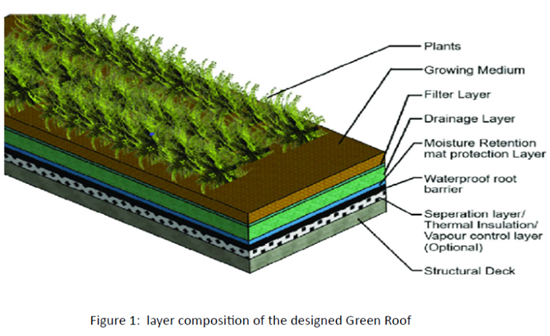
The scope is limited to the eight core physical layers (Vegetation, Growing Medium, Filter, Drainage, Waterproofing, Vapor Barrier, Insulation, and Roof Deck). It includes their material types and performance properties, such as thickness, weight, and drainage capacity.
Intended Users & Intended Use:
Users: Civil and environmental engineers, architects, building consultants, and digital modeling specialists.
Use: Supporting engineering analysis, consistent documentation, and interdisciplinary communication for sustainable building design.
Class Hierarchy:
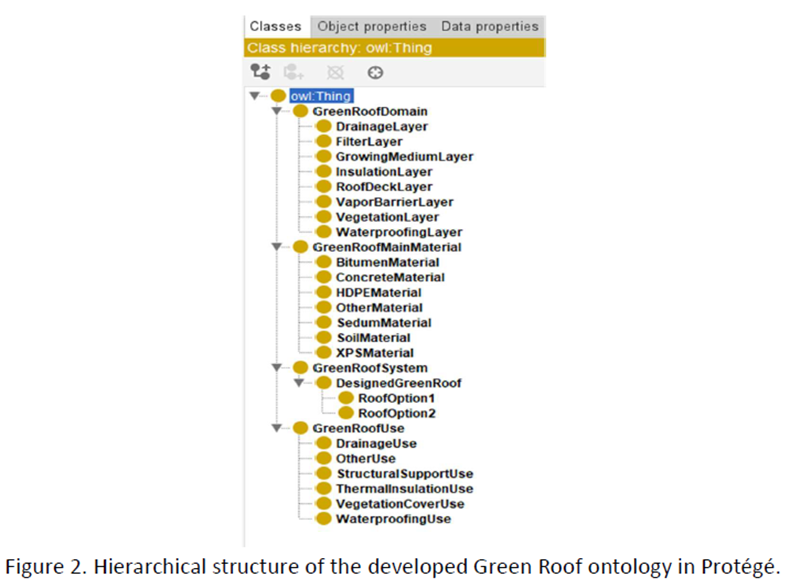
The ontology is built around four top-level classes: GreenRoofSystem, GreenRoofDomain, GreenRoofMainMaterial, and GreenRoofUse. Each of the eight physical layers is a disjoint subclass under GreenRoofDomain, ensuring no individual element belongs to more than one layer.
Ontograf (Logic & Properties):
The system uses transitive properties (hasComponent) and inverse properties (isAbove/isBelow) to define the vertical order of layers. Measured parameters like thickness, weight, and drainage capacity are captured via data properties. Logical axioms (existential and universal) ensure every system includes all required layers.
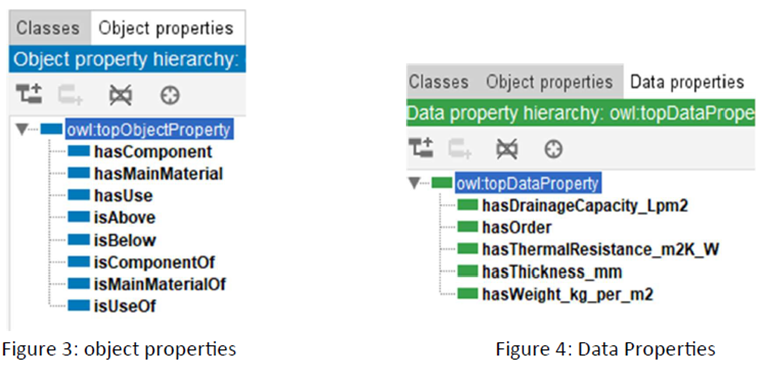
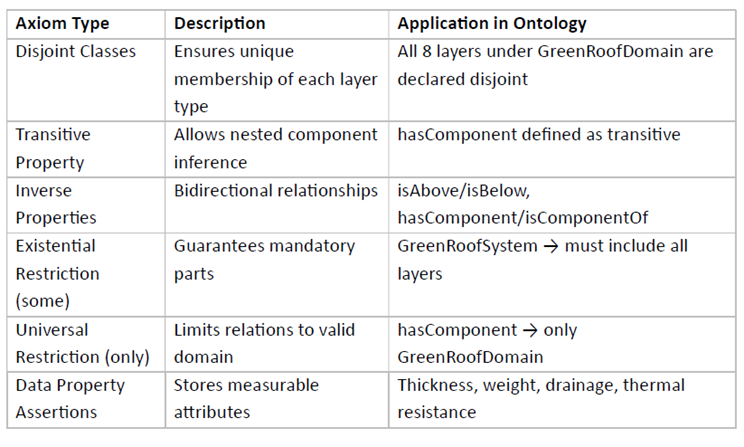
Table 1: Logical axioms and their implementation in the ontology
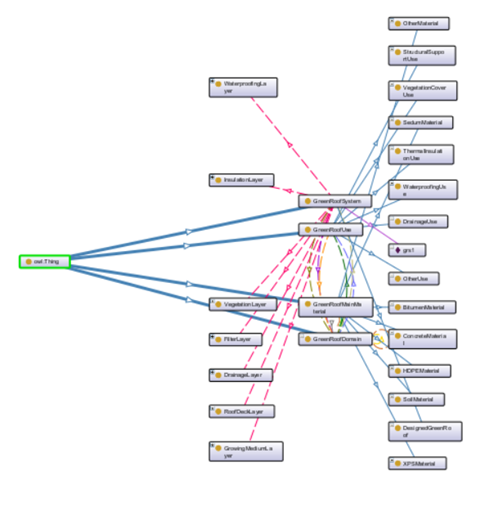
Figure 5: Ontograf
Engineering Examples:
- Policy Standardization: Providing a consistent vocabulary for municipality guidelines and public tenders.
- Retrofit Evaluation: Comparing different material configurations to improve insulation and water management in older buildings.
- Maintenance Logic: Identifying dependencies between layers to link future sensor data for predictive performance analysis.
Conclusion:
The model successfully translates physical components into a machine-readable format validated by the HermiT reasoner. It establishes a consistent foundation for future extensions like real-time monitoring.
References:
1. FLL. (2018). Guideline for the Planning, Execution and Upkeep of Green Roof Sites. Forschungsgesellschaft Landschaftsentwicklung Landschaftsbau e.V., Bonn, Germany.
2. ZinCo GmbH. (2020). Technical Data Sheets – Extensive and Intensive Green Roof Systems. ZinCo GmbH, Germany. Retrieved from https://www.zinco-greenroof.com
3. Krötzsch, M., Simancik, F., & Horrocks, I. (2012). A Description Logic Primer. arXiv preprint arXiv:1201.4089.
4. Optigrün International AG. (2021). Green Roof Systems and Product Overview. Optigrün International AG, Krauchenwies, Germany. Retrieved from https://www.optigruen.com
5. Noy, N. F., & McGuinness, D. L. (2001). Ontology Development 101: A Guide to Creating Your First Ontology. Stanford Knowledge Systems Laboratory Technical Report KSL-01-05.
6. TU Berlin Civil Systems Engineering. (2025). Modeling Civil Engineered Systems – Bridge Ontology Tutorial. Lecture materials, Technische Universität Berlin.
7. Ökobau.dat. (2023). German National Database for Environmental Product Declarations (EPD) for Building Materials. Federal Institute for Research on Building, Urban Affairs and Spatial Development (BBSR). Retrieved from https://www.oekobaudat.de
8. DGNB. (2022). Sustainability Certification System for Buildings and Urban Districts – Technical Manual. Deutsche Gesellschaft für Nachhaltiges Bauen e.V., Stuttgart, Germany.
9. EnEV. (2023). German Energy Saving Ordinance (Energieeinsparverordnung) – Consolidated Version. Federal Ministry for Economic Affairs and Climate Action (BMWK).
10. W3C OWL Working Group. (2012). OWL 2 Web Ontology Language: Document Overview. World Wide Web Consortium (W3C). Retrieved from https://www.w3.org/TR/owl2-overview/