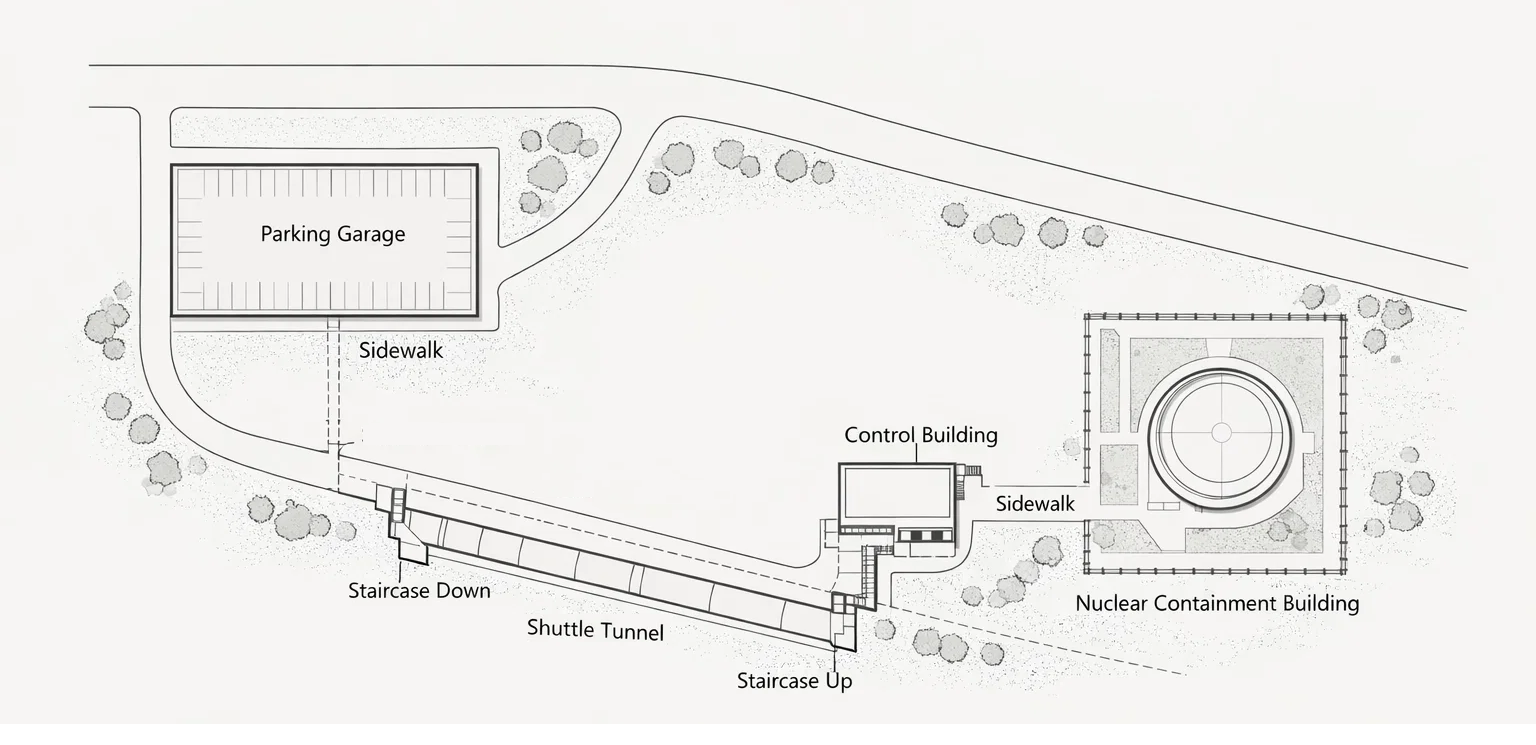
As the scope of the maintenance is considered for the critical elements of the system. Based on the intended site layout and operational design, the flow within the facility is presented in the above figure. (whatever using a red line or whatever). The circulation originates from the parking structure and continues along the pedestrian sidewalks leading into the shuttle tunnel, which is then connected to the control building. While the control building lies along the designed circulation path, it is not included in the scope of the maintenance analysis. Instead, the nuclear containment building is considered due to its strict regulations requirements, and high constraints on any integrated maintenance plans.
In this study, four critical systems are considered:
The parking garage is the single entry point for all personnel, since private vehicles are not allowed inside the plant perimeter. From there, staff move through a pedestrian passage that leads to the shuttle tunnel, which transports them to the control building, where most operators, engineers, and technicians work on daily monitoring and supervision tasks.
These systems are connected through clear functional interfaces. The parking garage directly determines the volume and timing of personnel entering the facility, which affects both the pedestrian passage and the shuttle tunnel. The pedestrian passage acts as a transition interface in between different systems. The shuttle tunnel is the main transport interface between the logistical zone and the operational zone, making its availability essential for daily plant operation.
Although the containment building is not on the staff’s main daily circulation path, and is not physically connected to the other systems, it still has an integral influence on the parking garage, pedestrian passage, and shuttle tunnel’s maintenances. Even though a dedicated access exists for maintenance operations, the presence and coordination of qualified personnel still depend on these access systems. Personnel must be able to move quickly to the containment building for inspections, maintenance, or to monitor critical situations, which means the parking, pedestrian passage, and tunnel must always be available and reliable.
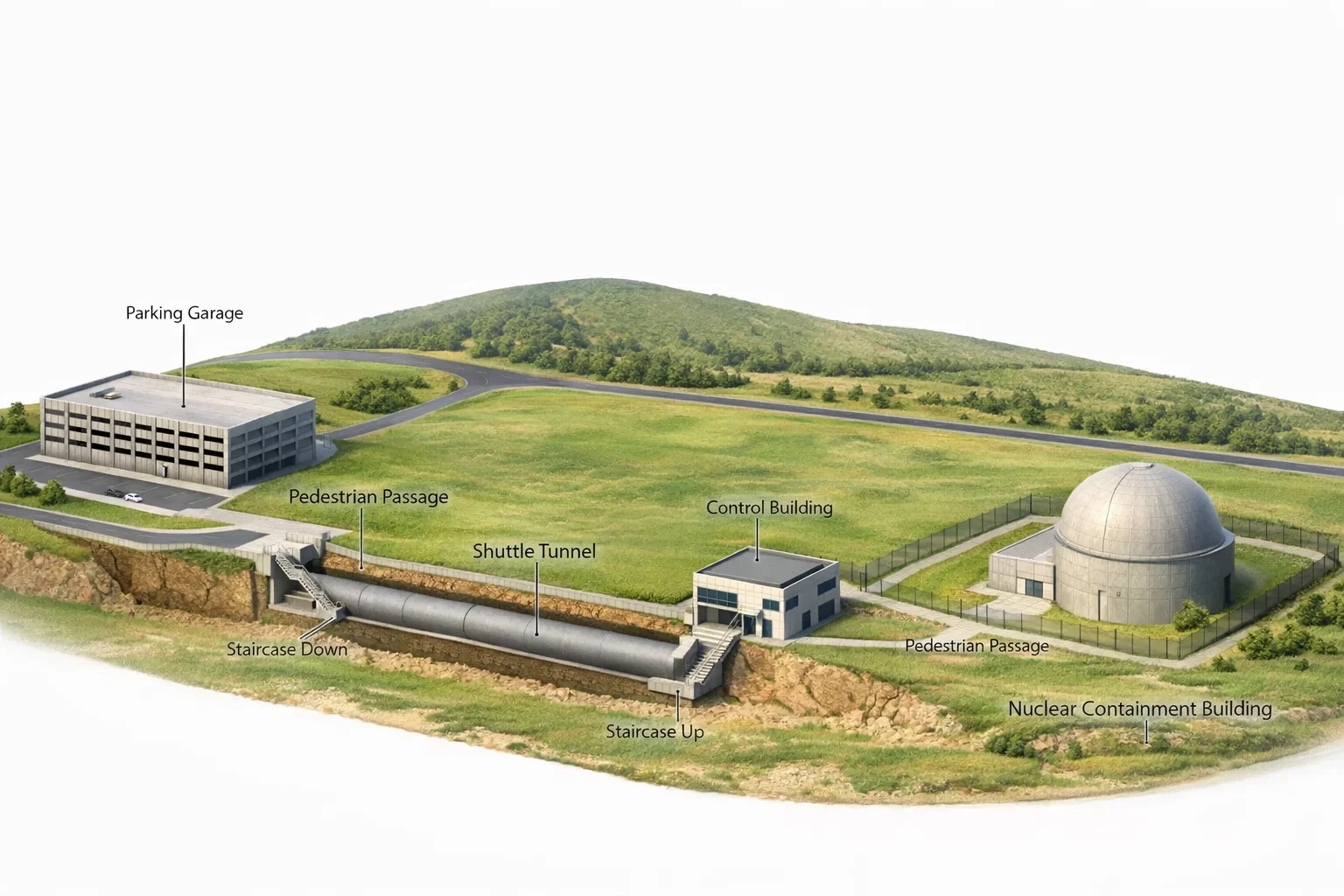
In contrast, the condition of the containment building directly affects the operation of the plant. As the primary safety barrier, any detected anomaly can lead to operational restrictions or even a complete reactor shutdown. Furthermore, the daily supervision of the reactor, carried out from the control building, depends on the integrity of the containment: personnel must be able to access the control systems and respond immediately if a critical situation arises.
While there are inroads in the nuclear power plant site, they are only used when the nuclear containment building requires maintenance and material transportation. Due to its reduced frequency use it has been excluded from the scope of the research and maintenance analysis as a whole.
Over the life cycle of the plant, these interfaces influence each other continuously. Increased use of one system accelerates its aging and increases maintenance needs, which can reduce availability for the connected systems. Maintenance or failure in one interface propagates its impact to the others, affecting personnel accessibility, operational continuity, and safety margins. For this reason, it would be optimal to analyze the four systems together. Their interfaces must be considered jointly in order to ensure consistent maintenance planning, long-term reliability, and sustained nuclear safety.
Main | Introduction | Integration Context | Maintenance Strategies | Life-Cycle Analysis | Multi-Objective Optimization | Conclusion