Introduction
The Tiny House represents a one-story technical building that functions as the central energy management hub within the offshore island microgrid. Rather than serving residential or hospitality purposes, this building is designed to receive electricity generated by the offshore wind turbine and distribute it efficiently to the hotel and restaurant systems. By acting as an intermediary node between energy production and consumption, the Tiny House ensures controlled power flow, system stability, and coordinated energy management across the island.
Within the ontological framework, the Tiny House is modeled as a service-oriented building system that integrates structural components with functional energy roles. Its simplified geometry and compact dimensions allow it to operate as a low-demand facility while maintaining critical infrastructure responsibilities such as energy distribution, monitoring, and operational support. This approach supports the broader project objective of treating buildings and energy infrastructure as interconnected subsystems within a unified civil engineered system.
Class hierarchy
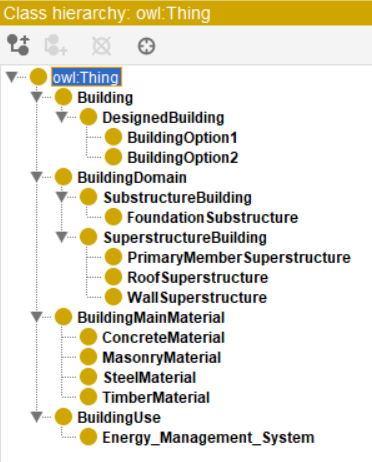
The ontology class hierarchy organizes the Tiny House Energy Management System into structured layers that represent its design, structure, materials, and functional role. Starting from owl:Thing, the model defines Building as the main class, which is further divided into DesignedBuilding, BuildingDomain, BuildingMainMaterial, and BuildingUse. Structural elements are separated into SubstructureBuilding and SuperstructureBuilding, ensuring clear representation of foundation and load-bearing components. This hierarchical structure supports logical reasoning, modular design, and consistent integration with the overall island system ontology.
Ontograph
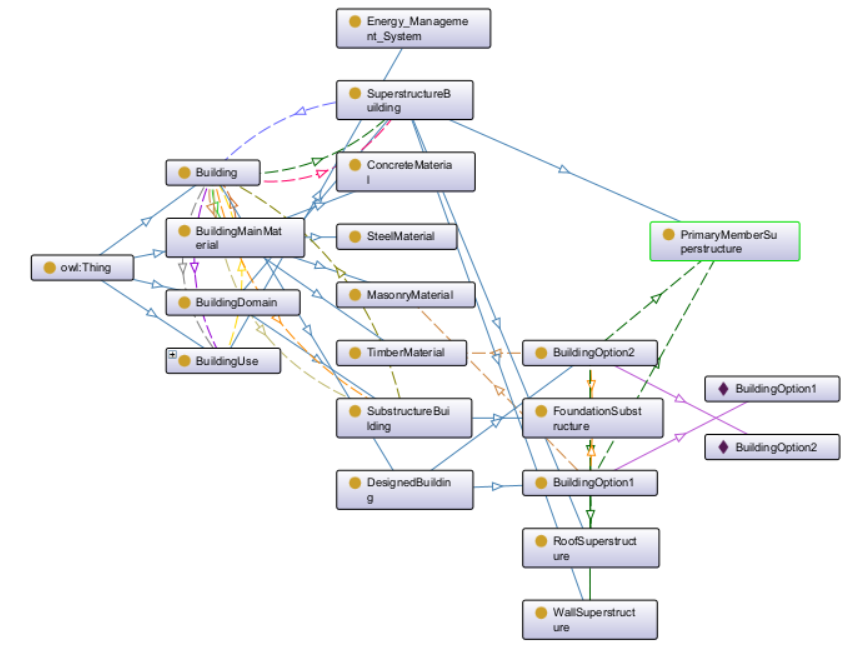
The OntoGraph visualizes the semantic relationships between the Tiny House Energy Management System and its structural, material, and functional classes. It illustrates how building components, materials, and design options are interconnected within the ontology, enabling clearer understanding of system dependencies. This graphical representation supports logical reasoning and highlights the integration of the energy management role within the overall building structure.
Refarences:
- Zhangcheng Qiang, Stuart Hands, Kerry Taylor, Subbu Sethuvenkatraman,Daniel Hugo, Pouya Ghiasnezhad Omran, Madhawa Perera, Armin Haller, Asystematic comparison and evaluation of building ontologies for deploying data-drivenanalytics in smart buildings. https://www.sciencedirect.com/science/article/pii/S0378778823002840
- M.R. Bashir, A.Q. Gill, To enabled smart buildings: A systematic review, Intelligent Systems Conference (2017). https://doi.org/10.1109/