The Ontology
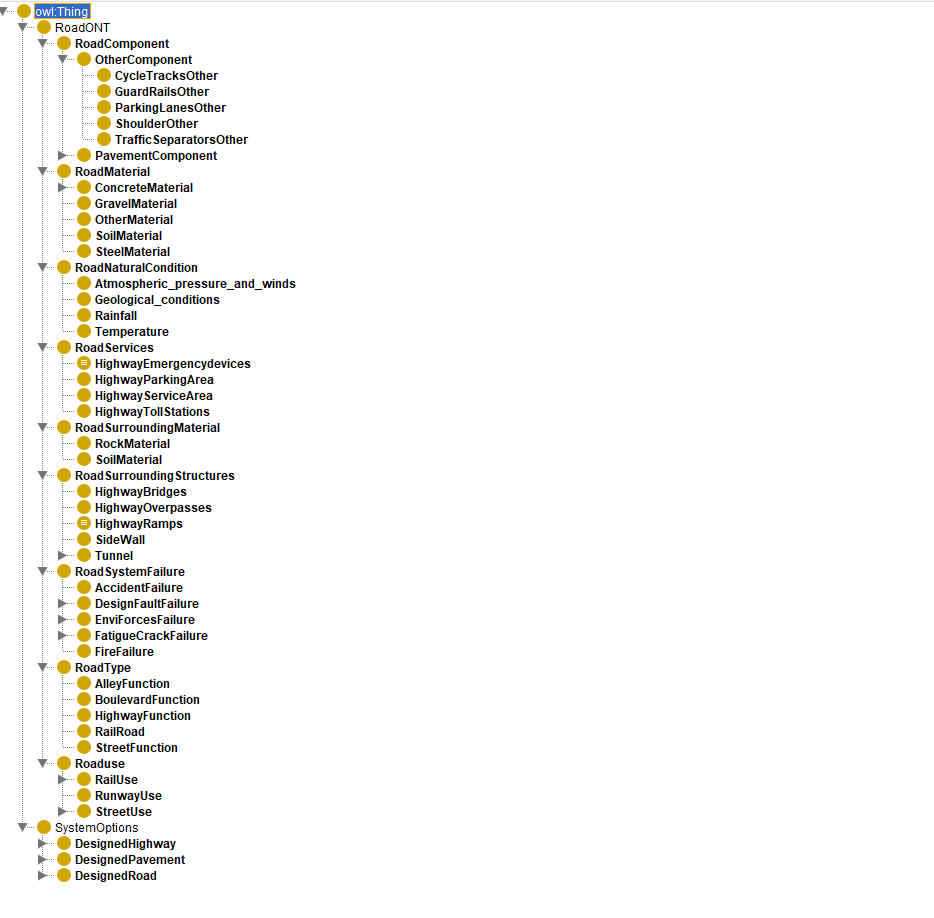
This ontology presents a conceptual model of road infrastructure. Its main objective is to support road designers and civil engineering students in the early stages of the road design process by organizing essential design knowledge in a structured way[1].
The ontology focuses on the main elements required for road design including road function material pavement and side components traffic type and natural conditions[2][3]. The scope is defined using competency questions and is limited to conceptual and preliminary design aspects without including detailed engineering calculations or construction procedures[1].
The main class of the ontology is Road, which is connected to other classes representing function, material, components, traffic, and natural conditions. This class-based structure reflects common classifications used in road engineering literature [2][3].
To illustrate the use of the ontology, two example instances are created: an urban street and a highway. These examples show how differences in traffic and environmental conditions result in different road design characteristics[3][4]. The ontology also offers a basic conceptual structure that can be further developed in future work to include aspects such as cost, maintenance and safety.
Parametric Model
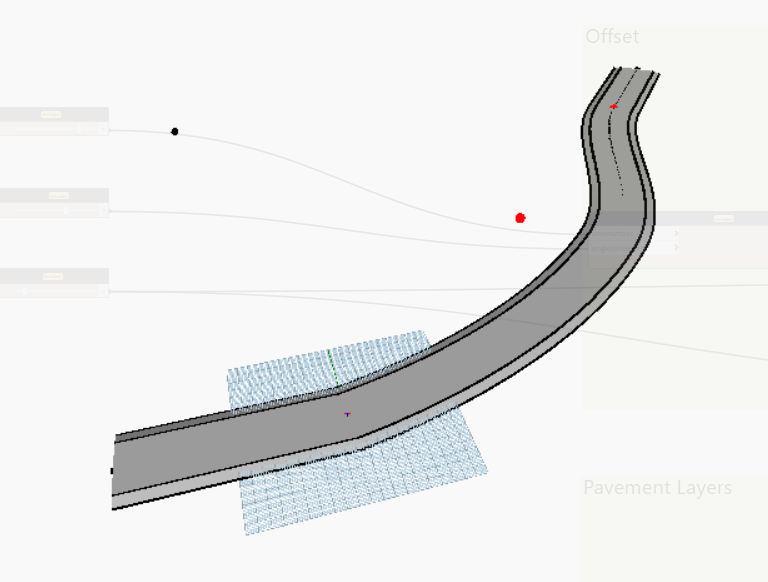
A parametric model is a design method in which the shape and characteristics of a system are controlled by a number of adjustable parameters and the relationships between them. In this road design project, the model is used to connect two straight road sections by means of a curve, where the curve geometry changes automatically according to the values defined by the user[7].
The main parameters considered in the model include the distance and angle between the two straight sections, design speed, lane number and width, shoulder width, and the thickness of pavement layers[5][6]. These parameters have a direct effect on the curve radius, overall alignment geometry, level of safety, and the structural quality of the pavement[6][7].
The model logic is defined so that changes in the input parameters automatically update the road geometry and pavement structure. This allows different design options to be evaluated in a short time[7].
As a result, the parametric approach supports performance-based design by helping designers balance speed, safety, pavement quality, and cost. This is especially useful in the early stages of road and highway design[5][6].
References
[1] Noy, N. F., & McGuinness, D. L. (2001). Ontology Development 101: A Guide to Creating Your First Ontology. Stanford University.
[2] Fajardo, M. B. (1993). Elements of Roads and Highways. 5138 Merchandising.
[3] Mehdian, M., Mirzahossein, H., & Kordani, A. A. (2022). A data-driven functional classification of urban roadways based on geometric design, traffic characteristics, and land use features. Journal of Advanced Transportation.
[4] Acharya, A., & Nepal, A. (2018). Transportation Engineering – Hill Roads. Tribhuvan University, Institute of Engineering.
[5] City of Toronto. (2017). Road Engineering Guidelines: Lane Width Guideline. Transportation Services.
[6] Florida Department of Transportation. (2018). Flexible Pavement Design Manual. Office of Design, Pavement Management Section.
[7] Donnell, E., Kersavage, K., & Tierney, L. F. (2018). Self-Enforcing Roadways: A Guidance Report. Office of Research, Development, and Technology.