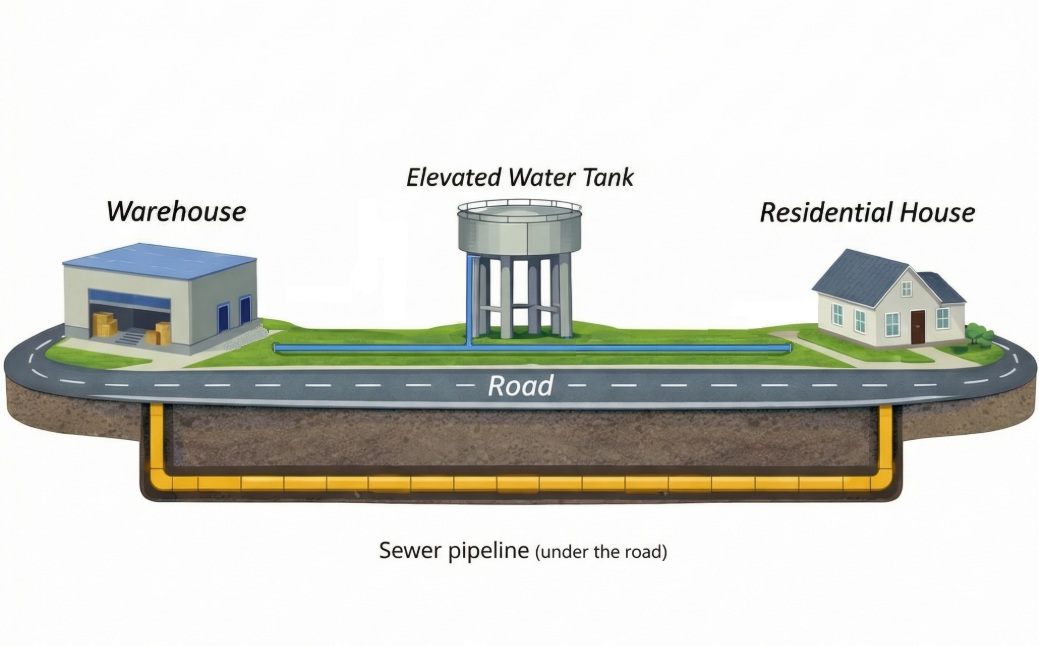
Figure 1
Individual Systems and Selected Design Options
The integrated civil infrastructure system analyzed in this project consists of multiple subsystems selected and evaluated by individual group members. Each subsystem is represented by the preferred design option identified through life-cycle assessment (LCA) and multi-criteria decision-making (AHP):
- Road Infrastructure – asphalt base layer with reinforced concrete surface (BK 1.8)
- Gravity Sewer Pipeline – Vitrified Clay Pipe (VCP)
- Elevated RCC Tank (Staging System) – RCC columns with CFRP retrofit
- Steel Warehouse Structure – exterior wall and roof cladding system selected from comparative assessment
- Residential Home Foundation – selected foundation option based on lowest weighted environmental impact
Together, these subsystems form an integrated residential–industrial infrastructure system, providing housing stability, industrial operation space, mobility, potable water storage, and wastewater conveyance.
Integrated System Description
The system represents a mixed-use residential and industrial zone in which infrastructure components are spatially co-located and functionally interdependent. The residential house relies on the road network for accessibility, the gravity sewer pipeline for wastewater conveyance, and the elevated water tank for reliable water supply. Similarly, the industrial warehouse depends on the same road and pipeline networks for logistics, utilities, and maintenance access.
Infrastructure subsystems interact across all phases of the life cycle, including design, construction, operation, maintenance, and rehabilitation. Deterioration processes or intervention schedules in one subsystem can directly influence the serviceability and availability of others, making isolated component-level assessment insufficient. Therefore, maintenance planning and life-cycle analysis must be conducted at the system level to adequately capture these interactions [1], [2].
Subsystem Roles and Interdependencies
Road Infrastructure
The road infrastructure forms the primary surface-level connector within the integrated system, enabling access for residents, industrial operations, maintenance vehicles, and emergency services. It physically overlies the gravity sewer pipeline and provides access to the residential house, warehouse, and elevated water tank.
Surface deterioration such as cracking, rutting, or potholes can restrict access and delay maintenance interventions in other subsystems. Conversely, excavation for pipeline rehabilitation or foundation repairs directly impacts road availability. As a result, road maintenance schedules must be coordinated with subsurface and above-ground interventions to minimize service disruption and cumulative impacts over the system life cycle [3].
Gravity Sewer Pipeline
The gravity sewer pipeline conveys wastewater from the residential house and industrial warehouse to downstream treatment facilities. As buried infrastructure, it exhibits strong physical and functional dependencies with the overlying road network and adjacent building foundations.
Failures such as leakage, blockage, or joint displacement can undermine pavement structures, alter soil conditions beneath foundations, and compromise sanitation services. Sewer maintenance and rehabilitation typically require excavation, which directly affects road availability and access to nearby infrastructure. This creates a strong interdependency between pipeline condition, road serviceability, and building functionality within the integrated system [2].
Elevated Reinforced Concrete Water Tank
The elevated reinforced concrete (RCC) water tank functions as a shared storage and pressure-regulating component, ensuring reliable potable water supply for residential consumption, industrial use, and emergency conditions. Its operation supports both domestic activities and industrial processes, making it a critical system-wide service node.
Maintenance activities such as inspections, protective system renewal, or structural repairs require coordinated access via the road network and may temporarily affect nearby pipeline operations. In addition, changes in ground conditions caused by sewer leakage or road excavation can influence the tank’s foundation performance. The water tank therefore represents a vertical integration point linking surface access, subsurface stability, and service continuity [4].
Steel Warehouse Structure
The steel industrial warehouse serves as the primary operational facility within the integrated system, providing sheltered space for storage, processing, and industrial activities. While structurally independent from the residential foundation, its functionality depends strongly on shared infrastructure services, including road access, water supply, and wastewater conveyance.
Maintenance or rehabilitation activities associated with the warehouse compete for access and logistical resources with road, pipeline, and water tank interventions. Road closures or utility disruptions can directly affect warehouse productivity and operational continuity, illustrating the warehouse’s dependence on system-wide infrastructure performance rather than isolated structural behavior [5].
Residential Home Foundation
The residential building foundation system transfers structural loads safely to the ground while maintaining service connections to water and sewer infrastructure. Although it does not support industrial structures, it shares the same subsurface environment as the road and pipeline systems.
Foundation deterioration mechanisms such as settlement, cracking, or moisture ingress can disrupt utility connections and alter local soil conditions, potentially increasing maintenance demand for adjacent pipelines and pavements. Likewise, sewer leakage or road excavation can influence foundation performance. The residential foundation therefore plays a critical role in local system resilience, where small-scale failures can propagate into multi-subsystem interventions [6], [7].
System-Level Integration and Life-Cycle Perspective
The interaction between subsystems creates a tightly coupled infrastructure network. Pipeline failures can damage road surfaces, road closures can delay water tank or warehouse maintenance, and foundation settlement can disrupt utility services. These interdependencies highlight the limitations of uncoordinated, component-level maintenance planning [1].
From a life-cycle perspective, aligning inspection intervals, preventive maintenance strategies, and major rehabilitation activities across subsystems can significantly reduce downtime, environmental impacts, and total life-cycle cost. The integration context established in this project provides the basis for combined maintenance scenarios, updated life-cycle assessments, and multi-objective optimization of system performance using AHP-based decision frameworks [8], [9].
Figure 1 illustrates the integrated residential–industrial infrastructure system and highlights the functional and maintenance-related interfaces between the residential foundation, road network, gravity sewer pipeline, elevated water tank, and industrial warehouse.
References
[1] ISO, ISO 14040: Environmental management – Life cycle assessment – Principles and framework. International Organization for Standardization, 2006.
[2] M. R. Halfawy, “Municipal infrastructure asset management systems: State-of-the-art review,” Journal of Computing in Civil Engineering, vol. 22, no. 6, pp. 433–446, 2008. doi: 10.1061/(ASCE)0887-3801(2008)22:6(433).
[3] A. Bolognesi, C. Bragalli, C. Lenzi, and S. Artina, “Energy efficiency and maintenance optimization in road infrastructure systems,” Transportation Research Part D: Transport and Environment, vol. 25, pp. 1–11, 2013. doi: 10.1016/j.trd.2013.07.003.
[4] Bureau of Indian Standards, IS 3370: Code of practice for concrete structures for the storage of liquids, 2017.
[5] American Institute of Steel Construction, Steel Structures Maintenance and Repair Manual. AISC, 2021.
[6] BRE, Deterioration and Maintenance of Building Foundations. Building Research Establishment, 2018.
[7] S. Nielsen, “Life cycle assessment of building foundations,” Building and Environment, vol. 43, no. 11, pp. 1873–1880, 2008.
[8] T. L. Saaty, The Analytic Hierarchy Process. New York: McGraw-Hill, 1980.
[9] World Steel Association, Life Cycle Assessment Methodology Report. Brussels, Belgium, 2021.
Home | Introduction | Integration Context | Maintenance Strategies | Life Cycle Analysis | Multi-Objective Optimization