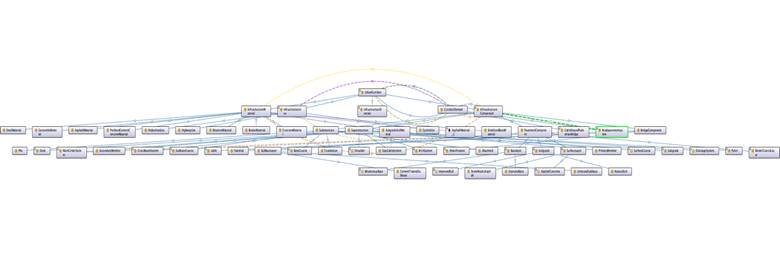
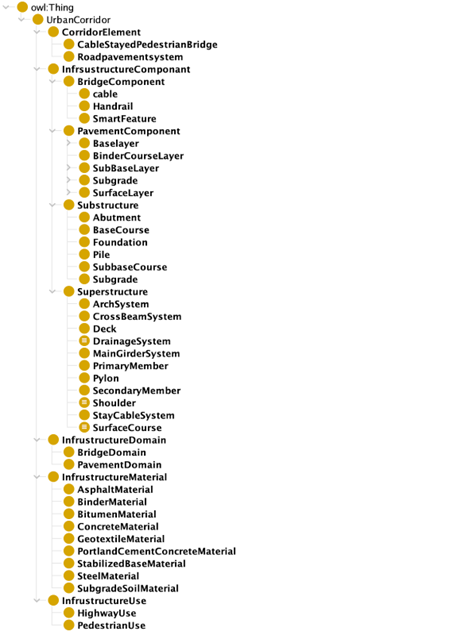
We developed a group ontology (OWL/Protégé) to provide a shared semantic backbone for the UrbanCorridor system and to keep terminology consistent across the integrated project. The ontology defines the corridor at the top level (UrbanCorridor) and major CorridorElement categories such as CableStayedPedestrianBridge and Roadpavementsystem, then decomposes them into BridgeComponent and PavementComponent. For pavements, it explicitly models the layered assembly (SurfaceLayer, BinderCourseLayer, BaseLayer, SubBaseLayer, Subgrade) with common alternatives (e.g., AsphaltConcrete/StoneMasticAsphalt).
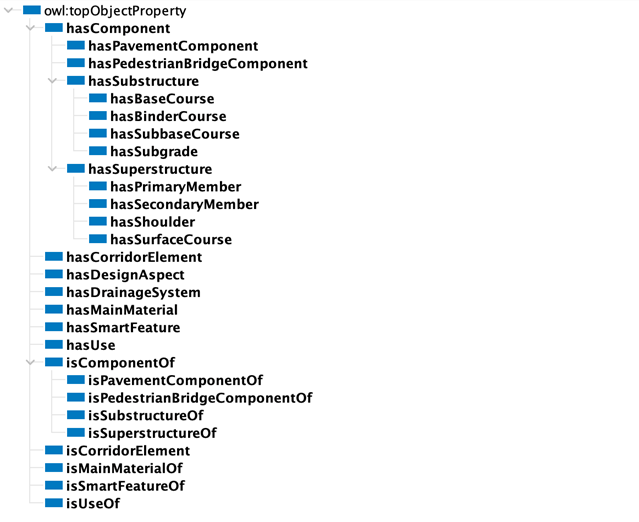
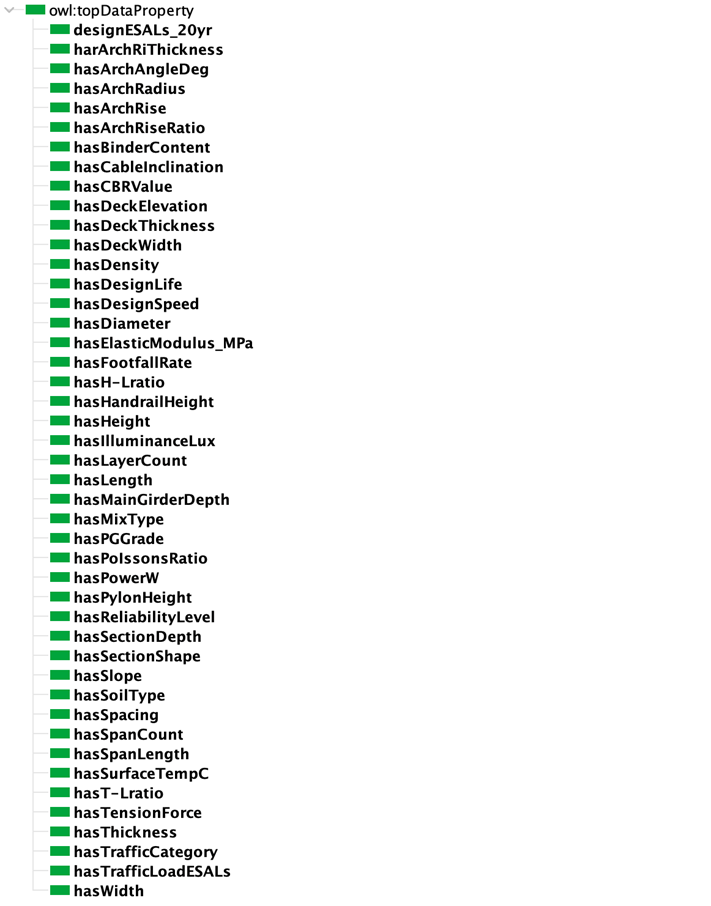
Integration relations are formalized via an object property hierarchy centered on hasComponent (with inverse isComponentOf), and key descriptors are captured through a data property hierarchy (e.g., hasDeckWidth/Thickness/Elevation, hasCableInclination, hasPylonHeight, hasMainGirderDepth, and design/traffic indicators).
The ontology also includes individuals that represent the concrete elements and options from our individual projects, so it captures specific bridge/pavement configurations and variants rather than remaining purely abstract. This makes it easier to trace how each individual contribution is reflected in the final integrated corridor model and supports clearer querying and documentation.
Figure 1 shows the Ontograph, Figure 2 the class hierarchy, Figure 3 the object properties, and Figure 4 the data properties of the group ontology.