Ontology
Project Context
Sanitary drainage networks are critical urban infrastructure systems designed to collect and convey wastewater from buildings to treatment facilities. These systems play a central role in public health protection, pollution control, and environmental sustainability. Their performance depends on the coordinated interaction of pipes, appurtenances, pumping facilities, and treatment interfaces operating under both gravity and pressurized conditions.
Objectives
The objective of this project was to develop an ontology-based representation of a sanitary drainage network that clearly formalizes its physical components, functional roles, and material characteristics. The ontology aims to support asset management, network retrofitting, capacity assessment, and improved understanding of system-wide dependencies for engineering and planning purposes.
Modelling Approach
An ontology was developed using OWL-based modelling to represent the sanitary drainage network as a hierarchical system of interconnected components and functions. The model distinguishes between network components, functional processes, and material classes, supported by object and data properties with defined domains, ranges, and characteristics such as inverse and transitive relationships. Parametrization was demonstrated through instantiated network configurations and component-level attributes, enabling logical reasoning and validation of system behavior.
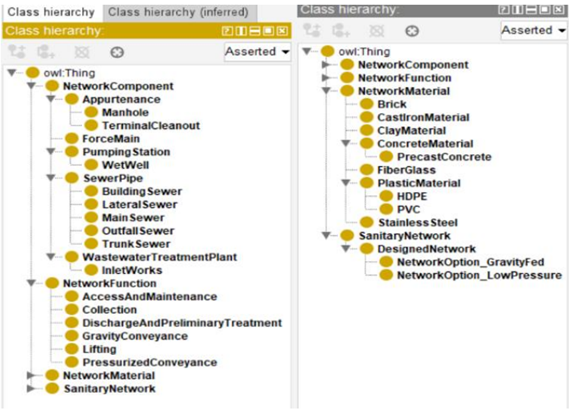
Figure 1: Class hierarchy
Key Outcomes
The ontology provides a logically consistent, machine-readable representation of a sanitary drainage network that supports structured reasoning and inference. Successful parametrization and reasoning demonstrate that the model can represent real network configurations, infer downstream relationships, and manage component data in a coherent and extensible manner.
Relevance & Future Potential
This work demonstrates the applicability of ontological modelling to wastewater infrastructure and urban utility systems. The framework offers strong potential for integration with asset management systems, hydraulic modelling tools, and BIM-based workflows, supporting informed decision-making, network upgrades, and long-term infrastructure planning.
Parametric Design
Gravity sanitary sewer
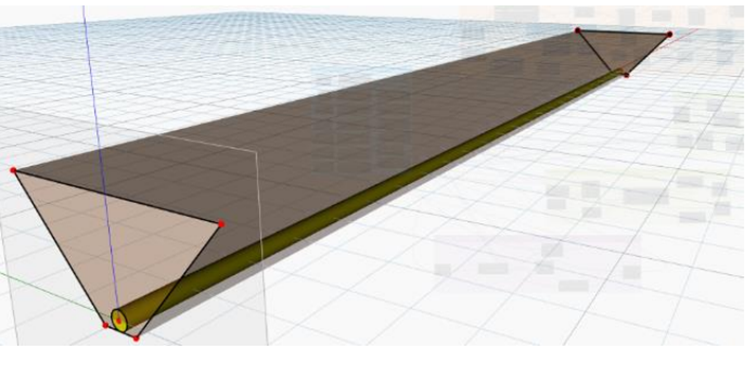
Figure 2: Parametric modelling of Gravity sanitary sewer
This project uses a parametric model to explore how a gravity sanitary sewer segment can be upgraded to handle future demand without defaulting to conservative or overdesigned solutions. The model was developed to respond directly to changes in flow demand, material choice, and geometric configuration, allowing rapid testing of multiple upgrade scenarios.
Rather than modelling an entire network, the focus is placed on a representative sewer segment, which acts as the critical unit controlling hydraulic capacity and construction cost. By increasing the design flow to reflect long-term population growth, the model highlights how small changes in diameter, slope, or material can significantly affect both performance and cost.
Key design inputs such as pipe diameter, longitudinal slope, and material roughness are treated as adjustable variables. These inputs automatically update hydraulic capacity, flow velocity, excavation volume, and total project cost. This makes it possible to compare alternatives in real time and identify configurations that satisfy operational constraints while avoiding unnecessary excavation or material use.
The project demonstrates how parametric modelling can shift sewer design from fixed-rule sizing toward informed exploration, where engineering decisions are supported by immediate feedback rather than manual recalculation.
Documentations
Home | Introduction | Individual Systems | Integration Context | Combined Ontology | Combined Parametric Model