Introduction
The civil engineering system chosen for this assignment is a composite culvert structure comprising Ultra-High Performance Concrete (UHPC) and conventional concrete designed to leverage the distinct advantages of both materials. Culverts are essential underground or embedded structures used for drainage, utility passage, or road and railway crossings, which help erosion control, flood prevention, effective sewer systems, disposal of industrial waste, and in some cases, a passageway for aquatic life. Culverts are typically subjected to combined mechanical loads (e.g., soil pressure, traffic loads) and environmental actions (e.g., temperature, humidity, chemical exposure)(Li et al., 2023a). Traditional culverts often face durability issues such as cracking, corrosion, and excessive deflection, especially under long-term service conditions(Zhu et al., n.d.) To address these limitations, the use of UHPC is a great fit due to its characterization based on superior compressive strength (>150 MPa), high tensile capacity, and exceptional durability due to its dense microstructure. This material has been increasingly used in composite applications (Yan et al., 2020).
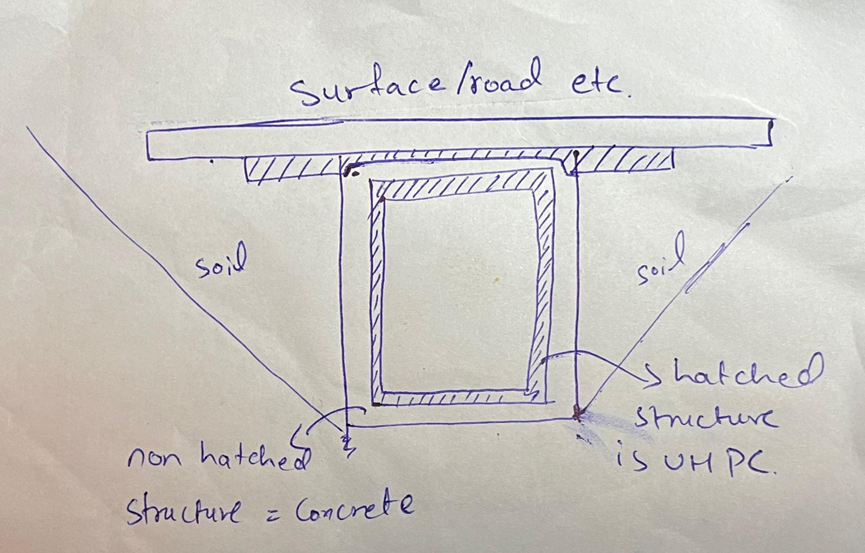
In such hybrid systems, the UHPC acts as an outer shell or bottom tension layer, while the conventional Concrete structure forms the core, contributing bulk stiffness and economic efficiency (Yan et al., 2020); (Student-Muhammad Atif Anwer Islam Mantawy & Azizinamini, n.d.) This configuration not only improves mechanical performance in scenarios where heavy heave live loads are involved in terms of flexural capacity and resistance to cracking, but also extends service life by mitigating environmental degradation(Li et al., 2023b). Furthermore, the use of prefabricated UHPC elements, such as inverted T-beams, simplifies construction and supports accelerated building techniques, including robotic spray application for repair and strengthening (Anwer et al. 2020). The composite system thus represents a sustainable and resilient solution for modern infrastructure, balancing performance, longevity, and cost-effectiveness.
Leveraging this knowledge, it is an engineering challenge to optimize the thickness of said cores and shells according to the on-ground scenario. Not only that, but parameters like structure weight, combined compressive strength, and resistance are also factors that need to be optimized before designing. This ontology will create a logically sound decomposition required to support a designing engineer.
A rough sketch of the system would show:
Summary of logical Axioms
| Logical Axiom (type) | Example in Ontology | Description |
| SubClassOf (Class Hierarchy) | Core ⊑ Culvert_Domain Shell ⊑ Culvert_Domain DesignedCulvert ⊑ Culvert | Defines the taxonomic hierarchy of concepts. |
| Object Property Hierarchy (SubPropertyOf) | HasCore ⊑ HasComponent HasShell ⊑ HasComponent IsCoreOf ⊑ IsComponentOf | Organizes relationships into a hierarchy |
| Inverse Property (owl:inverseOf) | HasComponent ≡ IsComponentOf⁻ HasCore ≡ IsCoreOf⁻ HasShell ≡ IsShellOff⁻ | Defines bidirectional relationships. |
| Property Characteristics (TransitiveProperty) | HasComponent ⊑ TransitiveProperty IsComponentOf ⊑ TransitiveProperty | Declares that the part-whole relationship is transitive. |
| Existential Restriction (Restriction: someValuesFrom) | Culvert ⊑ ∃ HasCore.Core Culvert ⊑ ∃ HasShell.Shell Culvert ⊑ ∃ HasMainMaterial.Culvert_Main_Material | Defines necessary conditions for class membership. |
| HasValue Restriction (Restriction: hasValue) | CulvertOption1 ⊑ =1 HasPrimaryMember.{CulvertOption01} | Defines a class by linking it to a specific individual. |
| Enumeration (owl:oneOf) | CulvertOption1 ≡ {CulvertOption01} CulvertOption2 ≡ {CulvertOption02} | Defines a class by explicitly listing its instances |
| Equivalent Class | CulvertOption1 ≡ {CulvertOption01} (via owl:oneOf) | States that two class expressions are equivalent and have the same set of instances |
| Disjoint Classes (owl:AllDisjointClasses) | Disjoint({Culvert, Culvert_Domain, Culvert_Main_Material, Culvert_Use}) Disjoint({aquaticlifeUse, erosioncontrolUse, …}) | Specifies that the instances of the listed classes cannot be the same. |
| Data Property Assertions (Literal Values) | BaseCore HasCompressiveStrength “40”^^decimal TopslabShell HasThickness “0.08”^^decimal | Assigns specific data values (e.g., numbers, strings) to individuals. |
| Annotation Assertions (rdfs:comment) | CulvertOption01 HasWeight “12.5” // “Tonnes per meter2” | Adds human-readable comments or notes to axioms, properties, or individuals to clarify the meaning of the data |
Description of Development Methodolgy
The ontology was developed to formally capture the knowledge about the UHPC-concrete composite culvert system. The process began by defining the scope and enumerating the key concepts, which naturally fell into categories like the physical structure, materials, and intended uses. These concepts were then organized into a hierarchical taxonomy. To model the system’s architecture, object properties were created to define the relationships between components, such as `hasCore` and `hasShell`, with inverse properties established to ensure logical consistency. Critical design rules were encoded using restrictions; for example, it was defined that every `Culvert` must have at least one `Core` and one `Shell`. Finally, the model was populated with specific design options and component individuals, annotating them with quantitative data like compressive strength and thickness to create a practical and rich knowledge base for comparing design alternatives.
The ontology was developed following the iterative methodology of Noy and McGuinness (2001) and refined to ensure its accuracy and relevance to practical culvert engineering. The definition of all object and data properties was consistently grounded in the logical representation framework put forth by Krötzsch et al. (2013).
The Pellet reasoner was executed and confirmed the ontology’s logical consistency, identifying no unsatisfiable classes. All individuals were correctly classified, validating the structural model and its property assertions.
Examples of the Ontology
1. Highway Upgrade Strengthening
An existing concrete culvert requires strengthening to support a new highway embankment built above it. The ontology is used to select a UHPC internal liner as the optimal strengthening method. A parametric model then determines the “minimum UHPC shell thickness” required to safely carry the increased load, optimizing for material cost and structural safety.
2. Emergency Flood Culvert Replacement
A failed culvert must be replaced within a tight deadline before the flood season. The ontology identifies a prefabricated UHPC shell with cast-in-place concrete core as the fastest construction method. Parametric optimization varies the “shell and core thicknesses” to find the configuration that allows the swiftest possible installation while guaranteeing immediate stability against hydraulic and earth pressures.
3. Deteriorated Culvert Rehabilitation
A corroded and spalling culvert in a coastal area needs rehabilitation to extend its service life. The ontology confirms that spraying a UHPC overlay is a valid repair strategy, leveraging its high durability and low permeability. The design focuses on applying the optimum UHPC overlay thickness required to restore structural integrity and provide a long-lasting protective barrier, minimizing intervention depth and cost.
References
Li, P., Wang, H., Nie, D., Wang, D., & Wang, C. (2023a). A Method to Analyze the Long-Term Durability Performance of Underground Reinforced Concrete Culvert Structures Under Coupled Mechanical and Environmental Loads. Journal of Intelligent Construction, 1(2), 1–17. https://doi.org/10.26599/jic.2023.9180011
Li, P., Wang, H., Nie, D., Wang, D., & Wang, C. (2023b). A Method to Analyze the Long-Term Durability Performance of Underground Reinforced Concrete Culvert Structures Under Coupled Mechanical and Environmental Loads. Journal of Intelligent Construction, 1(2), 1–17. https://doi.org/10.26599/jic.2023.9180011
Student-Muhammad Atif Anwer Islam Mantawy, G. M., & Azizinamini, P.-A. (n.d.). Use of UHPC in Conjunction with Pneumatic Spray Application and Robotics for Repair and Strengthening of Culverts-Phase I.
Yan, B., Qiu, M., Asce, S. M., Zeng, ; Tiansheng, Shao, X., Zhu, Y., & Li, M. (2020). Full-Scale Experimental Verification of UHPC-RC Composite Slab Culvert with a Clear Span of 8 m. https://doi.org/10.1061/(ASCE)
Zhu, X., Maekawa, K., Zhu, X. X., Kunieda, M., & Maekawa, K. (n.d.). An investigation on long-term excessive deformation of underground rc culverts coupled with soil foundation. https://www.researchgate.net/publication/288705856
Main | Introduction | Individual Systems | Integration Context | Combined Ontology | Combined Parametric Model | Analysis and Conclusions | References