The integration context for this model is a high-density urban mobility corridor, where three road segments (asphalt, flexible, and curved highway) and two pedestrian bridges (Smart and Cable-stayed) require explicit coordination through shared references and compatible geometry rather than isolated product models.This context is designed to demonstrate model integration by forcing clear interfaces,and the ability to generate variations under a unified system frame.
Engineering Challenge
The primary challenge is integrating a high-capacity highway into a dense urban environment. Highway infrastructure is designed for high-speed vehicular traffic, which often creates a significant physical and functional barrier between city areas.
- Connectivity Disruption: Major corridors disrupt pedestrian mobility and accessibility to adjacent public spaces.
- Safety & Intervention: At-grade crossings are typically avoided due to safety risks and vehicular delay, making grade-separated pedestrian bridge systems a necessary design intervention.
- Geometric & Construction Constraints: Construction must take place over live traffic corridors with limited space, requiring coordination between highway geometry and bridge structures.
System Interdependencies and Functions
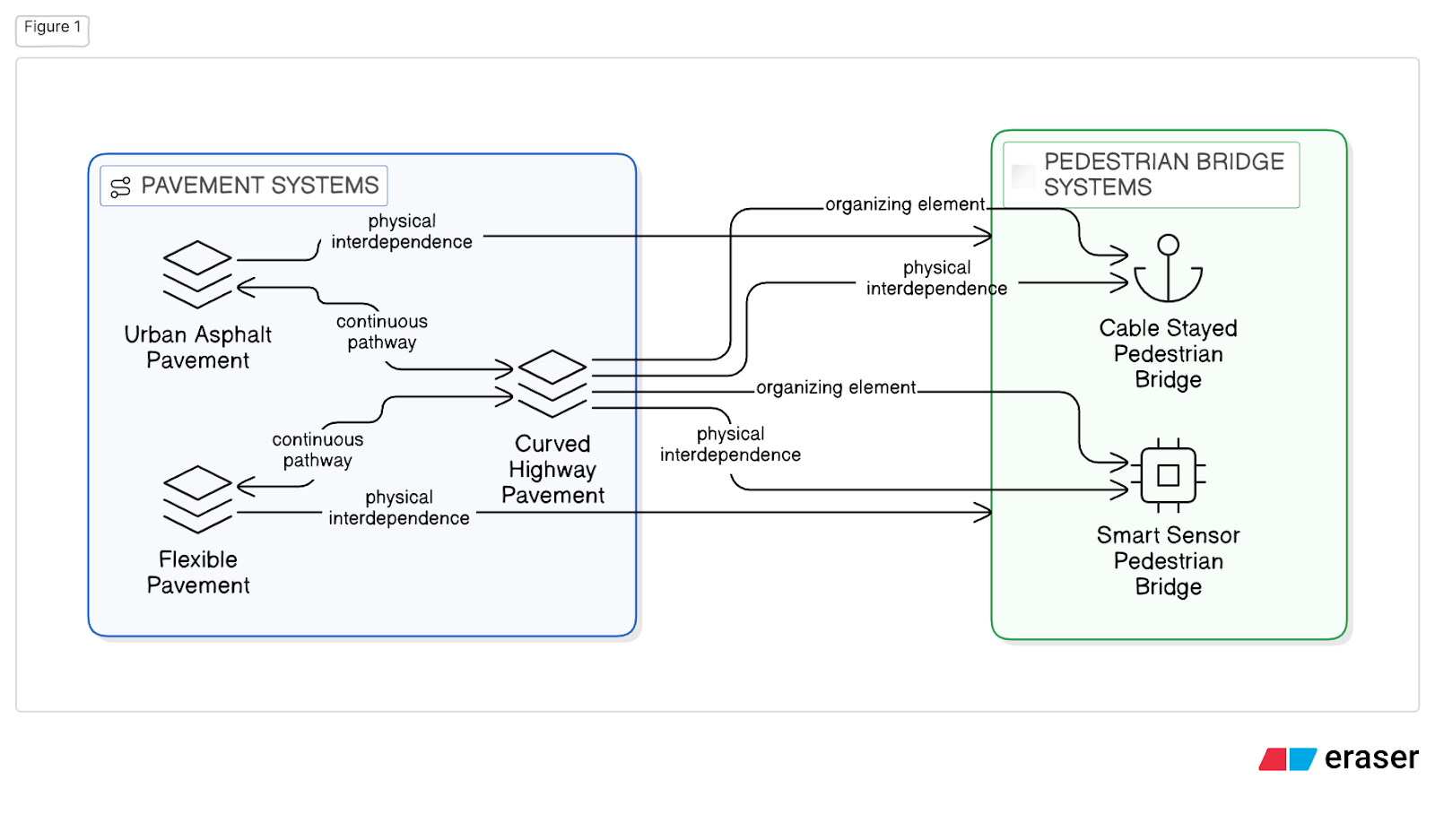
Across all of the five individual systems, there are several interdependencies that emerge for this urban corridor:
- Physical Interdependence – Deep work and/or excavation on one system impacts pavement integrity and structural stability of the pedestrian bridges.
- Functional Integration – The curved highway functions as the primary organizing element, which the pedestrian bridge systems use for crossing at various points.
- Geometric Connectivity – Pavement systems establish connections at both ends to create an uninterrupted pathway throughout the entire infrastructure.
Figure below shows the interdependencies of the systems so we will add them to the website
Role of Each Individual System
The role of our individual systems is shown in the table below:
| Subsystem | Primary Function | Key Inputs | Key Outputs | Role in System Integration |
| Urban Asphalt Pavement | Initial vehicular access | Site coordinates | Exit Reference point | Establishes the starting location for the entire integrated corridor. |
| Smart Pedestrian Bridge | Grade-separated crossing | Asphalt Pavement exit point | Pedestrian flow data | Connects local street access to the highway backbone without traffic disruption. |
| Curved Highway | High-capacity transit | Pavement exit reference | Main corridor alignment | Acts as the central organizing element for all subsequent modules. |
| Flexible Pavement | Transitional road link | Highway exit reference | Final site coordinates | Maintains vehicular continuity between the highway and the final bridge. |
| Cable Pedestrian Bridge | Secondary crossing | Flexible Pavement reference | Completed corridor path | Finalizes the grade-separated path at the corridor’s exit point. |
High Performance Criteria
Ensuring that the corridor operates effectively is one of the main priorities and therefore, the following performance criteria were established:
- Geometric Alignment: Alignment of geometry and definition of connection interfaces are critical for system stability.
- Structural Compatibility: Bridges must accommodate spans wide enough to traverse multiple traffic lanes.
- Regulatory Clearances: Vertical clearances above the roadway must be maintained in accordance with European design specifications.
- Long-Term Service Levels: Optimizing roadway safety, water service reliability, and structural resilience wherever it is applicable.
- Operational Continuity: The design must ensure that vehicular traffic is not significantly impacted during the construction and maintenance phases.