As the global shift towards an urbanised society continues, the provision of sustainable public transport options becomes increasingly essential. Train stations serve as primary gateways for metropolitan mobility and must demonstrate high levels of reliability to remain desirable for public use. To ensure these systems remain functional over many decades, it is necessary to move away from isolated component maintenance and towards an integrated management approach.
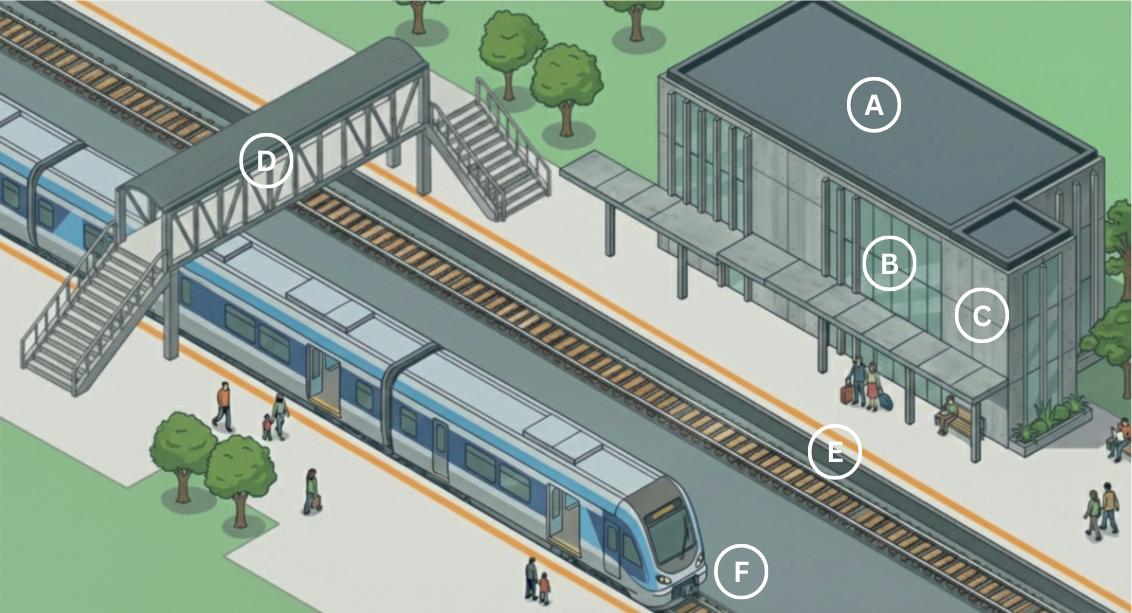
A. Building System | B. Glass Curtain Wall System | C. Precast Concrete Facade System | D. Steel Truss Bridge System | E. Concrete Railway Sleeper System | F. Timber Railway Sleeper System
Many contemporary transit facilities struggle with the challenge of synchronous ageing across diverse structural and architectural elements. Because these components are physically and operationally interdependent, their upkeep cannot be managed in silos. A sophisticated framework is required to evaluate how the deterioration of a single part affects the service life and environmental footprint of the entire facility.
In this project, the integration of six critical subsystems is analysed:
- A Railway System with Concrete Sleepers, representing standard modern railway infrastructure.
- A Railway System with Timber Sleepers, representing legacy railway components still in operation today.
- The Station Building, providing the vital structural foundation and administrative space for daily operations.
- A Pedestrian Steel Truss Bridge, facilitating the essential connection between passengers and the railway platforms.
- A Precast Concrete Façade, serving as a durable and functional exterior element.
- A Glass Curtain Wall, completing the high-performance building envelope.
The analysis of how these systems interact over time, focuses on:
- System Integration: Mapping the dependencies of all six subsystems.
- Maintenance Scenarios: Predicting deterioration patterns and intervention timelines.
- Life Cycle Assessment (LCA): Quantifying both the environmental footprint and economic impacts of the system.
- Multi-Objective Optimization: Balancing cost, carbon emissions, and service reliability to find the “Goldilocks” zone of infrastructure management.
By treating the station as a single, organism rather than a collection of parts, the aim is to extend service life, reduce carbon output, and ensure that the future of metropolitan mobility is as reliable as it is sustainable.