Crew-Based Integrated Maintenance Scenario
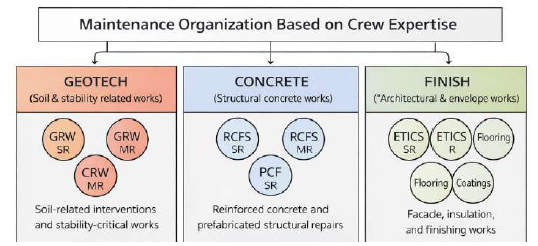
While developing this strategy, the organization of maintenance activities based on crew expertise was taken as the main starting point. Instead of classifying maintenance interventions primarily by their technical scale or impact level, activities were grouped according to the type of expertise, equipment, and site setup required to carry them out [13,14]. Within this framework, maintenance works were categorized into three main crew classes: Geotech, Concrete, and Finish.
The geotech category includes soil related and stability critical interventions, particularly those associated with retaining wall systems. The concrete category covers maintenance works related to reinforced concrete and prefabricated structural elements, while the finish category comprises envelope related activities such as surface treatments and insulation system works. This classification aims to reduce repeated crew mobilization and duplicated site setup efforts by enabling maintenance activities requiring similar expertise to be planned within common time windows.
From this perspective, some adjustments were deliberately made to the maintenance time intervals and intervention frequencies of certain subsystems compared to the first scenario. These adjustments are not intended to directly optimize maintenance timing, but are a natural consequence of reorganizing maintenance activities around crew expertise. The optimization objectives themselves remain unchanged and are identical to those used in the first scenario, namely the minimization of total interruption duration and the maximization of spacing between maintenance interventions. The crew based approach therefore defines only the strategic context for the optimization, rather than replacing it.
Although the underlying idea of this strategy differs from the first scenario, a system behavior similar to that observed in the first scenario is expected. The reason for this is that both strategies share common principles, such as grouping related maintenance activities and completing them within relatively narrow time windows, while aiming for a high level of integration. As a result, even though the organizational logic differs, the overall system response in terms of maintenance coordination and interruption behavior is anticipated to follow a comparable pattern.
Home | System Definition | Scenario 1 | Scenario 2 | Scenario 3 | Scenario 4 | Discussion | Appendix