1. Heating and Boiler Subsystem
The heating system is considered as an individual functional subsystem within the integrated station system, responsible for providing indoor thermal comfort and ensuring the operational usability of the building during its service life.
Heating systems therefore play an important role in the overall energy performance and operational efficiency of buildings [1]. Although the heating system is not structurally critical, its malfunction can significantly reduce system functionality and user comfort, especially during cold periods.
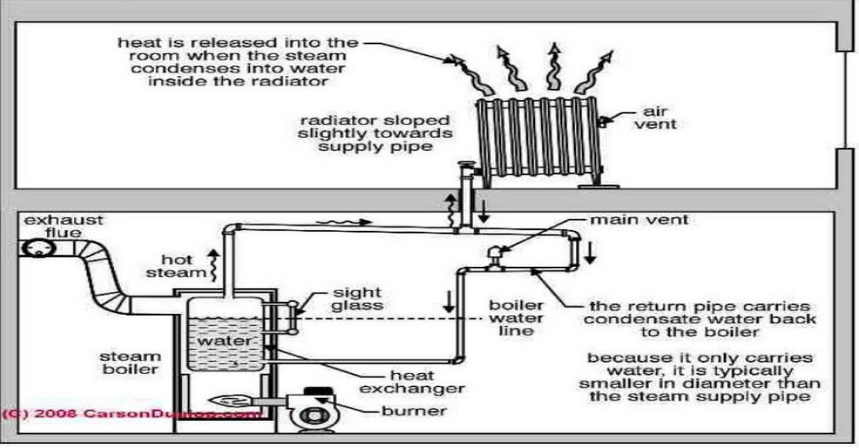
Figure 1. Schematic representation of a steam boiler heating system illustrating the conversion of fuel energy into thermal energy, steam distribution to radiators, heat release into indoor spaces, and condensate return to the boiler.
2. System Configuration, Operating Principle, and Technology Options
The heating subsystem is based on a steam boiler configration, in which fuel or electrical energy is converted into thermal energy inside the boiler to heat water and generate steam. The generated steam is transported through supply pipes to radiators, where heat is released into the indoor space as the steam condenses, while the condensed water is returned to the boiler through a separate return pipe, forming a closed-loop heating cycle [3].
Within this configuration, three steam boiler technologies were considered in the individual analysis: gas-fired, oil-fired, and electric steam boilers. These technologies differ in terms of thermal efficiency, fuel consumption, operational cost, and environmental impact [2]. Gas-fired and oil-fired boilers rely on combustion processes with different fuel properties and combustion performance characteristics [2], whereas electric steam boilers operate without on-site combustion and therefore produce no local CO₂ emissions during operation [1].
3. Failure Behaviour and Maintenance Characteristics
Heating systems are characterised by relatively frequent inspection and maintenance requirements due to mechanical wear and operational stress. Typical maintenance activities include routine inspections, preventive maintenance, component repair, and periodic boiler replacement [3]. Major boiler replacement events restore the system to an initial performance state and can be interpreted as lifecycle reset points. Minor maintenance actions slow down deterioration but do not fully reset the lifecycle of the system.
4. Role within the Integrated System
Failures of the heating subsystem do not directly cause structural system shutdown but can reduce indoor comfort and building usability. Such failures therefore contribute to system-level performance degradation rather than complete system failure. When heating system maintenance activities coincide with interventions in other subsystems, they can be coordinated within a single maintenance window [3]. This maintenance bundling reduces the number of system interruptions and improves overall system availability.
5. Contribution to System-Level Life-Cycle Analysis
The heating subsystem contributes to system-level lifecycle performance through continuous energy consumption and recurrent maintenance demand. While individual heating system failures are generally low in severity, their high frequency leads to cumulative impacts on lifecycle cost and environmental performance. Integrating the heating subsystem into the system-level framework demonstrates how functional subsystems influence trade-offs between availability, cost, and sustainability [1][2].
Refrence
1. Valentina Turanjanin et.al., 2015, Different heating systems for a single family house: Energyand economic analysis, University of Belgrade, 5, 11.
2. Wan Ahmad Najmi Wan Mohamed, 2006, Comparison Of Combustion Performance Between Natural Gas And Medium Fuel Oil At Different Firing Settings, Faculty of
Mechanical Engineering University of Technology MARA, 8, 10.
3. A. Bhatia, 2014, HVAC – Space Heating Systems, CreateSpace Independent Publishing Platform, 9, 13, 21, 23, 24.
Home | introdaction | Integration Context | Maintenance Strategies | Life-cycle Analysis | Multi-Objective Optimizatin