Small-Scale Water Supply System:
Increasing water demand, climate-driven variability, and deteriorating infrastructure continue to strain conventional water supply systems worldwide. As a result, small-scale and modular water treatment solutions have expanded in application for disaster recovery, rural communities, and decentralized infrastructure systems (United Nations Department of Economic Affairs 2025) (Containerized Desalination Plants Market n.d.). These compact systems provide operational flexibility and can be rapidly deployed in environments where centralized utilities are absent or unreliable.
System Overview:
The small-scale water supply system provides clean water through a containerized desalination unit connected to a water storage tank and pipeline distribution to end users. The containerized unit and storage tank are supported by a foundation. The simplicity of the system allows for relatively rapid design and deployment to rural or coastal communities with brackish or saline water (Davis and Lambert 2002). A literature review of reliability of desalination units and civil works associated with storing and transporting potable water was conducted.
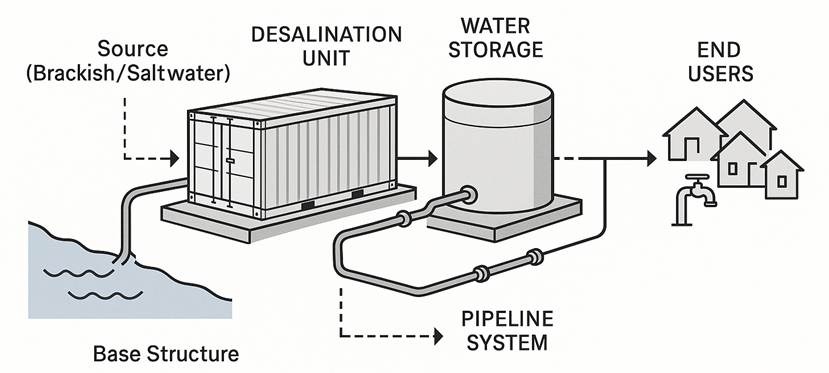
Figure 1: Small-scale water supply system. Image generated using ChatGPT with prompt of the system description.
Subsystem: Water Tank
The functional unit is defined as one water-storage tank subsystem delivering its intended storage function for the full service life of the water supply system, including required service interventions.
A | B | C |
Figure 1. Examples of water storage tank types: HDPE tank (A) and steel tank (B) (Eccles 2023) and Ferrocement Cast-in-place water Tank (C) (UNHCR 2006).
The goal of this life-cycle assessment is to evaluate and compare the environmental impacts associated with three alternative water-storage tank design materials used in a small-scale, decentralized water supply system.
Environmental Performance:
The environmental performance of the three tank design options, HDPE (Option 1), galvanized steel (Option 2), and ferrocement (Option 3), was evaluated using total life-cycle energy consumption and emissions of CO₂, NOx, and VOC. These impact totals were derived from the material-based life-cycle inventory and calculated according to the methodology described in Section 5. The following section summarizes the comparative results and the final ranking obtained using the Analytic Hierarchy Process (AHP).
 |  |
 |  |
Figure 4: Total life-cycle energy consumption and emissions of CO₂, NOx, and VOC of the three tank design options, HDPE (Option 1), galvanized steel (Option 2), and ferrocement (Option 3).
The AHP analysis integrates the four indicators with the comparison of energy consumption, CO₂, NOx, and VOC emissions into a ranking each option.
| Energy | CO₂ | NOx | VOC | |
| Energy | 1 | 4 | 5 | 5 |
| CO₂ | 1/4 | 1 | 3 | 3 |
| NOx | 1/5 | 1/3 | 1 | 2 |
| VOC | 1/5 | 1/3 | 1/2 | 1 |
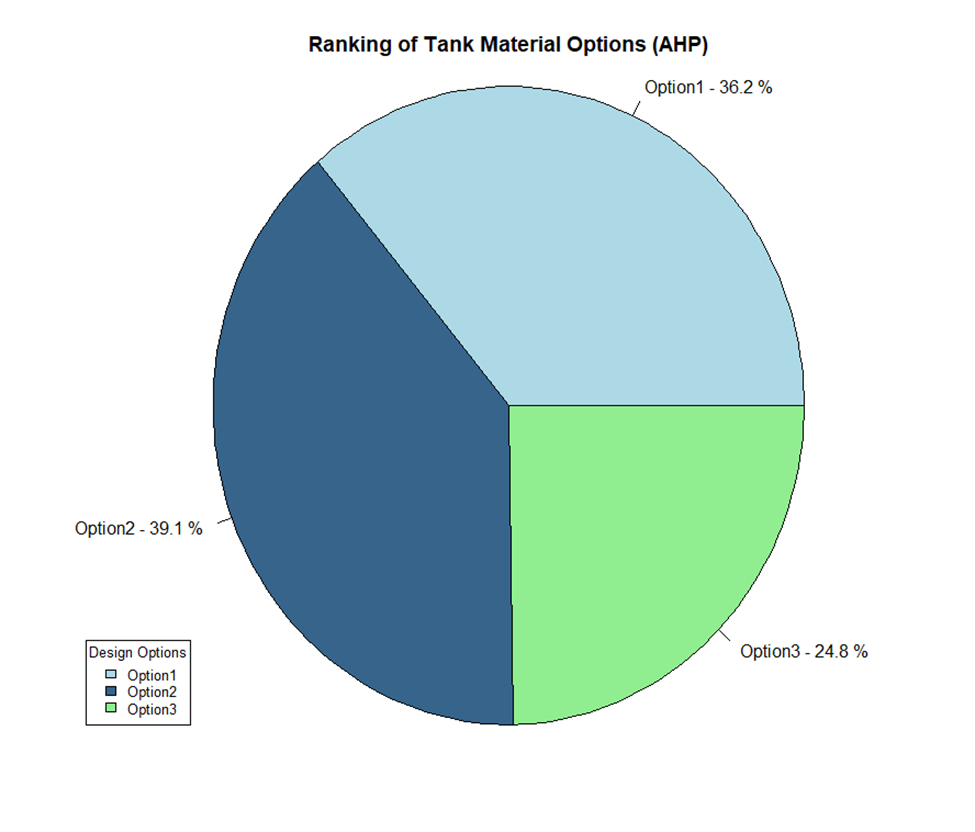
Figure 5: Final ranking derived from AHP analysis of the three tank design options, HDPE (Option 1), galvanized steel (Option 2), and ferrocement (Option 3).
Results:
This assessment demonstrates that while HDPE offers the lowest emissions profile and ferrocement provides long service life, galvanized steel emerges as the preferred option when energy use is weighted most heavily in decision-making. In the field and especially in low resource environments, the most economical option that meets capacity and durability requirements is often selected. However, with the increasing global emphasis on emissions reduction and the growing requirement from donors to document and justify environmental impacts, integrating life-cycle assessment into early design decisions has become essential. This study shows that transparent LCA and multi-criteria evaluation enable more informed, climate-aligned choices, balancing cost, durability, and environmental responsibility.
References:
Davis, Jan, and Robert Lambert. 2002. Engineering in Emergencies: A Practical Guide for Relief Workers (2nd ed.). Warwickshire, UK: Intermediate Technology Publications Ltd.
Eccles, Alek. 2023. Water Tank Specification Tables. Accessed 11 8, 2025. https://www.ntotank.com/blog/water-tank-specification-tables?srsltid=AfmBOoo3OEl9d60ibeYyjZKlXn_JKbo3oTPnY8Kx1d2dywy5C7Aye7s6.
German Federal Ministry of the Interior, Building and Community. 2024. Oekobaudat: Life Cycle Assessment Database for Construction Materials. Accessed 11 5, 2025. https://oekobaudat.de/.
Rashid, Abu Reza M, and et.al. 2021. “Life cycle assessment of rainwater harvesting system components – To.” Journal of Cleaner Production 326.
Saaty, Thomas L. 1980. The Analytic Hierarchy Process: Planning, Priority Setting, Resource Allocation. New York: McGraw-Hill.
Sendanayake, Sisuru. 2016. “LIFE CYCLE ANALYSIS OF FERRO-CEMENT RAINWATER TANKS IN SRI LANKA: A comparison with RCC and HDPE tanks.” International Journal of Advances in Engineering Research (International Journal of Advances in Engineering Research) 12 (II): 30-42.
UNHCR. 2006. Large Ferrocement Water Storage Tank. Technical Support Section, Division of Operational Support.
United Nations Department of Economic Affairs. 2025. “. The Sustainable Development Goals Report 2025. New York. (revision August 2025).”
Next >