Introduction
Ontology can be defined as an explicit, formal specification of concepts within a domain and the relationships among them [1]. It provides a shared vocabulary for researchers and systems that need to exchange information in a structured and machine-interpretable way [1]. Ontologies enable knowledge sharing, reuse, and semantic interoperability by making domain assumptions explicit and separating conceptual knowledge from operational details [1].
In computer science, ontological models are typically represented using Description Logics (DLs), a family of knowledge representation languages that form the theoretical foundation of the OWL Web Ontology Language standardized by the World Wide Web Consortium (W3C) [2]. DLs allow the precise definition of classes, relationships, and individuals, supported by formal semantics that enable logical reasoning and inference from stated facts [2].
In this project, we develop a concise ontology to model domain-specific concepts and their logical relations using the Protégé environment. The goal is to demonstrate how abstract relationships in a knowledge domain can be represented and reasoned upon through axioms, providing a structured conceptual framework applicable to real-world civil and building system design.
Ontology Scope
The main objective of this ontology is to provide a conceptual framework for understanding and analyzing flat roof systems within the broader building envelope system. The ontology allows engineers to formally represent and reason about the relationships between structural components, functional layers, and materials, ultimately supporting more informed design and material selection decisions.
The scope of this ontology focuses on the essential components of flat roof systems, including Roof Type, Roof Use, Roof Domain, and Roof Main Material.
The model is developed using Description Logic within the Protégé environment, following formal modeling principles to clearly define logical relationships between the concepts [2].
This framework can also be extended to other subsystems of buildings, such as exterior walls or flooring systems.
The intended users of this ontology are civil and structural engineers, architects, researchers in building system modeling, and developers of BIM and LCA tools.
These users can employ the ontology to document engineering knowledge, integrate data across analytical tools, and improve interdisciplinary collaboration [1].
The intended use of the ontology is to support engineering decision-making in the design, material selection, and performance analysis stages of roof systems.
By linking key functional aspects such as thermal insulation, waterproofing, and structural behavior, the ontology provides a foundation for optimizing both technical and environmental performance of roof systems.
Objective and Methodology
The objective of this study is to develop an engineering ontology that represents the technical knowledge of flat roof systems within the broader Building Envelope System.
The designed model formally represents and reasons about the logical relationships between the main components of a roof system. The ontology consists of five main classes:
- RoofType: Represents the structural form of the roof (e.g., reinforced concrete, ribbed slab, or composite deck).
- RoofUse: Describes the building function where the roof is applied (e.g., residential, commercial, or industrial).
- RoofDomain: Defines the functional layers of the roof, such as structural, insulation, waterproofing, or finishing layers.
- RoofMainMaterial: Refers to the primary materials used in each layer of the roof.
- Designed Roof: Represents the conceptual configuration of roof design alternatives, combining structural, material, and functional components within the roof system.
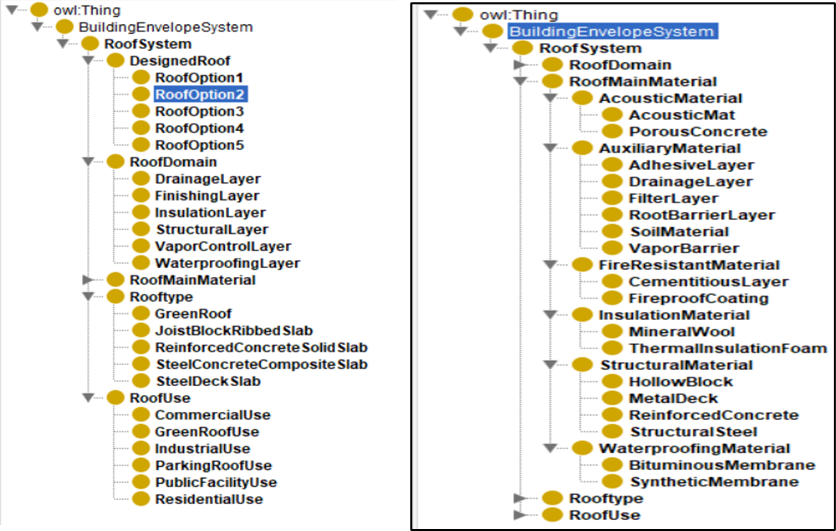
The ontology development process followed standard guidelines [1, 2]. The model scope was first defined, and the class hierarchy was constructed in the Protégé environment. Logical relations (Object Properties) and semantic constraints (Axioms) were then established to enable automated reasoning. For the design of roof types and material classes, data and references from studies on the durability of structures, life-cycle analysis (LCA), and composite material behavior were applied [5–9]. These references helped define the logical categorization and connection between roof types, performance aspects, and materials. Overall, the model provides a conceptual framework for performance assessment and design decision-making in roof systems, with potential extension to other building subsystems such as walls or floors.
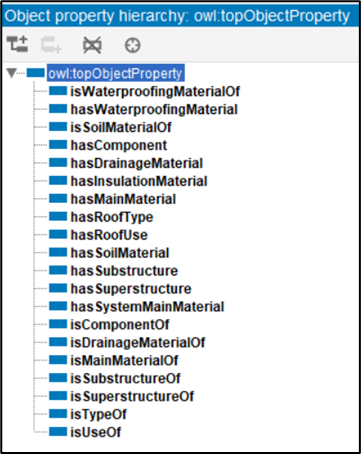
The object properties define the logical connections between the main ontology classes. As shown in the hierarchy, each property describes a specific relationship such as hasMainMaterial, hasRoofType, or hasInsulationMaterial, linking the RoofDomain to its related components. The corresponding table specifies the domain, range, and inverse property, ensuring bidirectional reasoning between classes during ontology inference.
| Property | Domain | Range | Inverse of |
| hasMainMaterial | RoofDomain | RoofMainMaterial | isMainMaterialOf |
Analysis and Results
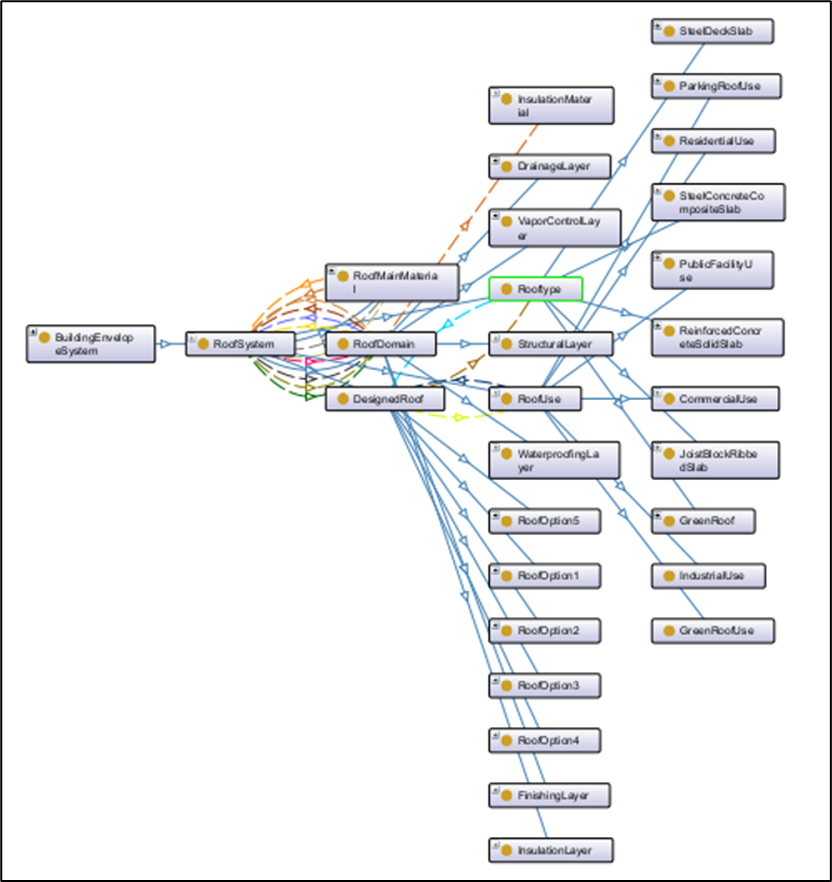
At this stage, the designed model was verified and validated through the execution of the reasoning process. By activating the reasoner, the relationships among classes and object properties were correctly identified and inferred. The results showed that each roof design option (such as RoofOption1 or RoofOption5) is automatically linked to appropriate materials, roof types, and functional uses. The final graph visually represented the hierarchical structure of the roof system and confirmed the logical consistency of the model. This structure enables engineers to analyze various design combinations and conceptually explore the interconnections among layers and materials.
Engineering Applications Examples
Retrofitting Aging Roof Structures with Smart Materials
Scenario:
Many existing buildings still rely on outdated, heavy roofing systems with poor thermal performance and low durability. These roofs often contribute to excessive energy consumption and structural stress, especially in aging infrastructures.
Use Case:
The developed ontology supports engineers in identifying compatible modern materials such as composite slabs, reflective membranes, and phase-change insulation. By linking material properties to roof layers and structural systems, the ontology enables knowledge-based decision-making in retrofitting design. This enhances energy efficiency, structural safety, and overall performance while maintaining material compatibility.
Integration of Green and Blue Roofs in Urban Drainage Management
Scenario:
Urban areas increasingly face problems related to heavy rainfall and stormwater management. Green and blue roofs have emerged as sustainable solutions to mitigate runoff and improve urban microclimates.
Use Case:
The roof ontology defines the relationships between drainage layers, soil materials, waterproofing membranes, and vegetation systems. By integrating these elements, the ontology helps engineers simulate and evaluate hydrological performance before implementation. This structured knowledge supports the design of resilient and eco-efficient urban roof systems aligned with sustainable drainage strategies.
Integration of Roof Ontology into Circular Economy Assessment
Scenario:
With the growing emphasis on sustainability, the recyclability and disassembly potential of construction materials are becoming key performance indicators in building design.
Use Case:
The ontology explicitly connects roof materials (e.g., reinforced concrete, steel, insulation, membranes) with their physical properties, reusability, and recyclability. It provides a structured framework for assessing end-of-life scenarios, supporting Life Cycle Assessment (LCA) and Circularity Scoring of roof systems. This integration enables engineers to design roofs that are not only efficient during use but also resource-responsible after deconstruction.
Referenecs
[1] Noy, N. F., & McGuinness, D. L. (2001). Ontology Development 101: A Guide to Creating Your First Ontology. Stanford Knowledge Systems Laboratory Technical Report KSL-01-05.
[2] Krötzsch, M., Simančík, F., & Horrocks, I. (2013). A Description Logic Primer. University of Oxford. arXiv:1201.4089v3.
[3] fib Bulletin 34. (2006). Model Code for Service Life Design. Fédération Internationale du Béton (fib).
[4] Kim, S., & Yoon, J. (2009). Condition Rating of Reinforced Concrete Bridge Decks. Journal of Performance of Constructed Facilities, ASCE.
[5] Oh, B. H., et al. (2017). Reliability Assessment of RC Slabs under Environmental Exposure. Construction and Building Materials, 135, 1–10.
[6] Chen, Z., et al. (2019). Performance Deterioration of Composite Slabs under Fatigue and Corrosion. Engineering Structures, 196, 109257.
[7] ISO 13823. (2008). General Principles on the Design of Structures for Durability. International Organization for Standardization.
Main | Introduction | Individual Systems | Integration Context | Combined Ontology | Combined Parametric Model | Analysis and Conclusions | References