Within this scenario, maintenance parameters are defined in accordance with the crew based
organization strategy introduced earlier. The maintenance intervals and activity ranges are adjusted
compared to the first scenario to reflect the grouping of interventions based on required expertise, while
remaining within the limits recommended in literature or commonly accepted in practice.
| Subsystem | Surface Repair | Major Repair/ Rehabitation | Replacement |
| Gravity Retaining Wall | 15-55 | 55-65 | 40-45 |
| ETICS | 20-65 | – | 55-65 |
| Cantilever Retaining Wall | 15-55 | 30-50 | 45-55 |
| Hardwood Flooring | – | 20-25 | 45-55 |
| Concrete Beam with Hollow Floor Slab | 20-25 | 25-50 | – |
As shown in table 2.a , the maintenance intervals are derived based on the frequency values obtained from the preliminary grouping exercise carried out within the allowed limits. Since each subsystem operates within certain acceptable boundaries, radical changes to the maintenance ranges were not possible. Nevertheless, this alternative strategy introduces a different organizational perspective, and its impact on the overall system behavior will be evaluated in the subsequent analysis.
Table 2.b presents the assumed durations of the maintenance activities. As no changes were made to the nature or execution of the maintenance works themselves, the duration values remain unchanged compared to the first scenario.
| Subsystem | Surface Repair | Major Repair/ Rehabitation | Replacement |
| Gravity Retaining Wall | 2 | 10 | 5 |
| ETICS | 3 | – | 5 |
| Cantilever Retaining Wall | 3 | 10 | 20 |
| Hardwood Flooring | – | 5 | 25 |
| Concrete Beam with Hollow Floor Slab | 8 | 25 | – |
Based on the preliminary analysis, figure 2.a illustrates how the crew based approach is reflected
in both separated and combined maintenance timelines, using the defined maintenance ranges and frequency values. It can be observed that activities requiring similar crew expertise tend to be clustered in comparable time periods. In particular, maintenance interventions for the two retaining wall systems
show a tendency to occur in similar years due to their shared geotechnical requirements. A comparable
pattern can also be identified for certain replacement activities and reinforced concrete building elements that require the involvement of concrete crews. Similarly, finishing related works such as
surface treatments, insulation, and flooring activities tend to align in time
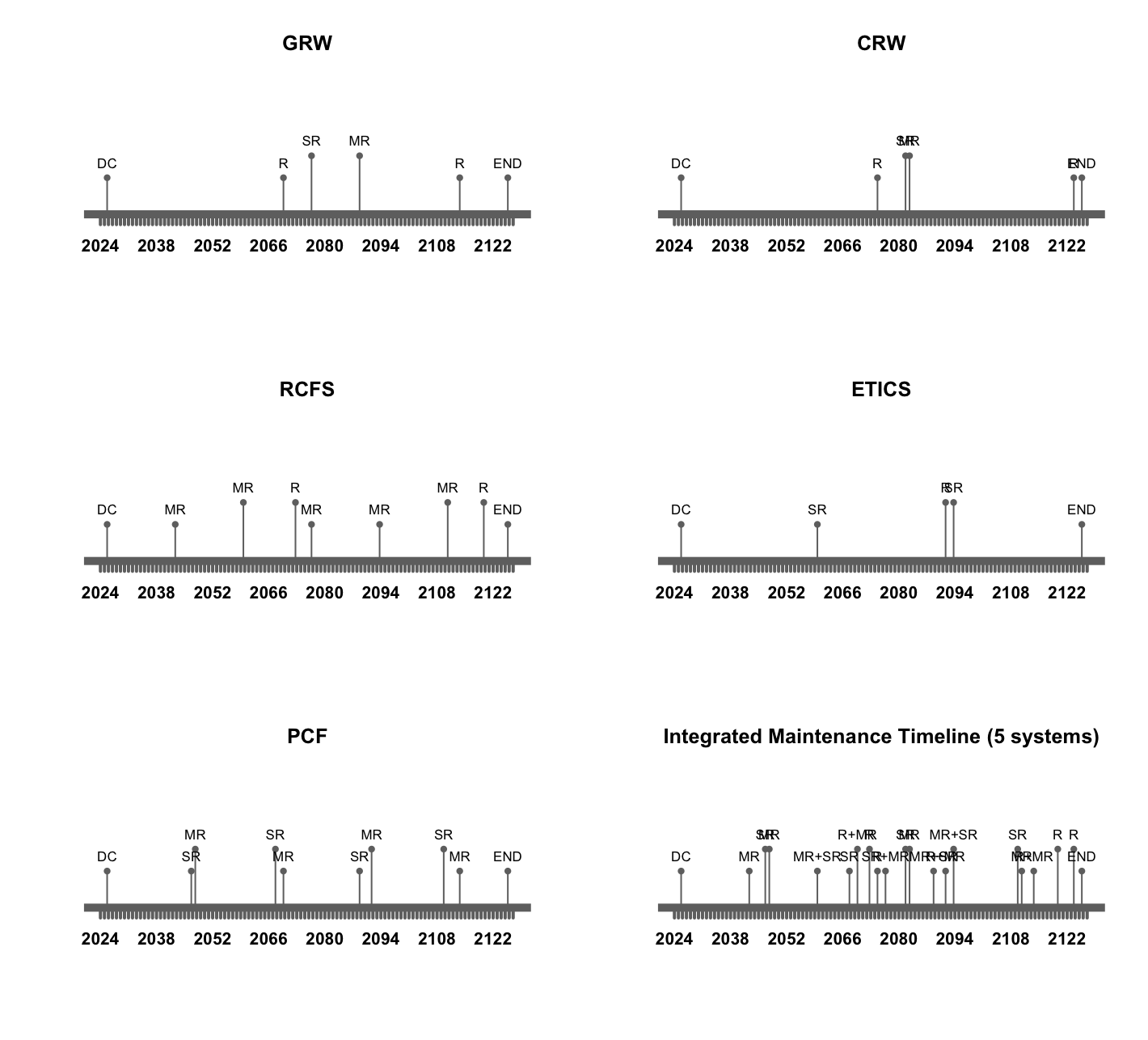
At this stage, the purpose of this exercise is not to define a final or fixed maintenance schedule. Instead, a coarse, strategy driven planning concept is used to provide an initial representation of how the proposed crew based organization may influence the temporal alignment of maintenance activities. This preliminary timeline serves as a reference for understanding how the adjusted ranges and frequencies may lead to different feasible alternatives in later analyses and how these alternatives will behave within the multi objective evaluation framework.
Home | System Definition | Scenario 1 | Scenario 2 | Scenario 3 | Scenario 4 | Discussion | Appendix