Figure 2.b illustrates the solution space obtained from the maintenance strategy optimization carried out within the framework of the initial maintenance ranges and frequencies defined using the crew based strategy. As in the first scenario, the optimization is evaluated based on the total system interruption duration and the minimum time spacing between maintenance interventions.
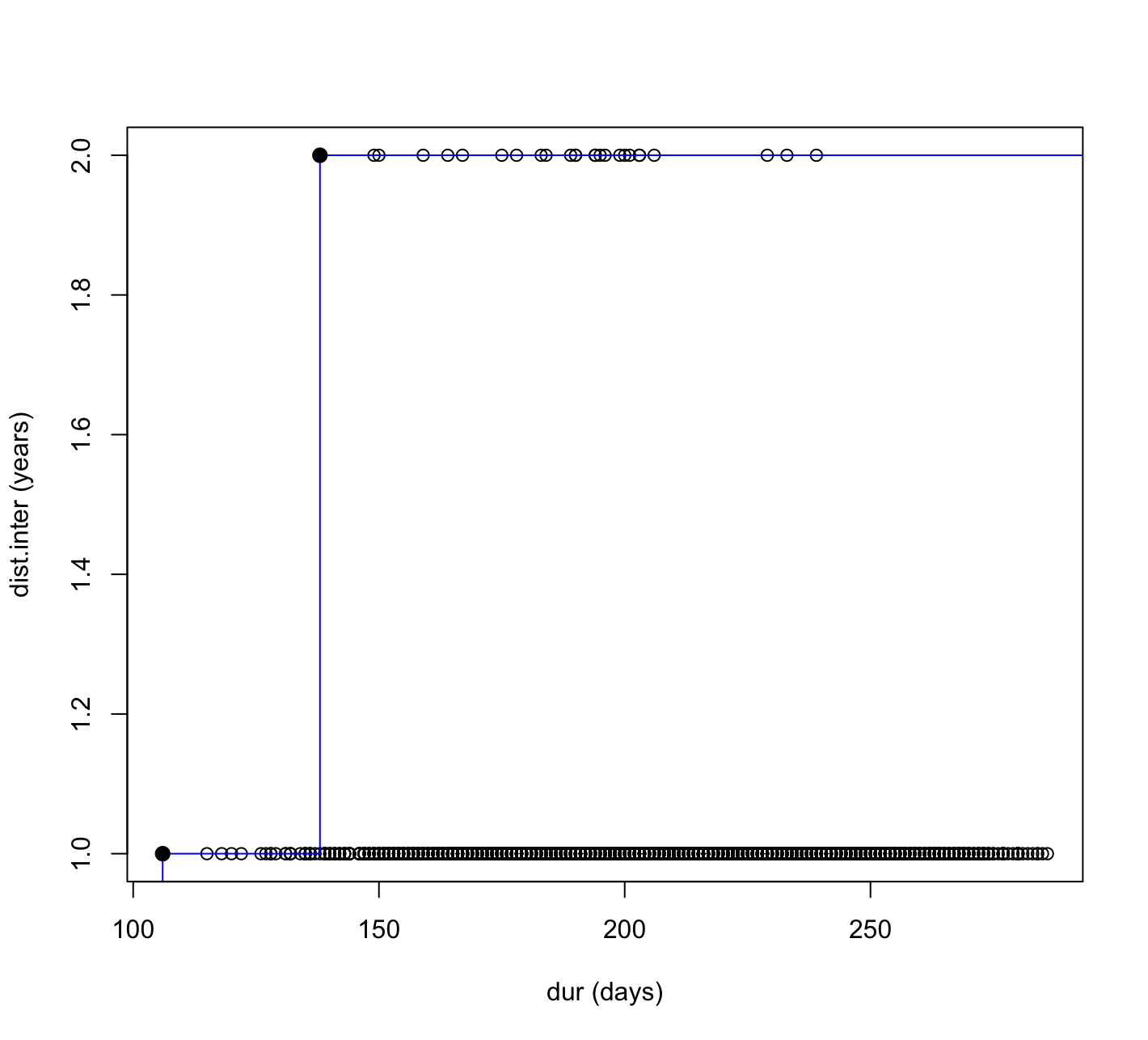
Within the allowed ranges derived from the underlying maintenance strategy, a total of 163 different alternatives were generated. This corresponds to approximately a 20% increase compared to the first scenario, which can be attributed to the increased flexibility introduced by the crew based approach in defining initial maintenance intervals. However, despite the larger number of generated alternatives, no significant change is observed in the overall system behavior. The majority of the solutions are still clustered around a minimum spacing of one year, forming a wide solution space. At the same time, although more alternatives are generated, the number of Pareto optimal solutions is slightly reduced..
When two representative alternatives are examined in more detail, it becomes evident that they correspond to different maintenance organization approaches. The alternative with a minimum spacing of one year and a total system interruption of 106 days represents a configuration in which maintenance activities are performed more frequently but with shorter individual durations. In contrast, the alternative with a minimum spacing of two years and a total interruption of 138 days reflects a strategy in which maintenance activities are less frequent but grouped into longer intervention periods. This comparison clearly shows that maintenance frequency alone does not directly determine the total service interruption.
Overall, the crew based strategy does not directly change the optimization objectives or the performance indicators. Instead, it defines the initial maintenance ranges and frequencies by grouping activities based on crew expertise. This modifies the set of feasible alternatives explored by the optimization without altering the optimization logic itself. As a result, the overall system behavior remains largely similar, while the decision space becomes broader and offers increased flexibility for maintenance planning.
LCA & Multi-Objective Analysis >>
Home | System Definition | Scenario 1 | Scenario 2 | Scenario 3 | Scenario 4 | Discussion | Appendix