This study adopts a system-level analytical approach to investigate the failure behaviour and maintenance planning of a station system composed of multiple interacting subsystems. The methodology integrates deterministic failure timeline modelling, system-level maintenance coordination, and performance-based evaluation to support subsequent life-cycle and optimization analyses. Component-level maintenance timelines are subsequently integrated into a unified system-level representation by aligning intervention events along a common time axis. When maintenance actions of multiple subsystems occur simultaneously or within the same planning window, these interventions are treated as concurrent system-level events. A maintenance bundling assumption is applied, whereby overlapping interventions are executed within a single system downtime window, enabling realistic estimation of system-level interruption durations.
2. Integrated Failure and Maintenance Analysis
Based on this integrated timeline, alternative maintenance strategies are evaluated using maintenance-specific performance indicators. The outcomes of this section provide the input for the life-cycle and multi-objective optimization analyses.
2.1 Component-Level Failure and Maintenance Timelines
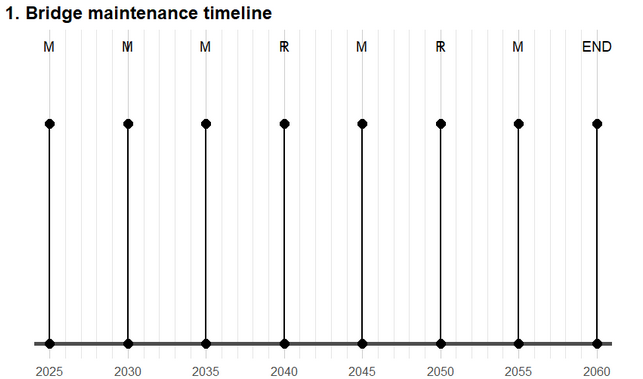
To capture the long-term behaviour of the station system, failure and maintenance timelines were developed for all major subsystems, namely the bridge structure, boiler/heating system, floors, stairs and platforms, and partition walls. Each subsystem exhibits distinct deterioration mechanisms and operational characteristics, which are reflected in subsystem-specific failure events and maintenance requirements. The bridge subsystem is characterised by progressive deterioration leading to major failure events over the service life. Its failure timeline includes early deterioration phases, extended failure periods, and major failure events, reflecting the critical structural role of the bridge.
Figure 1: Failure and maintenance timeline of the bridge subsystem
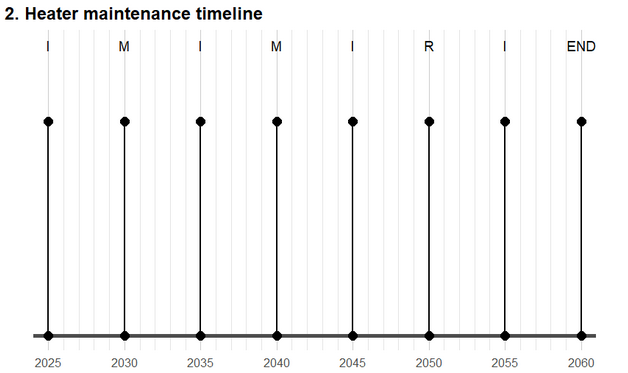
The boiler subsystem exhibits comparatively frequent failure events due to its mechanical nature and operational intensity. These failures are distributed across the service life and require repeated corrective interventions.
Figure 2: Failure and maintenance timeline of the boiler subsystem.
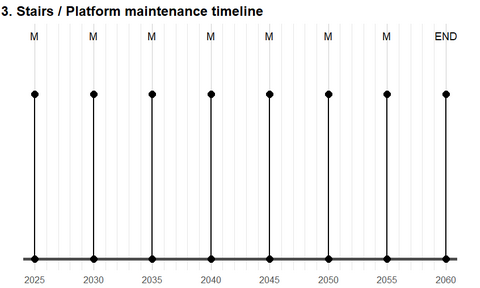
The stairs and platform subsystem is primarily affected by early deterioration and isolated failure events, reflecting its robust design and lower functional complexity compared to mechanical or primary structural components.
Figure 3: Failure and maintenance timeline of the stairs and platform subsystem.
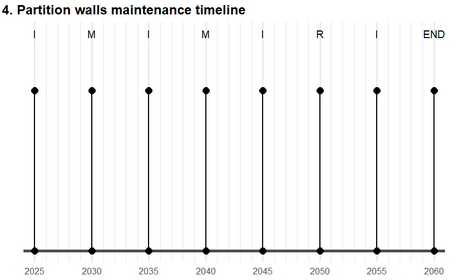
The partition wall subsystem exhibits limited failure events occurring later in the service life, consistent with its non-structural role and lower exposure to critical loading conditions.
Figure 4: Failure and maintenance timeline of the partition wall subsystem.
The floor was considered as a concrete platform, and the stairs were considered as a system intended for maintenance access.
2.2.Integrated System-Level Failure Timeline
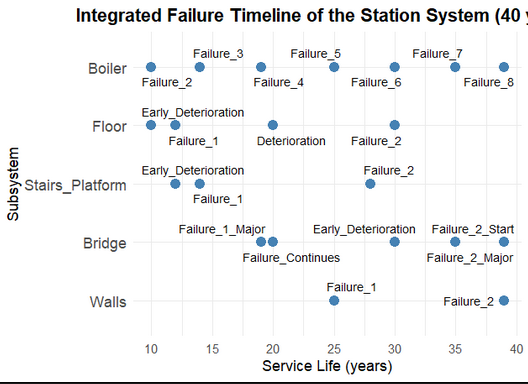
The individual subsystem failure timelines were integrated into a unified system-level failure timeline by aligning all failure and deterioration events along a common temporal axis. This integration enables the identification of periods during which multiple subsystems experience deterioration or failure simultaneously.
Figure 5: Integrated failure timeline of the station system over a 40-year service life.
3. Maintenance Strategy Design Space
Alternative maintenance strategies were formulated for the station system. Maintenance strategies are defined by varying the timing and frequency of maintenance interventions for each subsystem, including inspections, minor maintenance actions, and major repair or replacement activities. Each maintenance strategy represents a unique combination of intervention intervals applied consistently across all subsystems over the system lifetime. These combinations define a multidimensional maintenance design space, within which system-level performance can be evaluated.
4. Maintenance Performance Indicators
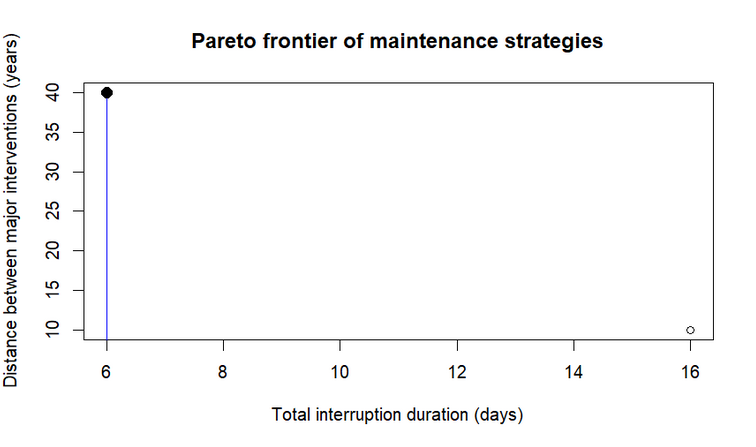
To assess and compare alternative maintenance strategies, two system-level maintenance performance indicators were defined:Total interruption duration, representing the cumulative system downtime over the service life, accounting for bundled maintenance interventions.Minimum distance between major interventions, representing the shortest time interval between successive major maintenance or repair events at the system level.
5. Pareto Screening of Maintenance Strategies
All maintenance strategies within the design space were evaluated using a Pareto-based screening approach based on the defined maintenance performance indicators.A strategy is classified as non-dominated if no other strategy achieves a lower total interruption duration while simultaneously increasing the minimum distance between major interventions.The resulting Pareto-optimal maintenance strategies define the feasible envelope of optimal system-level maintenance performance and are retained as inputs for subsequent life-cycle environmental assessment and multi-objective optimization analyses.
Figure 6: Pareto frontier illustrating the trade-off between total interruption duration and minimum distance between major maintenance interventions.