Summary
This project presents an ontology for modeling hotel infrastructure and resource interactions within a civil systems engineering context. The ontology models the hotel as a resource-aware civil system, explicitly linking structural components, building service systems, resource flows, and users within a single semantic framework.
The goal is to support an integrated understanding of how physical structure, systems, and resources interact in hotel buildings, especially at early design and evaluation stages.
Domain
The ontology focuses on hotel buildings as integrated engineering systems. It includes:
- HotelBuilding: the overall building that connects all other parts of the ontology.
- PhysicalComponent: Includes all tangible building elements. It has two sub-systems:
- Structural components – beam, column, slab, and foundation.
- Architectural components – wall, door, window, and other parts.
- BuildingSystem: covers service systems such as HVAC, water supply, electrical, and wastewater systems.
- Resource: represents water, electricity, and fresh air that flows through the building.
- BuildingUser: includes the people using or maintaining the hotel such as guests, staff, and maintenance teams.
Purpose
The purpose of the ontology is to represent hotel infrastructure in a structured and explicit way. Relationships between components, systems, resources, and users are formally defined to support conceptual comparison of design options and understanding of building-level resource use.
Scope
The ontology captures structural elements, service systems, and their interactions with resources and users. It includes hierarchical decomposition of physical components, system classifications, and logical relationships defined through object properties and constraints.
Two hotel design options are instantiated with different parameter values, allowing comparison within the same logical model.
Intended User and Intended Use
The ontology can be used by civil and building systems engineers, facility managers, and researchers concerned with how hotel structures and systems are organized. It is used to represent the relationships of building components, systems, resources, and users, and compare different hotel design configurations at the conceptual level.
Ontograph
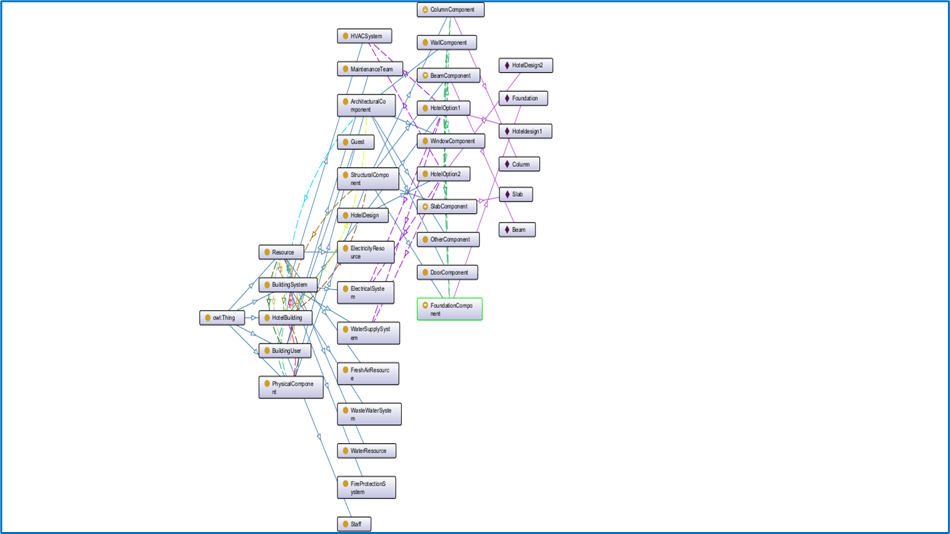
The OntoGraph illustrates the semantic structure of the hotel infrastructure ontology by showing how building components, service systems, resources, and users are interconnected within a single framework. It highlights the relationships between physical elements such as beams, slabs, walls, and foundations with operational systems like HVAC and electrical services. Resource flows, including electricity and water, are linked to both building systems and users, reflecting the hotel as an integrated civil engineered system. This visualization supports clearer understanding of dependencies and enables logical reasoning across different design options and system interactions.
Environmental Interfaces
The ontology connects with several digital and analytical environments used in civil engineering:
Building Information Modeling: The ontology can connect with BIM to import data like geometry, materials, etc. For example, a class of physical components, such as foundation, slab, beam, column, can get its properties from BIM data.
Life Cycle Assessment: The ontology can link with LCA software to estimate environmental impact. This enables engineers to assess the life cycle impact of different hotel design options.
IoT and facility management systems: Such an ontology will be able to connect to an IoT or any facility management system to monitor its actual performance in real time. For example, the class BuildingSystem consisting of HVAC, water and electrical systems will receive real-time data through installed sensors about energy use, airflow or temperature.
Engineering Examples
Here are the engineering examples with their specific scenario and use case:
Energy Efficiency Optimization
Scenario: A hotel wants to reduce energy consumption by retrofitting old, inefficient HVAC and electrical systems.
Case: The ontology helps locate all systems linked to Electricity and Fresh air, which engineers can compare the efficiency parameters and choose improved configurations.
Material Reuse in Renovation
Scenario: A remodeling project wants to reuse structural elements to reduce its embodied carbon.
Use: The ontology identifies components such as slabs, beams, and columns that can be reused and links them with material data to evaluate circular design.
Engineering Reflections and Limitations
The ontology shows how building information can be structured to represent relationships between components, systems, resources, and users, supporting early-stage lifecycle thinking in civil systems engineering. However, the model focuses on conceptual structural and system relationships and does not include detailed quantitative analysis, real-time operational data, or external environmental factors such as climate or regional energy sources.
Conclusion
The ontology demonstrates how semantic modeling can represent a real engineering system such as hotel infrastructure and its relationship with resources. Future work could extend the model by linking it with BIM, LCA, and IoT systems to enable quantitative analysis, real-time monitoring, and support the development of a digital twin for design and operation analysis.
References
- Singh AB, Mishra Y, Yadav S. Toward Sustainability: Interventions for Implementing Energy-Efficient Systems into Hotel Buildings. Engineering Proceedings. 2024; 67(1):80. https://doi.org/10.3390/engproc2024067080
- Buonicore, A.J. (2024). Energy Savings Calculations for Commercial Building Energy Efficiency Upgrades (1st ed.). CRC Press. https://doi.org/10.1201/9781032692777
- Eastman, Charles M. BIM handbook: A guide to building information modeling for owners, managers, designers, engineers and contractors. John Wiley & Sons, 2011.
- Zhang, Jiansong, and Nora M. El-Gohary. “Semantic NLP-based information extraction from construction regulatory documents for automated compliance checking.” Journal of computing in civil engineering 30.2 (2016): 04015014. https://doi.org/10.1061/(ASCE)CP.1943-5487.0000346