1 Introduction
Design decisions made during early project stages strongly influence the long-term environmental and economic performance of civil engineering structures. Parking deck slabs are particularly critical because they are among the most material-intensive components of multi-story parking facilities, are exposed to repetitive vehicle loading and environmental action, and require periodic maintenance to maintain safety and serviceability. Due to their large surface area and material volume, they contribute substantially to embodied energy, emissions, and life-cycle cost.
This study evaluates the life-cycle performance of a 50 m × 20 m concrete parking deck slab by comparing three structural alternatives: a GFRP composite layer slab (Option 1), a prefabricated reinforced concrete slab (Option 2), and a cast-in-place reinforced concrete slab using C30/37 concrete (Option 3). Life-Cycle Assessment (LCA) is applied to quantify total energy consumption and emissions of CO₂, NOx, and SO₂ over an assumed 70-year service life. These results are then integrated using the Analytical Hierarchy Process (AHP) to provide a multi-criteria sustainability ranking.
The environmental assessment includes raw material extraction, material processing, fabrication, construction, and maintenance interventions. Economic implications are indirectly captured through intervention frequency and replacement cycles. The objective is to support engineering decision-making by identifying how different slab systems perform over their entire life cycle, considering both durability and environmental impact.
2 Goal and Scope Definition
2.1 Goal of the Study
The main goal is to evaluate and compare the environmental and economic performance of three parking deck slab systems over their service life. The analysis focuses on understanding how material strategies and construction methods influence energy demand, CO₂, NOx, and SO₂ emissions, as well as long-term durability. The assessment supports decision-making by identifying the slab alternative that provides the best balance between environmental impact, durability, and performance.
2.2 System Description
The subsystem investigated is a single parking deck slab with dimensions 50 m × 20 m, representing a typical level in a parking facility. All options adopt a uniform thickness of 0.25 m, resulting in a slab area of 1,000 m².
| Design Option | Description | Thickness |
| Option 1 | GFRP composite layer slab | 0.25 m |
| Option 2 | Prefabricated concrete slab | 0.25 m |
| Option 3 | C30/37 cast-in-place RC slab | 0.25 m |
2.3 Functional Unit
The functional unit is defined as one parking deck slab of dimensions 50 m × 20 m over its assumed service life. This ensures all alternatives are compared on an equivalent structural and functional basis.
2.4 System Boundary
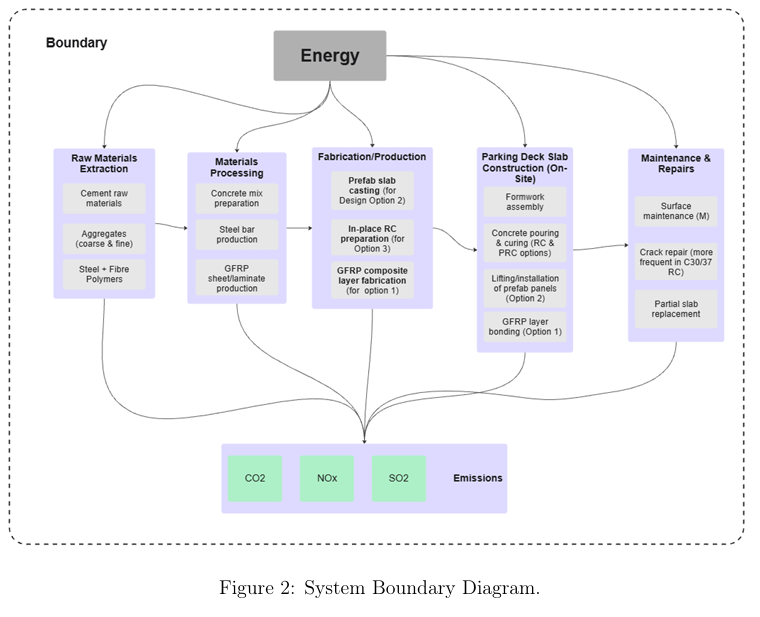
A cradle-to-maintenance approach is applied. The boundary includes raw material extraction, material processing, fabrication and production, on-site construction, and maintenance and repair interventions throughout the service life. End-of-life demolition and recycling, operational energy of the parking facility, and vehicle-related emissions during use are excluded.
3 Design Options and Maintenance Interventions
Three slab systems were evaluated using LCA and life-cycle costing logic. Maintenance timelines were generated using a Shiny application, producing intervention schedules that form the basis of the life-cycle inventory.
3.1 Overview of Intervention Strategies
| Design Option | Event Type | Frequency (years) | Interpretation |
| 1. GFRP Composite Deck | M | 20 | Low routine maintenance |
| PR | 35 | Occasional partial rehabilitation | |
| DR | 70 | Full replacement | |
| 2. Precast RC Deck (PRC) | M | 10 | Moderate maintenance |
| PR | 25 | Panel-level replacement | |
| DR | 60 | End-of-life replacement | |
| 3. Cast-in-Place RC Deck | M | 5 | Most frequent maintenance |
| SDO | 15 | Shallow deck overlay | |
| DR | 30 | Full replacement twice |
The GFRP deck represents the lowest maintenance alternative due to corrosion resistance and improved fatigue behavior. The PRC deck exhibits moderate intervention requirements associated with prestressing systems and panel joints. The cast-in-place RC deck shows the highest intervention density, reflecting cracking, chloride ingress, reinforcement corrosion, frequent overlays, and two full slab replacements within the 70-year analysis period.
4 Methodology
4.1 Model Structure and Data Sources (LCI)
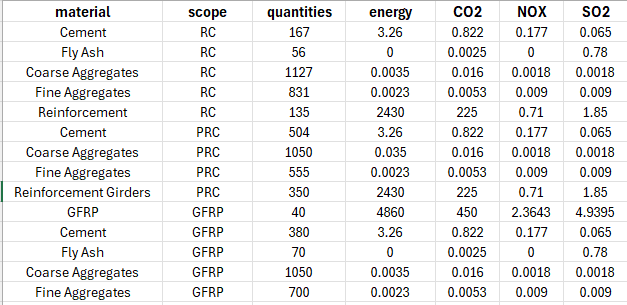
A Life-Cycle Inventory dataset was prepared in CSV format containing embodied energy values (MJ/kg), emission factors (CO₂, NOx, SO₂ in kg/kg), and material quantities for each design option. The R model calculated total material demand using slab geometry and applied intervention frequencies derived from the Shiny timelines. These were converted into intervention multipliers of 1.0 for GFRP, 1.5 for PRC, and 2.5 for RC to represent recurring maintenance-related material use.
4.2 Life Cycle Assessment (LCA)
The LCA computed total energy consumption and emissions of CO₂, NOx, and SO₂ over the full 70-year service life. An R function combined geometric volume, LCI intensities, and intervention multipliers to estimate cradle-to-maintenance impacts, including material production and replacement cycles.
4.3 Multi-Criteria Decision Analysis (AHP)
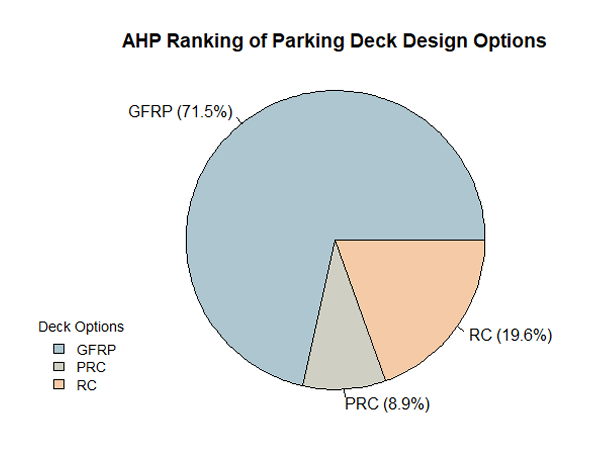
Environmental indicators were integrated using the Analytical Hierarchy Process. Pairwise comparison matrices were constructed following Saaty’s 1–9 scale. Energy and CO₂ were assigned higher importance, while NOx and SO₂ received medium weights. Eigenvector-based weighting produced alternative priorities, which were combined with criteria weights to generate final sustainability scores.
5 Results and Discussion
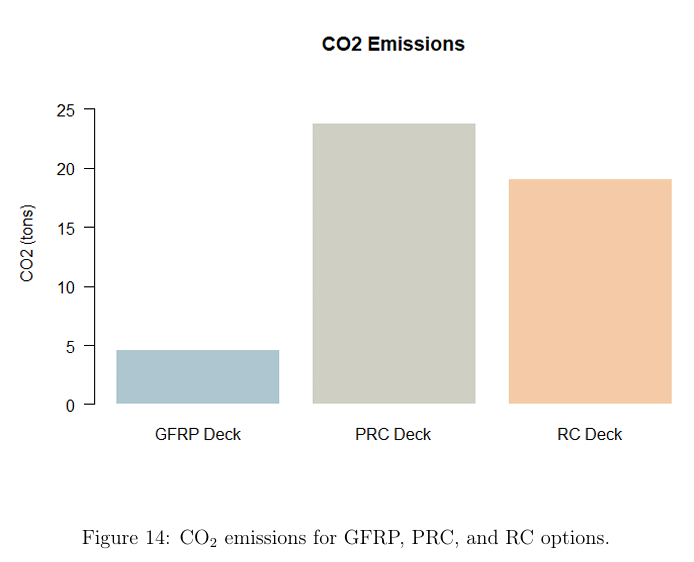
The LCA results demonstrate clear differences among the three alternatives. The GFRP deck exhibits the lowest life-cycle energy demand at approximately 50,000 MJ, significantly below RC (205,000 MJ) and PRC (260,000 MJ). This is attributed to reduced material intensity and minimal intervention requirements. The PRC deck shows the highest energy demand due to prestressing steel, factory-cast sections, and moderate intervention frequency. The RC deck performs between the two but is penalized by frequent maintenance and two full reconstructions.
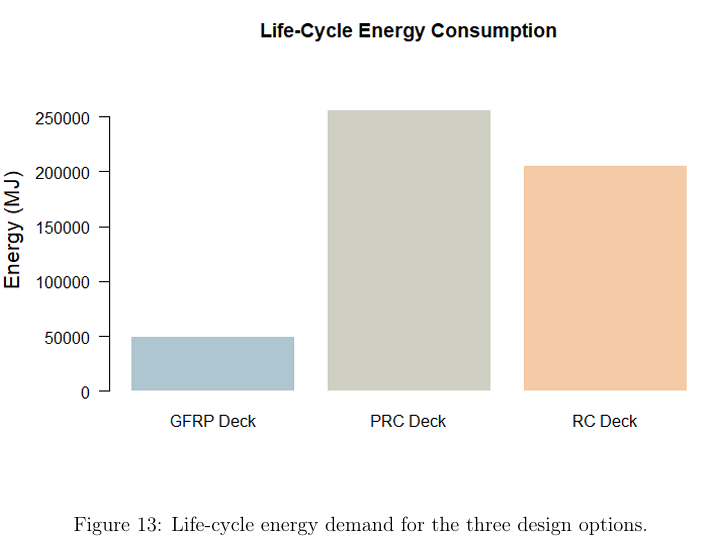
CO₂ emissions follow a similar trend. The GFRP option emits approximately 4.7 tons, compared to 19.2 tons for RC and 23.7 tons for PRC. Reduced concrete volume and the absence of steel replacement cycles contribute to the favorable GFRP profile. PRC produces the highest CO₂ emissions due to prestressing reinforcement and embodied cement impacts.
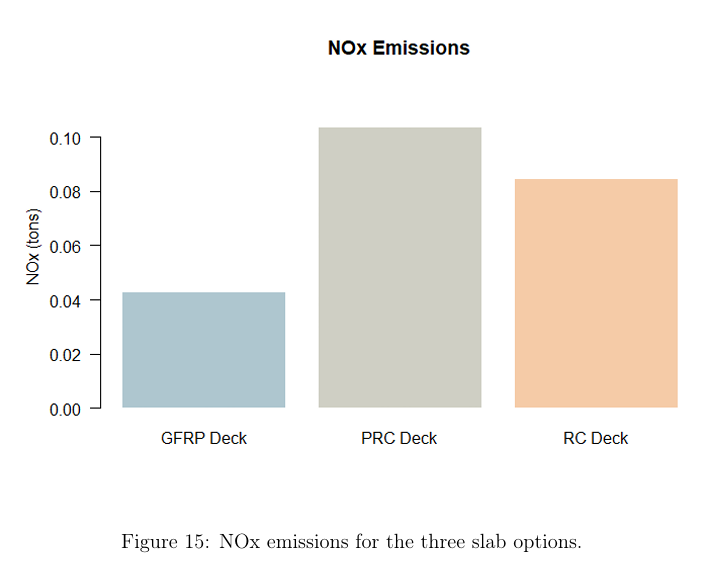
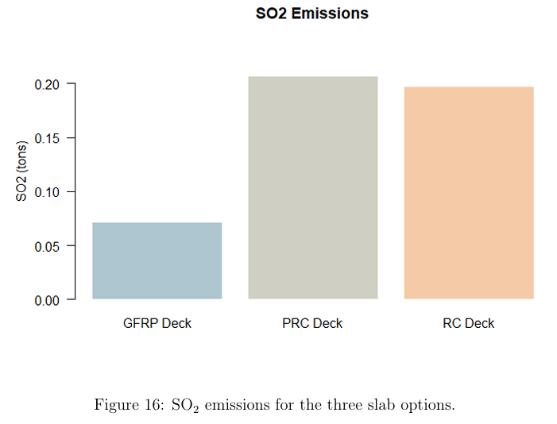
NOx and SO₂ emissions are lowest for GFRP (0.043 tons NOx and 0.073 tons SO₂). Both RC and PRC exhibit higher values, with PRC consistently exceeding RC. These emissions primarily originate from cement production and steel manufacturing, which increase with repeated repair cycles.
6 Conclusion
This study combined Life-Cycle Assessment, intervention-based durability modelling, and AHP to compare GFRP-reinforced concrete, precast reinforced concrete, and cast-in-place RC parking deck slabs over a 70-year service life. By incorporating intervention frequencies, the analysis captured both initial construction impacts and long-term consequences of deterioration and replacement.
Across all indicators like Energy, CO₂, NOx, and SO₂, the GFRP deck consistently showed the lowest impacts due to corrosion resistance and reduced maintenance needs. The PRC deck exhibited the highest life-cycle impacts, driven by prestressing steel and moderate intervention burden. The conventional RC deck performed intermediately but was penalized by frequent maintenance and two full replacements. The AHP ranking confirmed GFRP as the most sustainable option, followed by RC and PRC.
The results highlight the importance of considering full life-cycle behavior rather than initial construction impacts alone when selecting structural systems for parking facilities.
References Kim, S., & Yoon, Y. (2009). Reliability-based service life prediction of RC structures.
• Choi, J., et al. (2020). Deterioration trends in parking structures.
• Davis-McDaniel, C., et al. (2012). Structural reliability in reinforced concrete systems.
• Coreslab Structures (2022). Recommended Practice for Design and Construction of Parking Structures.
• Das, S., Chowdhury, S., & Saha, P. (2020). Life-cycle environmental impact assessment of concrete and alternatives.
• Gamage, N., Setunge, S., & Gravina, R. (2017). Long-term durability of reinforced concrete structures.
• Eurostat (2023). Construction Price Indices and Material Market Data.