Increasing water demand, climate-driven variability, and deteriorating infrastructure continue to strain conventional water supply systems worldwide. As a result, small-scale and modular water treatment solutions have expanded in application for disaster recovery, rural communities, and decentralized infrastructure systems (United Nations Department of Economic Affairs 2025) (Containerized Desalination Plants Market n.d.). These compact systems provide operational flexibility and can be rapidly deployed in environments where centralized utilities are absent or unreliable.
System Overview
The small-scale water supply system provides clean water through a containerized desalination unit connected to a storage tank and distribution via a pipe network to end users. The containerized unit and storage tank are supported by a foundation. The design option 1 includes a concrete water tank on a reinforced concrete foundation pad linked with pressurized pipe network. An alternative design includes elevated tank on steel frames with gravity-fed distribution. The simplicity of the system allows for relatively rapid design and deployment to rural or coastal communities with brackish or saltwater. The design can be created and installed in a relatively short period of time to use in the case of disaster recovery, where it may provide clean water for during and after a disaster recovery phase (Davis and Lambert 2002).
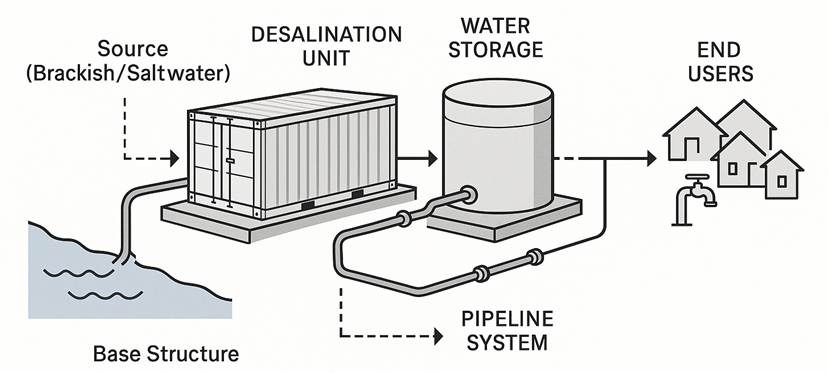
Figure 1: Small-scale water supply system. Image generated using ChatGPT with prompt of the system description.
Ontology:
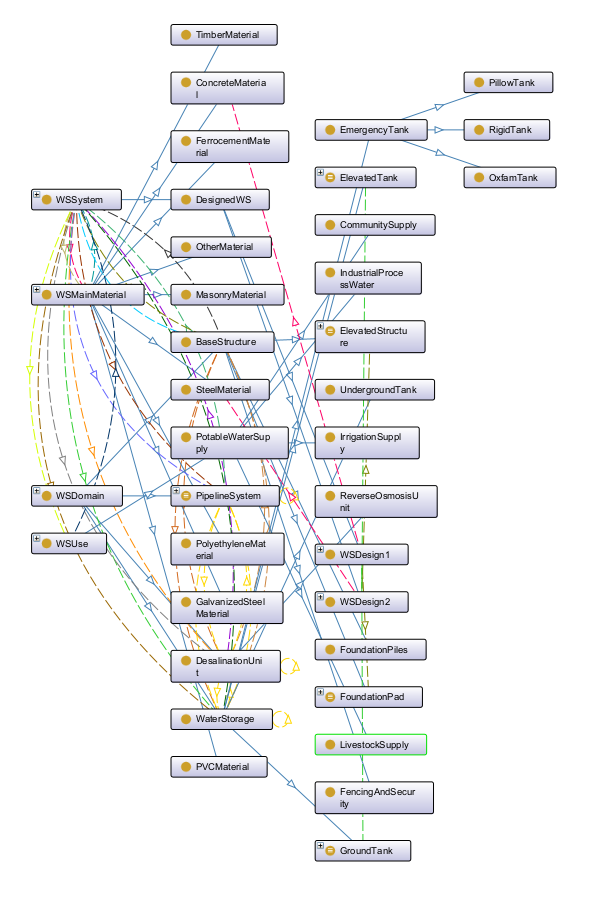
Figure 2: Small-scale water supply system ontology graphic. Generated with Protoge
Key Insights:
The ontology provides a lightweight decision-support mechanism by formalizing relationships between system components and their materials, it enables reasoning-based design and supports cross-sector decision-making.
Logical relationship building supports interoperability across organizations, which is a core challenge of decentralized infrastructure deployment, especially in emergencies.
Configurable System: By combining (i) disjoint top-level component classes, (ii) “must-have” existential restrictions for WSSystem, and (iii) option-encoding via enumerated classes and value restrictions (e.g., PipelineSystem ≡ {PipeOption1Ind, PipeOption2Ind} and WSDesign1 ⊑ hasPipeOption value PipeOption1Ind), the ontology turns an informal concept sketch into a machine-checkable configuration grammar that both prevents category mistakes and automatically exposes which design choices are fixed versus still under-specified.
Parametric Model
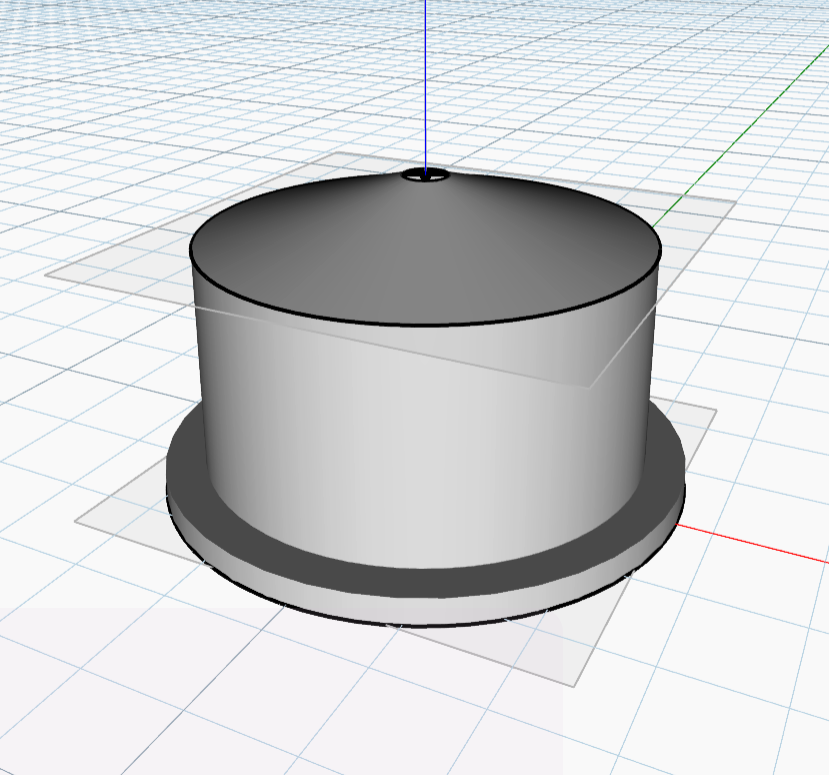
Figure 3: Ferrocement tank with foundation. Generated with Dynamo
This parametric model develops a model of a ferrocement storage tank and foundation to evaluate geometric, structural, and hydraulic trade-offs to material costs using material efficiency (EE) and pressure-per-material (PPM) as high-performance criteria. The results show that optimized geometries outperform traditional short-wide designs, demonstrating that parametric modeling can guide more efficient and context-appropriate tank configurations while highlighting the need to also consider constructability and field implementation factors.
High performance criteria
Two high-performance criteria were defined to evaluate how effectively each design meets user and structural requirements, while minimizing quantity of material used, and therefore material cost. The first criteria was Material Efficiency (EE) which quantified how much usable water volume is obtained per unit of construction material. It is defined as EE=Vtank/Vmaterial, where Vtank is the internal storage capacity and Vmaterial is the total volume of composite material used for the walls, roof, and foundation. Higher values indicate more economically efficient use of materials.
The second criterion evaluates how effectively geometric configuration provides hydraulic head relative to material requirements, defining a sustainability element with pressure available per volume of material required (PPM). The maximum static pressure at the tank outlet is calculated as P= ρgh, where h is the water column height. PPM is expressed as PPM=P/Vmaterial.
Results
Table 1. Performance of Selected Tank Design Alternatives
| Design Option | Height (m) | Diameter (m) | EE | PPM | Slenderness (h/d) | Total Volume (L) |
| PPM Peak | 4.0 | 2.7 | 9.65 | 0.017 | 1.49 | 22,700 |
| EE Peak | 4.8 | 3.2 | 12.3 | 0.015 | 1.49 | 38,000 |
| Mid-Point Design | 3.7 | 3.7 | 10.5 | 0.0097 | 1.00 | 39,500 |
| Typical Design | 2.5 | 4.5 | 8.00 | 0.0049 | 0.55 | 39,600 |
| UNHCR Design | 2.2 | 5.3 | 9.22 | 0.0030 | 0.40 | 48,000 |
The UNHCR ferrocement tank geometry was evaluated as a validation benchmark (UNHCR 2006). All configurations in Table 1 met structural feasibility requirements for hoop stress and hydrostatic loading, and all but the UNHCR design satisfied the slenderness guideline of 0.5–1.5 used as an expert validation check.
The PPM Peak design achieved the highest hydraulic efficiency (PPM = 0.017), reflecting the advantage of a tall, narrow tank, though at the cost of increased wall thickness and lower EE. The EE Peak design showed the best material efficiency (EE = 12.3) while still providing strong pressure performance, making it the most cost-effective solution overall, with best value for material costs. The results in Table 1 show that the optimized configurations outperform the traditional design across both high-performance criteria and illustrate how parametric modeling supports informed selection of efficient tank geometries.
References
- Containerized Desalination Plants Market. TechSci Research LLC. Accessed 11 3, 2025. https://www.techsciresearch.com/report/containerized-desalination-plants-market/29409.html.
- Davis, Jan, and Robert Lambert. 2002. Engineering in Emergencies: A Practical Guide for Relief Workers (2nd ed.). Warwickshire, UK: Intermediate Technology Publications Ltd.
- Naaman, Antoine E. 1979. “Performace Criteria for Ferrocement.” Journal of Ferrocement 75-92.
- UNHCR. 2006. Large Ferro-Cement Water Tank. Tehcnical Support Section, Division of Operational Support.
- United Nations Department of Economic Affairs. 2025. “. The Sustainable Development Goals Report 2025. New York. (revision August 2025).”