Combined Ontology: Integrated Emergency Water Supply System for a Critical Building
Purpose
The ontology formalizes the essential concepts and relationships required to describe and compare emergency water supply strategies for buildings in the city within a demand-driven framework. It makes system integration explicit by defining how water demand, supply, storage, distribution and backup delivery interact. This enables consistent evaluation of service availability and resilience under normal and disrupted conditions.
Scope
The ontology includes concepts related to critical buildings, water distribution networks, water supply sources, elevated water storage tanks and road infrastructure along with their key materials, components, and interrelationships. The scope is deliberately limited to building-scale emergency water supply and excludes unnecessary subsystem details that are not relevant for resilience and integration analysis.
Intended Users
- Civil systems engineers and students who require a transparent knowledge structure to integrate subsystems of an emergency water supply system for a critical building and to reason about failure and redundancy logically.
- Team members working in parallel on different products who need a shared vocabulary for integration limited to building, tank, network and road.
Intended Use
The ontology is intended to be used as a knowledge representation framework to support integrated parametric modelling and system-level comparison of design alternatives. It enables consistent linking of building water demand to supply, storage, distribution and backup delivery systems, allowing evaluation of system performance, redundancy, and reliability under different emergency scenarios.
Ontology Structure
The ontology is organized as a domain-based hierarchy under owl:Thing, structured around the main systems required for emergency water supply at the building scale. These systems include critical buildings (ACI 318-19; EN 1992-1-1), water distribution networks (Trifunović, 2020), water supply sources (Davis & Lambert, 2002), elevated water storage tanks (CPHEEO Manual, 2013), and road infrastructure (Mehdian et al., 2022) along with their key materials, components, and interrelationships.
Rather than modelling water supply, storage and pipeline as separate top-level systems, these elements are intentionally combined under a single PipeNetworkDomain. This reflects the project focus on functional water delivery where sources, pipelines, valves and storage operate as one integrated hydraulic system during emergency conditions. The ontology development follows established ontology engineering principles (Noy & McGuinness, 2001) and semantic web principles (Krötzsch et al., 2012). The five integrated systems are highlighted in the ontology structure to illustrate their interaction.
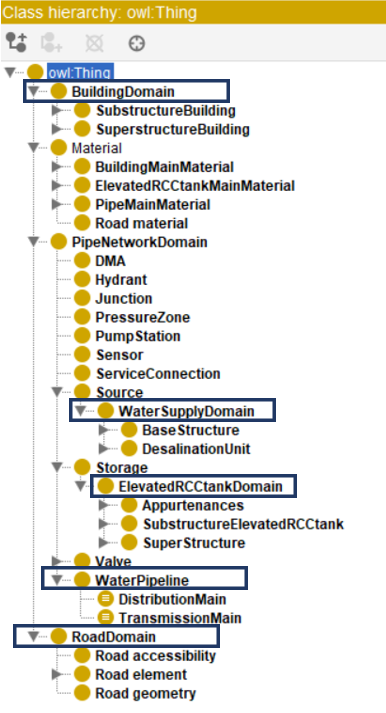
The ontology follows a system-of-systems logic at the building scale where the building is defined as the primary water demand node. Water supply, storage and distribution are intentionally grouped within the PipeNetworkDomain to reflect their operation as a single functional hydraulic system during emergency conditions while the RoadDomain represents alternative delivery pathways through truck-based supply. This consolidation keeps the ontology compact and readable and supports parametric modelling where changes in building demand propagate consistently through the entire water supply chain. The object property hierarchy is shown below.
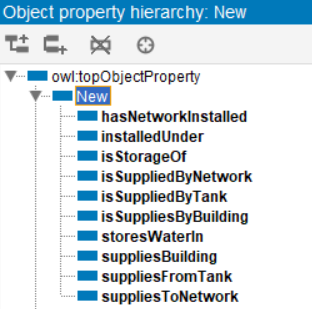
Object properties are used in the ontology to represent relationships between individuals of different classes. The object property hierarchy is shown below and for each property and its corresponding inverse property, the domain and range are defined according to the Table.
| Property | Domain | Ranges |
| hasNetworkInstalled | RoadDomain | WaterPipeline |
| installedUnder | WaterPipeline | RoadDomain |
| storesWaterin | WaterSupplyDomain | ElevatedRCCtankDomain |
| isStorageOf | ElevatedRCCtankDomain | WaterSupplyDomain |
| suppliesBuilding | DistributionMain | BuidlingDomain |
| isSuppliedbyBuilding | BuidlingDomain | DistributionMain |
| suppliesFromTank | ElevatedRCCtankDomain | DistributionMain |
| issuppliedFromTank | DistributionMain | ElevatedRCCtankDomain |
| suppliesToNetwork | WaterSupplyDomain | TransmissionMain |
| issuppliedToNetwork | TransmissionMain | WaterSupplyDomain |
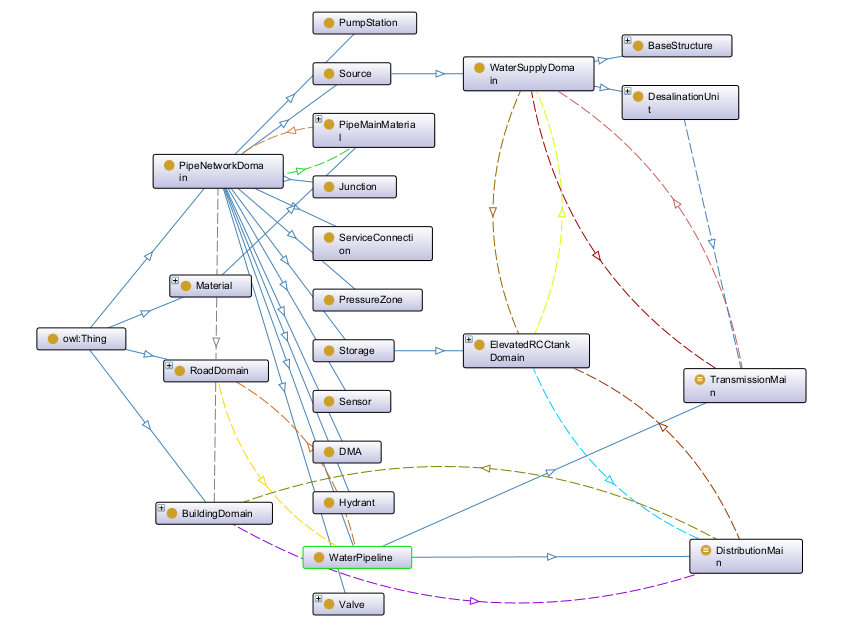
Visualizing the Ontology using OntoGraf
Integration Challenge
The integration challenge is to ensure continuous water delivery to buildings in the city under partial infrastructure failure by coordinating redundancy across the pipe network, on-site storage and road-based emergency delivery. Building water demand acts as a shared driver across all systems, directly influencing storage capacity, network sizing and backup delivery requirements. System resilience therefore depends on representing both pipe-based water connections and road-based emergency delivery when the network is disrupted.
Engineering Examples
The following engineering examples illustrate how the combined ontology and integrated parametric model support design, evaluation and adaptation of an emergency water supply system for a critical building.
1. Emergency Water Supply Design for a Critical Building
A critical building must maintain water supply during emergency situations such as infrastructure failure or natural disasters that disrupt the municipal water network. The ontology defines the relationships between building demand, the pipe network, on-site storage and road-based emergency delivery. Engineers can use this structure to test different system configurations by adjusting building demand, tank capacity and pipe dimensions then evaluate how these changes affect service availability. The linked parametric model enables consistent assessment of water availability and redundancy under normal and disrupted supply conditions.
2. System Response to Partial Infrastructure Failure
A failure occurs in the pipe network supplying the building, limiting or completely interrupting normal water delivery. Using the ontology, engineers can identify alternative supply pathways, such as on-site storage and truck-based delivery via the road network. The parametric model allows simulation of how long the building can be supplied by the elevated tank alone and how emergency trucking compensates for network failure. This supports resilience assessment by quantifying system performance under partial failure scenarios.
3. Capacity Expansion Due to Increased Building Demand
An increase in building occupancy or functional change leads to higher emergency water demand. The ontology highlights the key parameters affected by increased demand including storage volume, pipe conveyance capacity and road accessibility requirements. Engineers can evaluate different adaptation strategies such as enlarging tank capacity, increasing pipe diameter or improving road access for emergency delivery. The parametric model ensures that all subsystems respond consistently to demand changes supporting informed design decisions and performance comparison.
References
- ACI 318-19. Building Code Requirements for Structural Concrete. American Concrete Institute, 2019.
- EN 1992-1-1:2004. Eurocode 2: Design of Concrete Structures – Part 1-1. CEN, Brussels.
- Trifunović, N. (2020). Introducon to Urban Water Distribuon: Theory. CRC Press.
- Davis, Jan, and Robert Lambert. 2002. Engineering in Emergencies: A Practical Guide for Relief Workers (2nd ed.). Warwickshire, UK: Intermediate Technology Publications Ltd.
- CPHEEO. (2013). Manual on Water Supply and Treatment. Government of India, Ministry of Urban Development.
- Mehdian, M., Mirzahossein, H., & Abdi Kordani, A. (2022). A data-driven functional classification of urban roadways based on geometric design, traffic characteristics, and land use features. Journal of Advanced Transportation, Article ID 4.
- Noy, N. F., & McGuinness, D. L. (2001). Ontology Development 101: A Guide to Creating Your First Ontology. Stanford University.
- Krötzsch, M., Hitzler, P., & Rudolph, S. (2012). Foundations of Semantic Web Technologies. CRC Press.
Home | Introduction | Individual systems | Integration Context | Integrated Ontology | Integrated Parametric Model | Conclusion