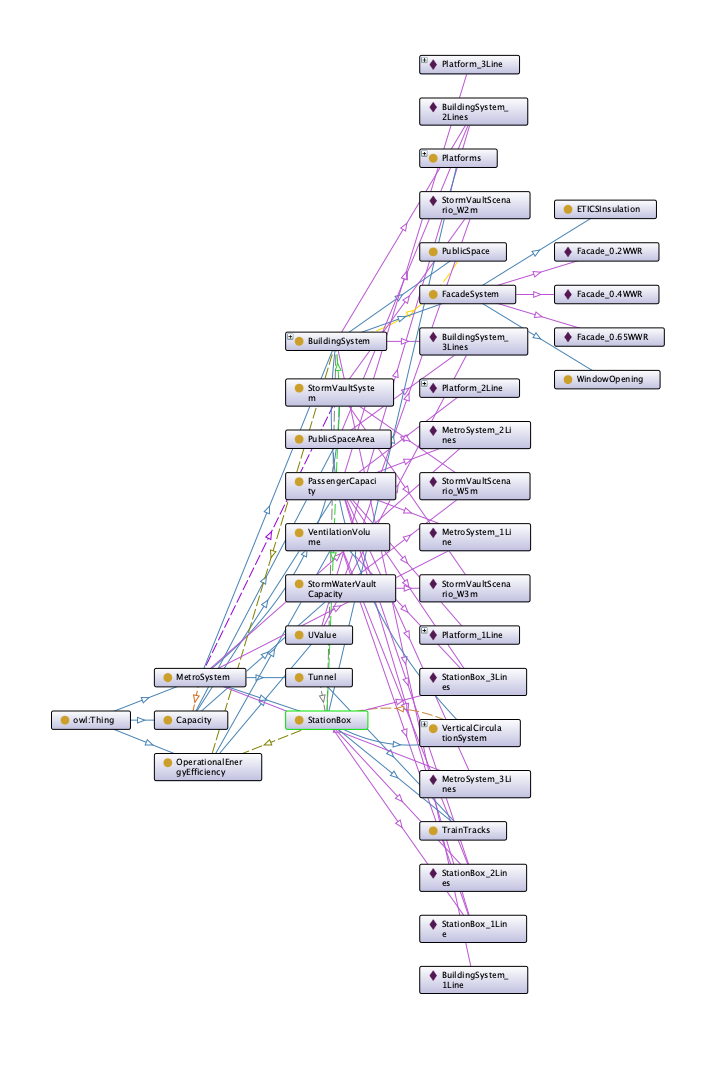
The ontology developed in this project acts as a knowledge-structuring mechanism that primarily serves to explain how the parametric model implemented in Dynamo operates, rather than to describe metro stations as generic infrastructure systems. While the Dynamo model represents the operational design environment, where geometry, parameters, and configurations are manipulated, the ontology functions as the conceptual backbone that makes the underlying logic, dependencies, and system relationships explicit. In this sense, the ontology is designed to support user understanding of how individual subsystems interact within the integrated model and how changes in parameters propagate through the system.
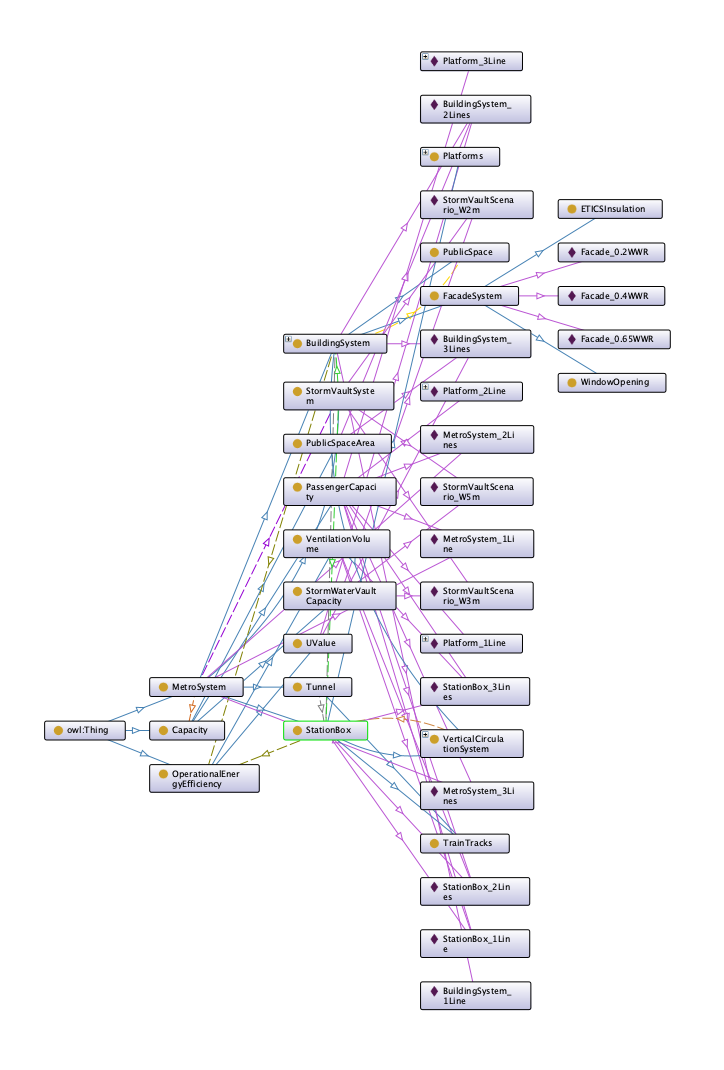
Within the ontology, the high-performance criteria established in the introduction are explicitly represented and aligned with the measurable outputs generated by the Dynamo model. These criteria are further specialized to reflect the model’s performance indicators. The main classes are structured around the integrated system and the two high-performance criteria: Capacity and OperationalEnergyEfficiency. Capacity is further specialized into PassengerCapacity, PublicSpace, and StormWaterVaultCapacity, while OperationalEnergyEfficiency is specialized into UValue and VentilationVolume. These subclasses directly correspond to the metrics computed within the parametric model.
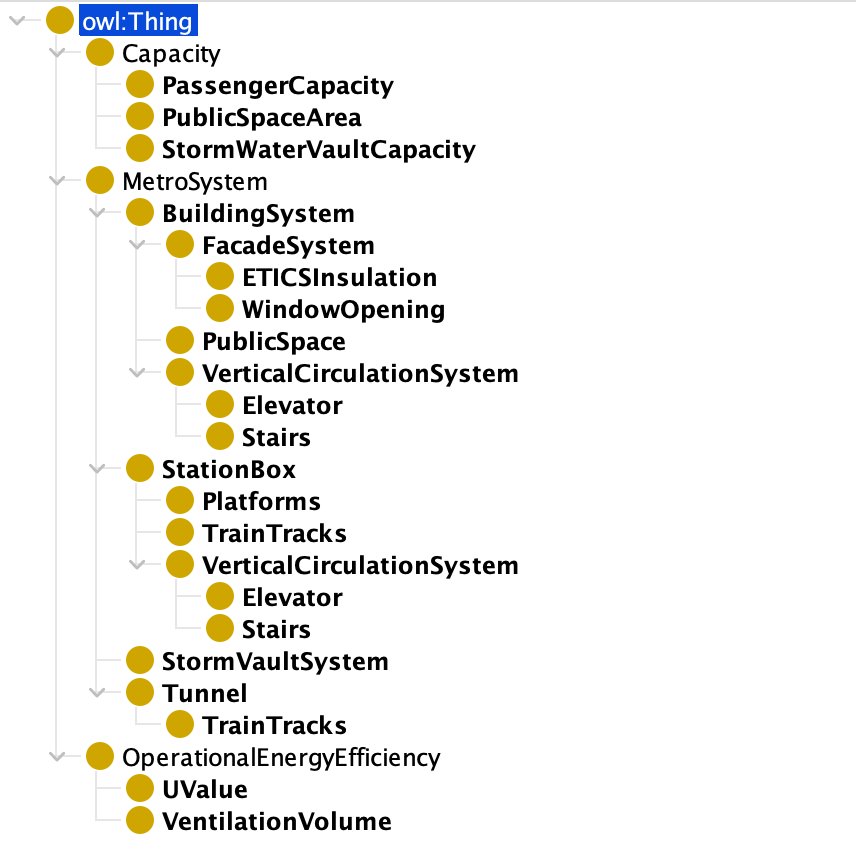
At the system level, the MetroStation class aggregates the primary subsystems modeled in Dynamo, including StationBox, Tunnel, StormWaterVaultSystem, FacadeSystem, and ETICSInsulation. To better represent system interactions and functional dependencies, the ontology also includes supporting systems such as VerticalCirculationSystem, with subclasses Stairs and Elevator, as well as a BuildingSystem class that groups façade and insulation-related components. These additions allow the ontology to capture not only individual subsystems, but also their role within the overall station configuration.
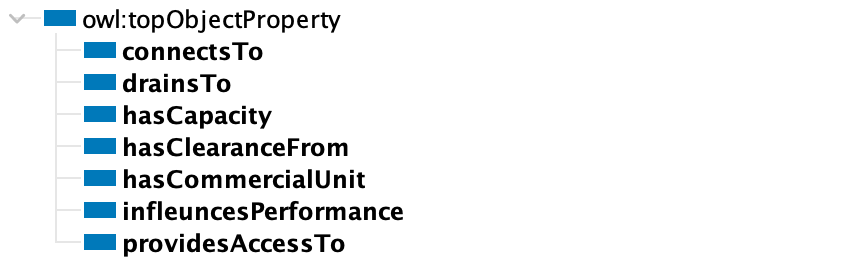
The object properties of the ontology are used to describe relationships between classes and systems. System-to-system interactions are represented using the property connectsTo, which captures physical or functional connections, for example between a Tunnel and a StationBox. Capacity-related relationships are expressed through properties such as hasCapacity, linking systems like the StormWaterVaultSystem to StormWaterVaultCapacity, and public spaces to their associated PublicSpaceArea. These relationships formalize the principal dependencies embedded in the parametric model.
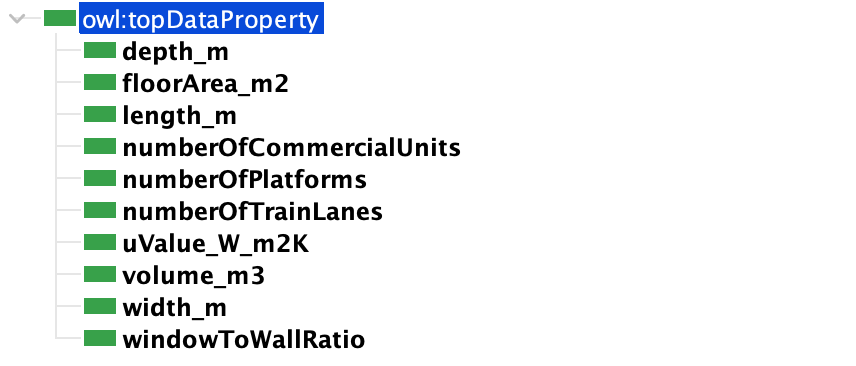
Finally, the data properties focus on the parameters and outputs that are directly manipulated or measured within Dynamo. Attributes such as depth_m, length_m, width_m, and numberOfMetroLines are assigned to individuals of the relevant classes, allowing specific design configurations and model outcomes to be represented explicitly. Through these properties, the ontology documents example parameter settings and their resulting performance values, reinforcing its role as an explanatory layer for the parametric model.
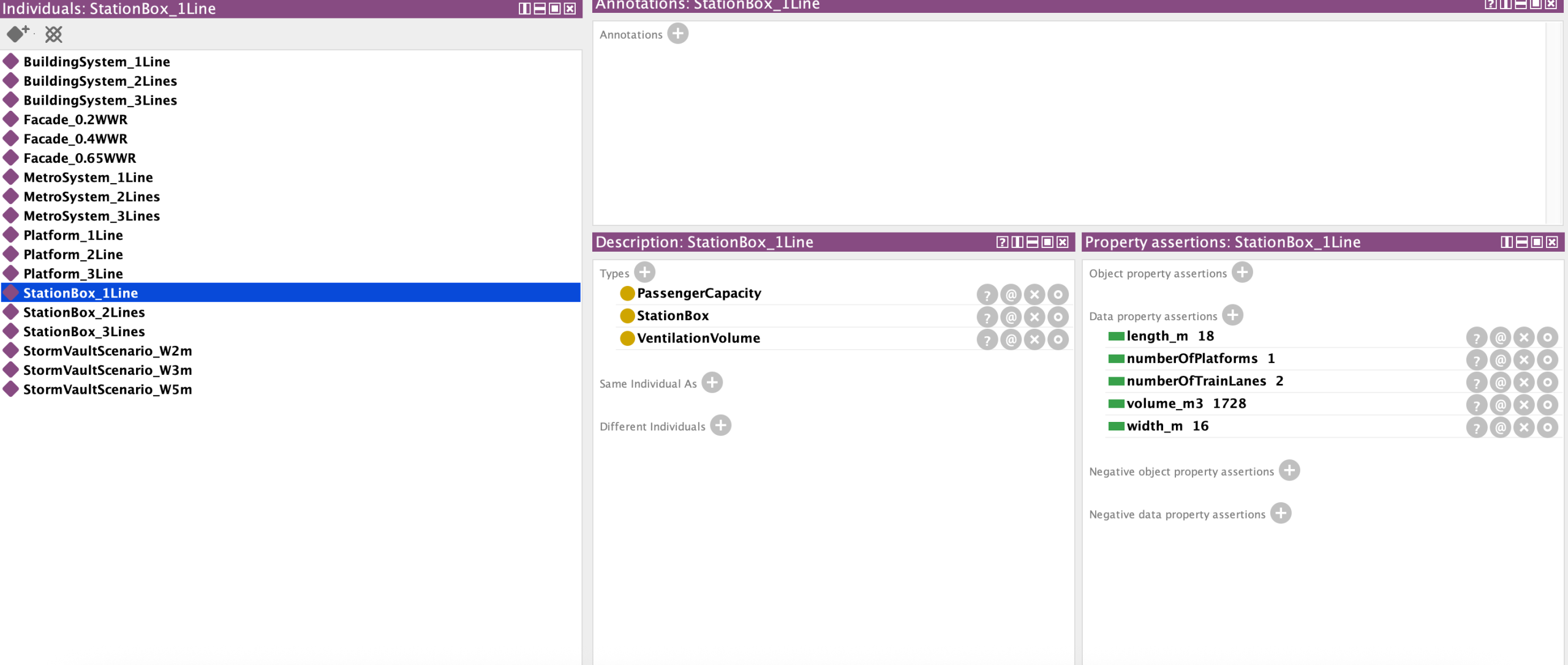
Overall, the ontology is developed explicitly with the Dynamo parametric model in mind. Rather than functioning as a general descriptive model of metro stations, it serves to clarify the intrinsic relationships, assumptions, and dependencies embedded within the parametric design environment, thereby improving transparency, interpretability, and extensibility of the integrated modelling approach.
| Axiom Type | Purpose in the Ontology | Example Axiom (Description Logic / OWL-style) | Explanation |
|---|---|---|---|
| Class Hierarchy (SubClassOf) | Defines system decomposition and specialization | StationBox ⊑ MetroStation | A station box is a specific subsystem that is part of a metro station. |
| Class Specialization | Refines performance criteria into measurable indicators | PassengerCapacity ⊑ Capacity | Passenger capacity is a specific type of capacity considered in the model. |
| Object Property (Relationship) | Represents interactions between systems | Tunnel ⊑ ∃ connectsTo.StationBox | Every tunnel is connected to at least one station box. |
| Object Property Domain & Range | Restricts valid relationships between classes | Domain(connectsTo) = MetroStationRange(connectsTo) = MetroStation | The connectsTo relation is only valid between metro station subsystems. |
| Existential Restriction | Enforces required system dependencies | StormWaterVaultSystem ⊑ ∃ hasCapacity.StormWaterVaultCapacity | A stormwater vault system must have an associated storage capacity. |
| Data Property (Parameter Definition) | Represents numerical inputs or outputs | depth_m : StationBox → xsd:double | Station box depth is represented as a numerical parameter. |
| Data Property Restriction | Links performance indicators to measured values | UValue ⊑ ∃ measuredBy.uValue_Wm2K | The U-value performance indicator is quantified by a numeric U-value. |
| Performance Alignment | Connects ontology concepts to Dynamo outputs | VentilationVolume ⊑ ∃ measuredBy.ventilationVolume_m3 | Ventilation volume is explicitly measured as a model output. |
| Functional Dependency | Encodes design logic assumptions | ETICSInsulation ⊑ ∃ connectsTo.FacadeSystem | ETICS exists only in relation to the façade system it insulates. |