This project analyses the long-term performance and reliability of precast reinforced concrete stadium stairs using a whole-life civil systems approach. The stair system was modelled over a 70-year service life to evaluate how deterioration, failure risk, and maintenance needs evolve under environmental exposure and operational loading (3).
To understand why failure occurs, a Fault Tree Analysis was developed that decomposed stair failure into structural, environmental, and surface-related mechanisms (4). The results clearly show that environmental degradation dominates system failure, with carbonation-induced corrosion, chloride ingress, moisture penetration, and freeze–thaw damage contributing the highest probabilities (1,2). Structural overloading and cracking were found to be low-probability events but still relevant in stadium environments with dynamic crowd loading. An important observation from the fault tree is that most failure pathways are governed by OR-gates, meaning that a single degradation mechanism can be sufficient to compromise safety (4).
Environmental performance was assessed through a Life-Cycle Impact Assessment comparing cast-in-place concrete stairs, precast modular concrete stairs, and composite steel–concrete stairs (5). The results show that precast modular concrete stairs achieve the lowest life-cycle energy consumption and CO₂ emissions over the 70-year period (5). This outcome is primarily attributed to factory-controlled production, reduced material waste, and more efficient maintenance and replacement strategies (12). Cast-in-place concrete stairs exhibit the highest CO₂ emissions and energy demand due to greater cement usage and the significant impact of major mid-life repair interventions (3). Composite steel–concrete stairs perform moderately in terms of CO₂ but are penalized by frequent maintenance and the high embodied emissions associated with steel components (3).
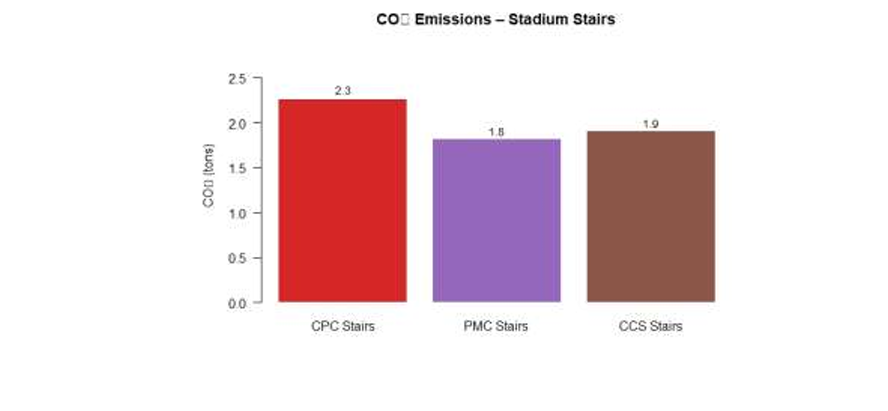
Figure 1. CO₂ emissions comparison for stadium stair alternatives over the assessment period
To integrate environmental results with engineering and operational priorities, an Analytic Hierarchy Process was applied. The AHP ranking strongly favours cast-in-place concrete stairs due to perceived structural robustness, continuity, and fewer major replacement events over the service life (3). Precast modular stairs ranked second despite their superior environmental performance (5), while composite steel–concrete stairs ranked lowest due to high maintenance intensity. This outcome highlights a clear trade-off between environmental sustainability and traditional engineering decision criteria such as durability, risk aversion, and long-term reliability (3).
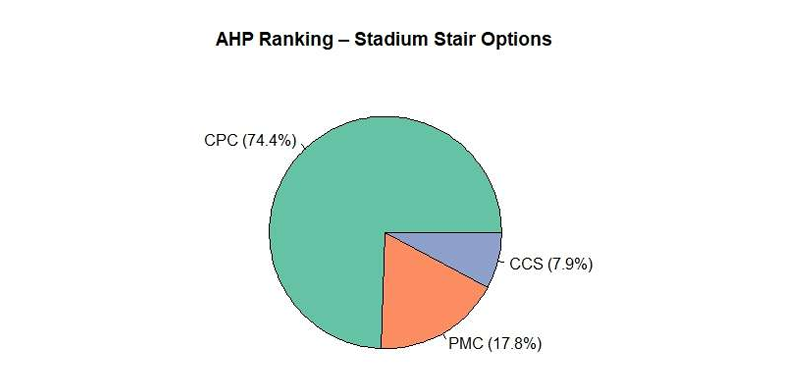
Figure 2. Analytic Hierarchy Process (AHP) ranking of stadium stair alternatives
Overall, the results demonstrate that environmental exposure is the primary driver of both deterioration and emissions throughout the service life of stadium concrete stairs (1). Design choices and maintenance strategies significantly influence cumulative CO₂ emissions and energy demand, and proactive inspection and preventive maintenance are essential not only for safety and reliability but also for reducing long-term environmental impact (3).
References
1) Bertolini, L., Elsener, B., Pedeferri, P., Redaelli, E., & Polder, R. (2013). Corrosion of Steel in Concrete: Prevention, Diagnosis, Repair. Wiley-VCH.
2) Tuutti, K. (1982). Corrosion of Steel in Concrete. CBI Research Report.
3) Frangopol, D. M., & Soliman, M. (2016). “Life-cycle performance and cost of structural systems.” Journal of Structural Engineering, ASCE.
4) Stewart, M. G., & Rosowsky, D. V. (1998). “Structural reliability assessment and prediction of deterioration due to reinforcement corrosion.” Structural Safety.
5) PCI (2017). Precast/Prestressed Concrete Institute Handbook.
Home | introdaction | Integration Context | Maintenance Strategies | Life-cycle Analysis | Multi-Objective Optimizatin