1. Objective and Methodological Framework
The objective of this task is to integrate the maintenance planning strategies of the climate-responsive highway pavement system, the urban road system, and the supporting drainage system over a 30-year analysis period. Following the methodological framework, each subsystem is represented by a set of discrete maintenance interventions characterized by predefined intervention types, frequencies, and durations.
The integration focuses on aligning maintenance cycles across systems in order to minimize cumulative service interruptions while maintaining acceptable service levels throughout the life cycle. System performance is evaluated using the total expected duration of maintenance-induced interruptions and the minimum distance between successive interventions.
2. Maintenance Parameters and Intervention Models
2.1 Climate-Responsive Highway Pavement System
The highway pavement system is subject to high traffic loads and continuous environmental exposure, resulting in comparatively high deterioration rates. Although climate-adaptive materials are assumed to mitigate thermal cracking and rutting, regular maintenance remains necessary over the 30-year life cycle.
Intervention types and parameters
| Intervention Code | Description | Frequency (years) | Expected Occurrences (30 yrs) | Duration (days) |
|---|---|---|---|---|
| M_h | Routine maintenance (crack sealing, patching) | 5 | 6 | 2 |
| R_h | Resurfacing (milling and asphalt replacement) | 15 | 2 | 8 |
| O_h | Structural overlay | 30 | 1 | 20 |
| END | End of analysis period | 30 | 1 | 0 |
Routine maintenance represents frequent low-impact interventions, whereas resurfacing and overlays restore functional and structural capacity at longer intervals. The relatively high frequency of interventions reflects the dominant role of the highway pavement in determining corridor availability.
2.2 Urban Road System
The urban road system experiences lower axle loads than highways but is more sensitive to surface deterioration, water accumulation, and access-related constraints. Maintenance planning must therefore balance technical performance with service continuity in densely used urban environments.
Intervention types and parameters
| Intervention Code | Description | Frequency (years) | Expected Occurrences (30 yrs) | Duration (days) |
|---|---|---|---|---|
| M_u | Surface maintenance (local repairs, joint sealing) | 6 | 5 | 2 |
| R_u | Surface renewal (asphalt renewal or slab repair) | 15 | 2 | 6 |
| U_u | Major urban rehabilitation | 30 | 1 | 15 |
| END | End of analysis period | 30 | 1 | 0 |
Although individual urban road interventions are generally shorter in duration, their impact on service availability is significant due to limited detour possibilities.
2.3 Drainage System
The drainage system ensures the functional and structural integrity of both pavement systems by controlling surface and subsurface water. Its deterioration rate is lower than that of the pavements, but its failure leads to accelerated deterioration of all dependent systems.
Intervention types and parameters
| Intervention Code | Description | Frequency (years) | Expected Occurrences (30 yrs) | Duration (days) |
|---|---|---|---|---|
| C_d | Preventive cleaning and inspection | 6 | 5 | 1 |
| R_d | Partial replacement of drainage components | 30 | 1 | 6 |
| END | End of analysis period | 30 | 1 | 0 |
Preventive drainage maintenance is assumed to significantly reduce moisture-related pavement damage, thereby indirectly extending pavement intervention intervals.
3 Integrated Maintenance Planning
To account for the physical and functional interdependencies between systems, maintenance interventions are not planned independently. Instead, explicit bundling rules are introduced to align interventions and reduce cumulative service interruptions.
Preventive drainage cleaning (C_d) is bundled with surface-level pavement interventions on both highway and urban roads (R_h and R_u). Major drainage replacements (R_d) are aligned with structural pavement interventions, namely highway overlays (O_h) and major urban rehabilitations (U_u). In addition, urban road interventions are synchronized with highway maintenance activities to avoid repeated disruptions of the same road corridor.
When multiple interventions occur simultaneously, the total interruption duration is defined as the maximum duration of the overlapping interventions.
4. Service Level Definition for the Integrated System
The service level of the integrated system is defined using two indicators applied consistently across the 30-year analysis period:
Total interruption time (days):
The sum of all maintenance-induced interruptions after accounting for bundling effects. This indicator represents system availability and user impact and is minimized.
Minimum distance between successive interventions (years):
The shortest time interval between any two maintenance events in the integrated timeline, representing operational stability and predictability. This indicator is maximized.
Each system contributes differently to the service level. Highway pavement interventions dominate total interruption duration, urban road interventions disproportionately affect perceived service quality, and drainage interventions govern the deterioration rates of the pavement systems.
5. Development of Maintenance Scenarios
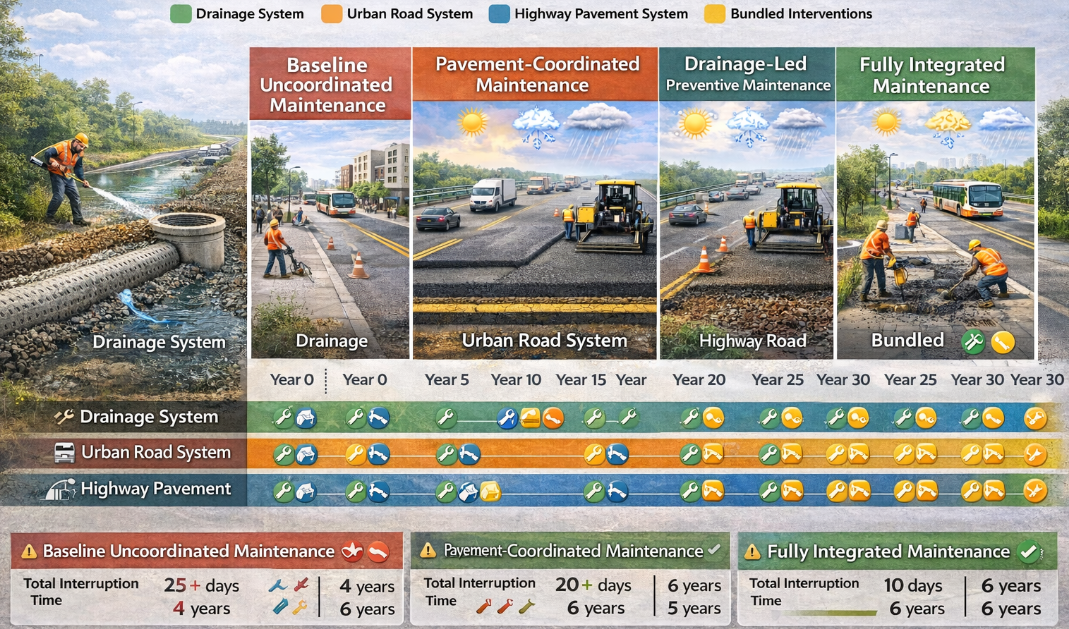
To assess the effects of different maintenance planning strategies on the performance and sustainability of the integrated road infrastructure system, four representative maintenance scenarios are defined and evaluated over a 30-year analysis period. The scenarios reflect increasing levels of coordination between the climate-responsive highway pavement system, the urban road system, and the supporting drainage system. By comparing these scenarios, the influence of maintenance integration on service availability and system-level performance can be systematically examined.
5.1 Scenario 1: Baseline Uncoordinated Maintenance Strategy
The baseline scenario represents a conventional maintenance approach in which each subsystem is planned and maintained independently. No explicit coordination between highway pavements, urban roads, and drainage infrastructure is assumed. Interventions are executed solely based on the deterioration characteristics of each individual system.
| System | Intervention Code | Frequency (years) | Expected Occurrences (30 years) | Duration (days) |
|---|---|---|---|---|
| Climate-Responsive Highway Pavement | M_h | 5 | 6 | 2 |
| R_h | 15 | 2 | 8 | |
| O_h | 30 | 1 | 20 | |
| Urban Road System | M_u | 6 | 5 | 2 |
| R_u | 18 | 1 | 6 | |
| U_u | 30 | 1 | 15 | |
| Drainage System | C_d | 7 | 4 | 1 |
| R_d | 30 | 1 | 6 |
Due to the absence of coordination, maintenance activities frequently overlap in time but are treated as separate service interruptions. As a result, this scenario is expected to produce the highest total interruption time and the shortest distance between successive interventions. From a sustainability perspective, repeated mobilization and redundant closures lead to inefficient resource use and increased indirect environmental impacts.
5.1.1 First Maintenance Strategy
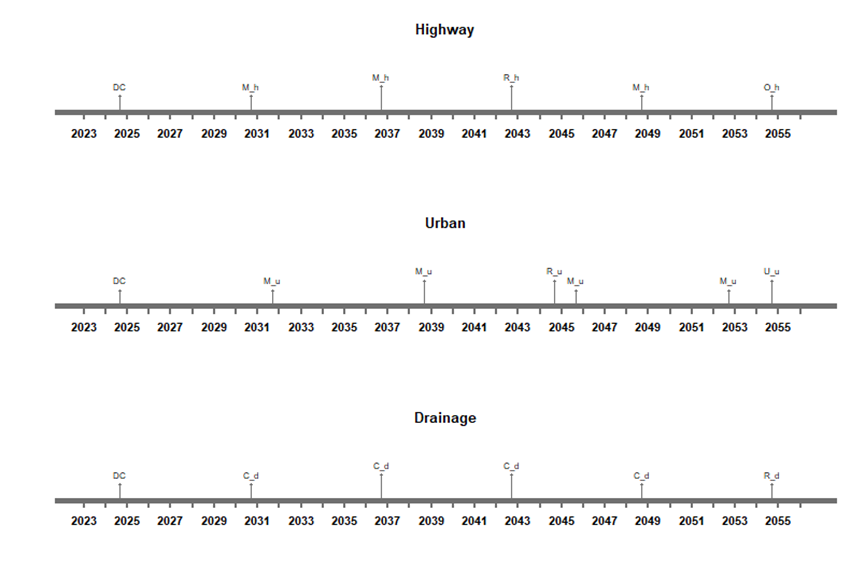
Figure 1 shows the intervention timeline for the three maintenance strategies. It can be seen that the maintenance frequency is 16 times within 30 years.
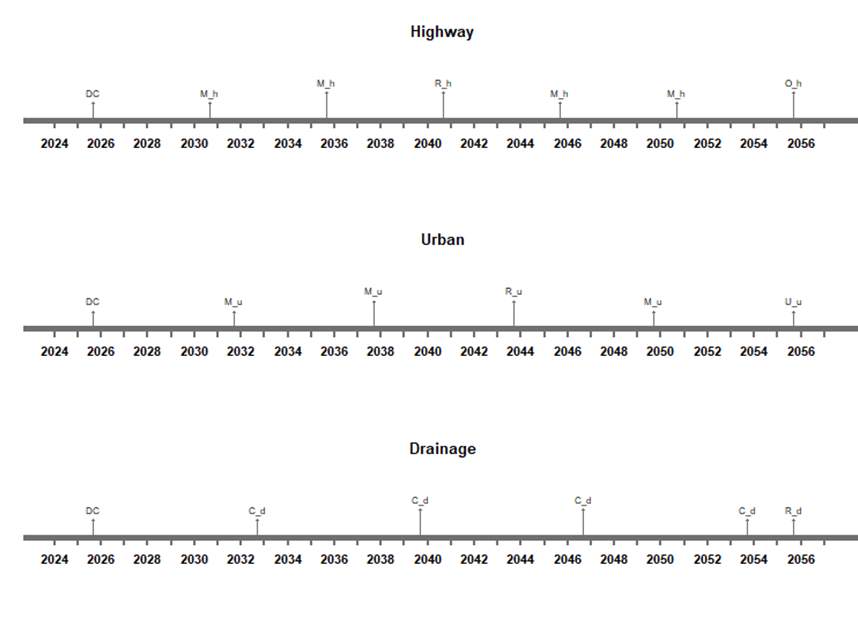

As shown in Figure 2, the total duration of the intervention is 32 days. This means that over the course of 30 years, the total duration of the intervention for all three systems amounts to 32 days.
5.2 Scenario 2: Pavement-Coordinated Maintenance Strategy
In the second scenario, maintenance planning is coordinated between the climate-responsive highway pavement system and the urban road system, while the drainage system continues to be maintained independently. This approach reflects a partial integration strategy that prioritizes the continuity of traffic service across the road network.
| System | Intervention Code | Frequency (years) | Expected Occurrences (30 years) | Duration (days) |
|---|---|---|---|---|
| Climate-Responsive Highway Pavement | M_h | 6 | 5 | 2 |
| R_h | 18 | 1 | 8 | |
| O_h | 30 | 1 | 20 | |
| Urban Road System | M_u | 6 | 5 | 2 |
| R_u | 18 | 1 | 6 | |
| U_u | 30 | 1 | 15 | |
| Drainage System | C_d | 7 | 4 | 1 |
| R_d | 30 | 1 | 6 |
The intervention parameters for both pavement systems remain identical to those defined in the baseline scenario. However, whenever highway and urban road interventions occur within the same time window, they are aligned and executed simultaneously. In contrast, drainage cleaning and replacement activities are scheduled independently. This scenario is expected to reduce the total interruption time compared to the baseline case, as some overlapping pavement interventions are consolidated. Nevertheless, insufficient coordination with drainage maintenance leads to continued moisture-related deterioration, limiting the overall improvement in service level and sustainability.
5.2.1 Second Maintenance strategy
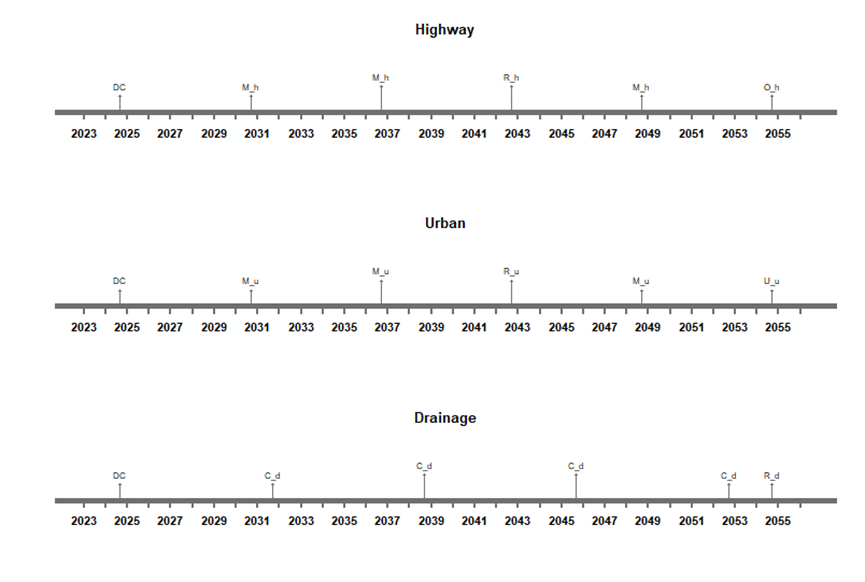
As can be seen from Figures 3 and 4, the second maintenance strategy after the last optimization has a total of 15 maintenance times in 30 years, and the total maintenance duration has decreased to 18 days, which is the lowest duration among the four strategies

5.3 Scenario 3: Drainage-Led Preventive Maintenance Strategy
The third scenario adopts a drainage-led preventive maintenance strategy, emphasizing the role of effective water management in reducing pavement deterioration. Preventive drainage cleaning is performed at shorter intervals, while improved drainage performance allows for moderately extended intervention intervals for both highway and urban pavements.
| System | Intervention Code | Frequency (years) | Expected Occurrences (30 years) | Duration (days) |
|---|---|---|---|---|
| Climate-Responsive Highway Pavement | M_h | 6 | 5 | 2 |
| R_h | 18 | 1 | 8 | |
| O_h | 30 | 1 | 20 | |
| Urban Road System | M_u | 7 | 4 | 2 |
| R_u | 20 | 1 | 6 | |
| U_u | 30 | 1 | 15 | |
| Drainage System | C_d | 5 | 6 | 1 |
| R_d | 30 | 1 | 6 |
In this scenario, routine maintenance and resurfacing of the highway pavement system are slightly less frequent than in the previous scenarios, and major structural interventions occur at longer intervals. Similar adjustments are applied to the urban road system. Preventive drainage cleaning is conducted every five years, and major drainage replacements are aligned, where feasible, with major pavement rehabilitation activities. This strategy reduces moisture-induced damage, leading to fewer major pavement interventions over the 30-year analysis period. Consequently, the cumulative interruption time is lower than in the first two scenarios.
5.3.1 Third Maintenance strategy
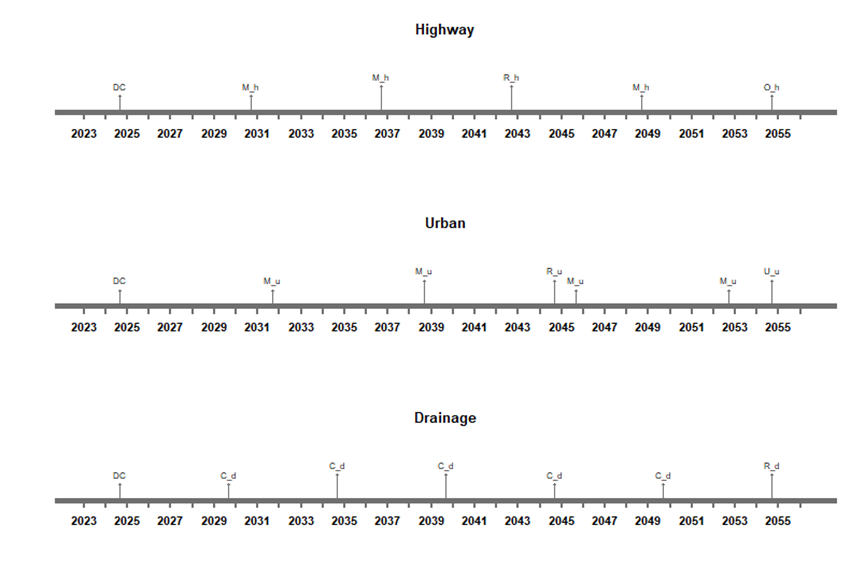
As can be seen from Figures 5 and 6, the third maintenance strategy requires a total of 17 maintenance sessions over 30 years, and the total maintenance duration increases to 32 days.

5.4 Scenario 4: Fully Integrated Maintenance Strategy
The fourth scenario represents a fully integrated maintenance planning approach in which all three subsystems are systematically coordinated. Both surface-level and structural interventions are bundled across the highway pavement, urban road, and drainage systems to minimize corridor-level service interruptions.
| System | Intervention Code | Frequency (years) | Expected Occurrences (30 years) | Duration (days) |
|---|---|---|---|---|
| Climate-Responsive Highway Pavement | M_h | 6 | 5 | 2 |
| R_h | 18 | 1 | 8 | |
| O_h | 30 | 1 | 20 | |
| Urban Road System | M_u | 6 | 5 | 2 |
| R_u | 18 | 1 | 6 | |
| U_u | 30 | 1 | 15 | |
| Drainage System | C_d | 6 | 5 | 1 |
| R_d | 30 | 1 | 6 |
Under this scenario, Preventive drainage maintenance is aligned with pavement surface interventions, while major drainage replacements are executed simultaneously with highway structural overlays and major urban rehabilitations. Urban road maintenance activities are consistently synchronized with highway interventions to avoid repeated disruptions of the same corridor. This approach is expected to yield the lowest total interruption time, the greatest distance between successive interventions, and the most stable service level over the analysis period.
5.4.1 Fourth Maintenance Strategy
As can be seen from Figures 7 and 8, the last maintenance strategy had a total of 16 maintenance times over 30 years, and the total maintenance duration decreased to 28 days.

6. Comparative Interpretation of Scenarios
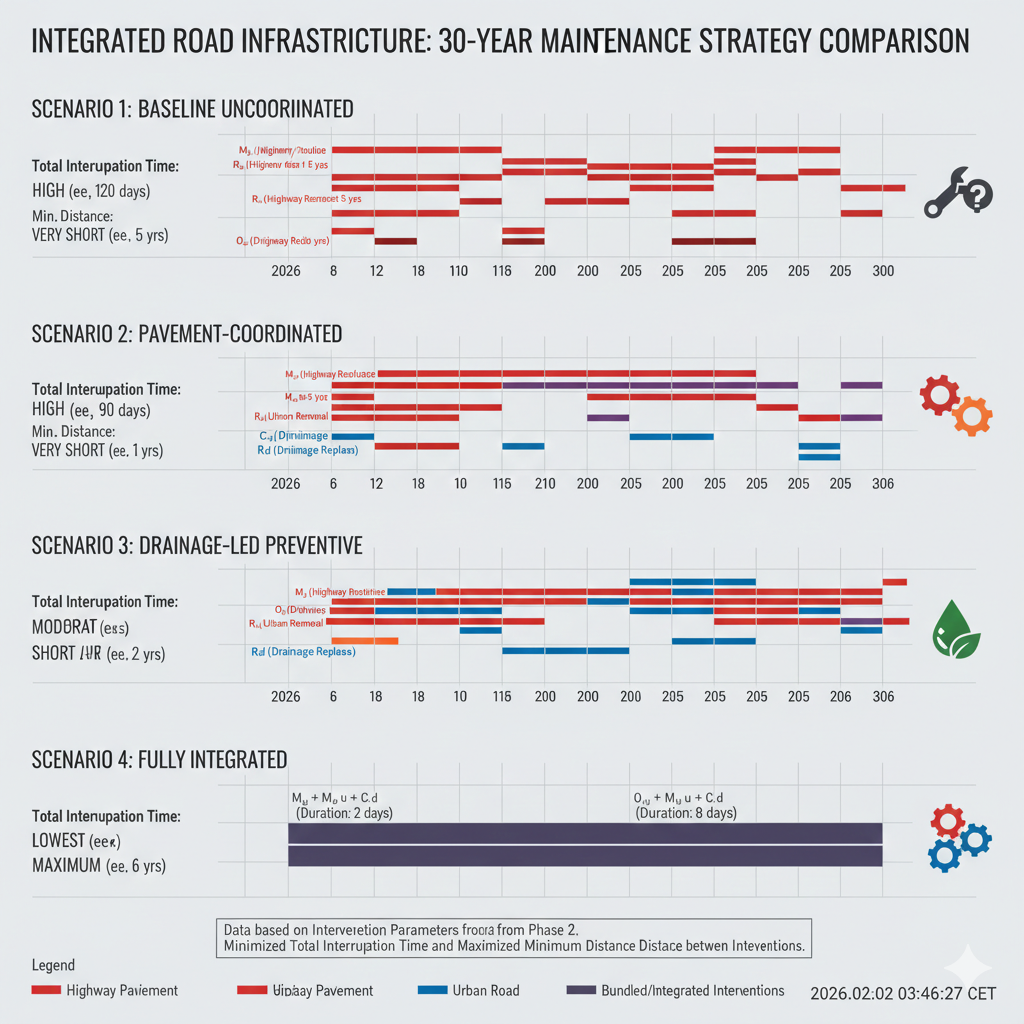
The four scenarios demonstrate the progressive benefits of maintenance integration within complex road infrastructure systems. While the baseline scenario highlights the inefficiencies associated with isolated maintenance planning, the pavement-coordinated and drainage-led strategies illustrate the partial benefits of targeted coordination. The fully integrated maintenance strategy provides the most favorable balance between service availability, operational stability, and sustainability, confirming the importance of system-level planning for long-term infrastructure management.
References:
- ISO. (2014). ISO 55000:2014 — Asset management: Overview, principles and terminology. International Organization for Standardization, Geneva.
- PIARC (World Road Association). (n.d.). Asset Management Manual. PIARC.
- Transportation Research Board (TRB). (1979). NCHRP Report 215: Pavement Management System Development. National Cooperative Highway Research Program, Washington, DC.
- Transportation Research Board (TRB). (2004). NCHRP Report 523: Optimal Timing of Pavement Preventive Maintenance Treatment Applications. National Cooperative Highway Research Program, Washington, DC.
- Federal Highway Administration (FHWA). (2002). Life-Cycle Cost Analysis in Pavement Design (FHWA-SA-98-079). U.S. Department of Transportation.
- Federal Highway Administration (FHWA). (2025). Work Zone Performance Measurement (Decision Support / Work Zone Management). U.S. Department of Transportation.
- Federal Highway Administration (FHWA). (2004). Asset Management Position Paper. U.S. Department of Transportation.