This project investigates an integrated road infrastructure system composed of climate-responsive highway pavements, urban road structures, and a supporting drainage system. The motivation for integration lies in the strong physical and functional interdependencies between these systems over their life cycle. Pavement performance, maintenance needs, and service availability are not only governed by traffic loading but also by climate exposure and water management. Therefore, analyzing these systems in isolation would underestimate deterioration mechanisms, maintenance interactions, and overall life-cycle impacts.
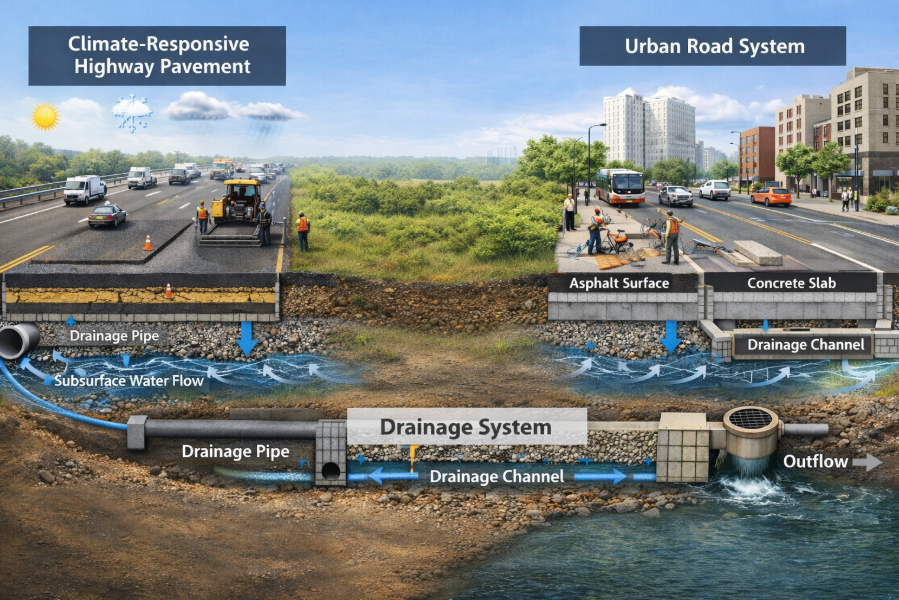
1. Climate-Responsive Highway Pavement System
The climate-responsive highway pavement system represents the primary load-bearing component of the infrastructure corridor. It is designed to accommodate high traffic volumes and heavy axle loads while being continuously exposed to climate-related stresses such as temperature fluctuations, freeze–thaw cycles, and intense precipitation events. Climate-adaptive asphalt materials are assumed to reduce thermal cracking and rutting; however, the system still exhibits relatively high deterioration rates compared to other subsystems. As a result, maintenance interventions such as resurfacing, partial rehabilitation, and structural overlays occur frequently throughout the life cycle. The performance of this system is highly sensitive to moisture infiltration, making its long-term reliability directly dependent on effective drainage functionality.
2. Urban Road System
The urban road system combines rigid road slab sections with urban asphalt pavements and serves local traffic, public transport, and non-motorised users. Compared to highways, deterioration is driven less by heavy loads and more by surface distress, frequent access requirements, and environmental exposure. Maintenance activities in urban areas occur more frequently at the surface level and have a disproportionate impact on service availability due to limited detour possibilities. Consequently, the timing of interventions in the urban road system must be carefully coordinated with adjacent highway works to minimize network-level disruptions. Water accumulation and insufficient drainage further accelerate surface damage, particularly in asphalt layers and slab joints.
3. Drainage System
The drainage system is introduced as a critical supporting system that ensures the functional and structural performance of both highway and urban pavements. Its primary role is to control surface runoff and subsurface water, preventing moisture-related damage such as stripping, base softening, and frost heave. Although drainage components typically have longer structural lifetimes and lower direct deterioration rates, their failure leads to accelerated degradation of all pavement systems. Maintenance actions such as cleaning, inspection, and partial replacement are therefore essential and must be synchronised with pavement interventions to avoid repeated service interruptions.
4. Integrated System Perspective
From an integrated engineering perspective, the three systems form a tightly coupled infrastructure network in which the maintenance of one component directly influences the performance and availability of the others. Pavement systems exhibit higher deterioration rates than drainage elements, requiring more frequent interventions. Aligning maintenance cycles across highway pavements, urban roads, and drainage infrastructure reduces total downtime, lowers life-cycle costs, and improves sustainability outcomes. System performance is evaluated based on total maintenance-induced interruption time and the minimum distance between successive interventions, reflecting the overall availability of the road corridor over its design life.
References:
- International Organization for Standardization (ISO). (2014). ISO 55000:2014 — Asset management: Overview, principles and terminology. Geneva: ISO.
- Transportation Research Board, National Cooperative Highway Research Program (NCHRP). (2007). NCHRP Report 583: Effects of Subsurface Drainage on Pavement Performance: Analysis of the SPS-1 and SPS-2 Field Sections. Washington, DC: National Academies.
- Transportation Research Board, National Cooperative Highway Research Program (NCHRP). (2002). NCHRP Report 499: Effects of Subsurface Drainage on Performance of Asphalt and Concrete Pavements. Washington, DC: National Academies.
- Federal Highway Administration (FHWA). (2002). Construction of Pavement Subsurface Drainage Systems. U.S. Department of Transportation.
- AASHTO. (1993). AASHTO Guide for Design of Pavement Structures (drainage quality/drainage coefficients included in design). American Association of State Highway and Transportation Officials.
- Federal Highway Administration (FHWA). (2006). Long-Term Pavement Performance (LTPP) Data Analysis: Frost heave reduction through drainage (field evidence). U.S. Department of Transportation.
- Transportation Research Board, NCHRP. (1984). NCHRP Synthesis 96: Pavement Subsurface Drainage Systems. Washington, DC: National Research Council.