Introduction
In the previous stage of our research, we conducted a systematic analysis of the deterioration process of tunnel structures. This project further shifts the research focus toward tunnel lining systems and provides a comprehensive evaluation of their environmental and resource consumption characteristics based on the Life Cycle Assessment (LCA) approach. Throughout the entire life cycle of an engineering project, engineers must make decisions regarding product configuration, material selection, construction methods, operational planning, and maintenance strategies. These decisions are often closely linked to life-cycle costs and environmental impacts. As a critical component of underground structures, tunnel linings are subjected to complex mechanical loads, environmental degradation, and gradually accumulated performance deterioration over long service periods. Conducting an LCA enables the quantitative identification of differences between various lining material systems in terms of resource consumption, pollutant emissions, and economic costs, thus providing a scientific basis for design optimization, sustainability assessment, and the selection of technical solutions. In addition, the introduction of LCA extends the evaluation of lining systems beyond structural performance to broader dimensions such as environmental impact, material efficiency, and long-term resource utilization, providing essential quantitative support for the advancement of green infrastructure development.
In this research, within a 100-year analysis period, we systematically compared and evaluated the environmental performance of different tunnel lining solutions from a carbon-footprint perspective, using four key indicators: cumulative energy consumption,CO2,emissions, NOx emissions and SO2emissions.
Design Options
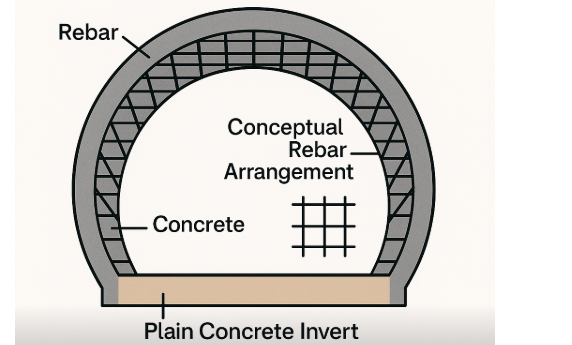
Traditional reinforced concrete lining(RC)
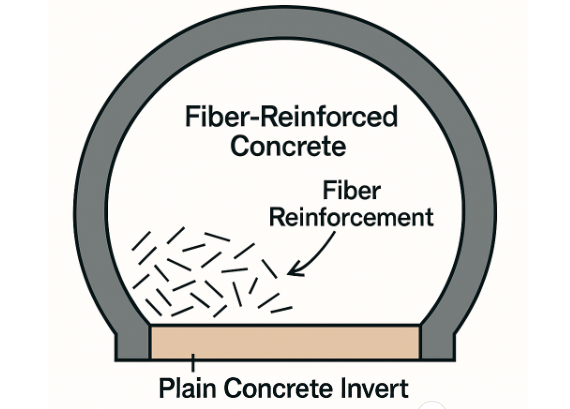
steel fiber-reinforced concrete lining(SFRC)
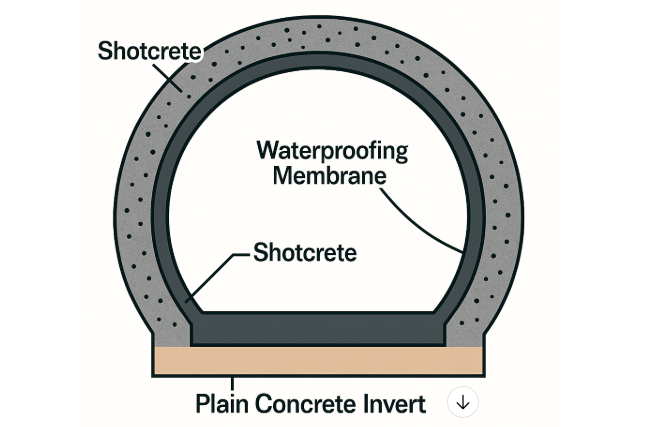
Shotcrete + Membrane Composite Lining(SC+WM)
Life Cycle Timeline
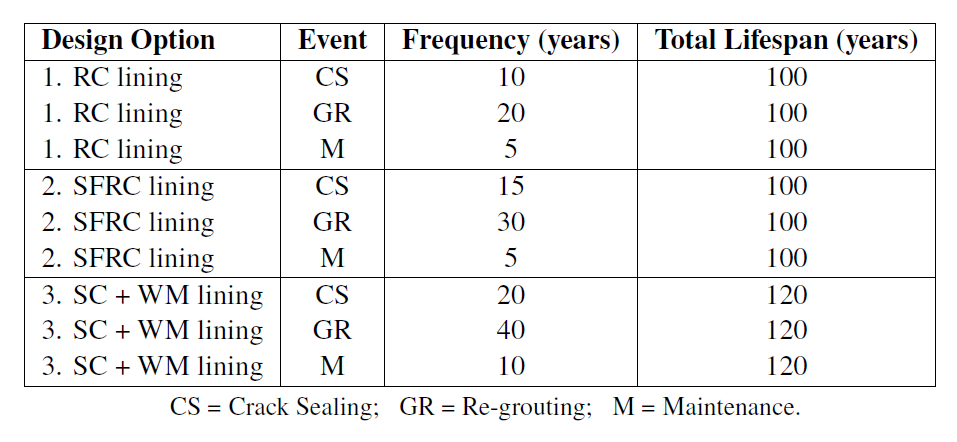
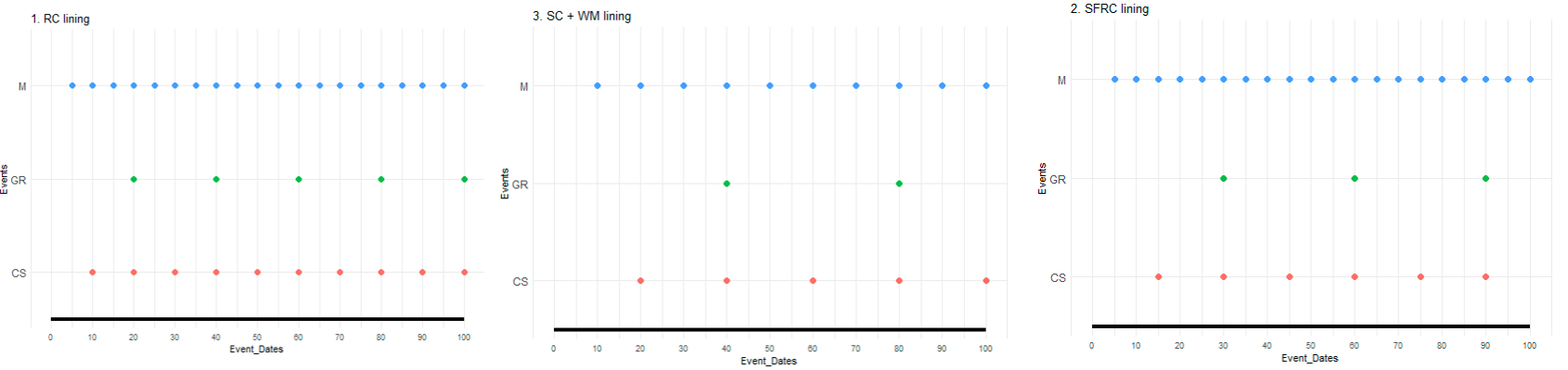
To more intuitively present the evolution of tunnel lining systems over their life cycle, a maintenance event schedule was developed to illustrate the expected frequencies of activities such as crack sealing, re grouting, and maintenance. Based on the maintenance requirements of each lining design option, the corresponding maintenance events and their occurrence intervals are listed in Table Below.
Life Cycle Inventory and Analysis
The computation process of the life cycle assessment can be divided into three steps.
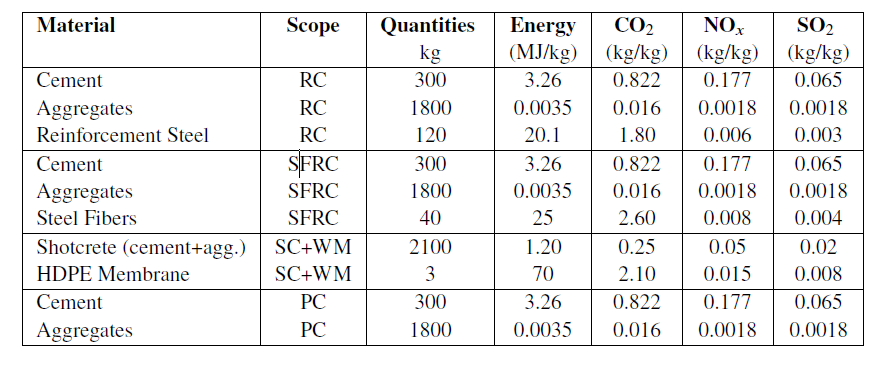
First, based on the geometric parameters of the tunnel, the baseline material quantities for each lining design option are calculated. Second, according to the maintenance and renewal cycles of the different design options, these baseline quantities are multiplied by the number of interventions determined from the intervention timeline, yielding the total life cycle material quantities categorized by material type.
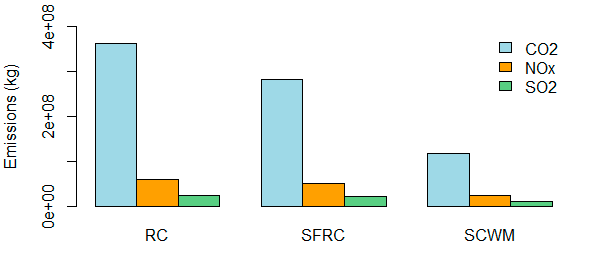
Finally, the total life cycle quantity of each material is multiplied by its corresponding unit energy consumption or emission factor from the inventory database, and the results are summed to obtain the total life cycle energy consumption and CO2, NOx and SO2 emissions for each lining design option. This enables a comparative assessment of the energy consumption and gaseous emissions of different lining design options, as illustrated in Figures Below.
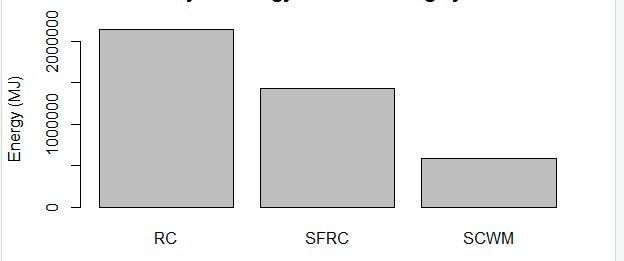
In terms of energy consumption, the RC design option incurs significantly higher energy use due to the large quantities of reinforcing steel and concrete involved. The SFRC design option reduces energy demand by decreasing the amount of steel reinforcement. The SC + WM design option, having the smallest total material volume, demonstrates the lowest energy requirement.
A consistent pattern is observed for CO2, NOx and SO2 emissions: the greater the total material quantity and the higher the proportions of steel and cement, the higher the emissions. Consequently, the RC design option results in the highest emissions, followed by SFRC, whereas the SC + WM design option yields the lowest values. Overall, the SC + WM design option demonstrates the most favorable performance among the three.
Since multiple performance indicators are involved, the decision-making process becomes challenging, as it represents a multi-criteria decision-making (MCDM) problem. To address this, we explore the application of several MCDM methods, such as the Analytic Hierarchy Process (AHP), to support the comprehensive evaluation and selection of tunnel lining design options.
AHP Analysis
To conduct a comprehensive evaluation of the environmental performance of the three tunnel lining design options (RC, SFRC, and SC + WM), this study applies the Analytic Hierarchy Process (AHP) for multi-criteria decision-making following the completion of the life cycle assessment (LCA). AHP enables the simultaneous consideration of both the relative importance of different criteria and the performance of each design option with respect to those criteria, thereby yielding ranking results that more accurately reflect engineering reality.
The objective of this study is to establish a ranking of the three tunnel lining design options. The evaluation criteria include energy consumption, CO2, NOx and SO2 emissions, while the alternatives are RC, SFRC, and SC + WM. Based on the quantitative LCA results, pairwise comparison matrices were first constructed for the three alternatives under each of the four environmental indicators. The judgment values used in the matrices follow the 1–9 scale proposed by Saaty (1980), where “1” indicates equal importance and “9” represents an extremely strong preference of one option over another.
Next, the principal eigenvector of each comparison matrix was calculated to obtain the relative weight of each design option under its corresponding environmental indicator. Because the weights must be comparable across different criteria, each eigenvector was normalized such that the sum of its elements equals 1, resulting in standardized weight distributions for the three design options across the four indicators. Finally, these alternative-level weights were aggregated with the criterion-level weights to obtain the overall score for each lining design option, enabling a systematic ranking of the three
systems.
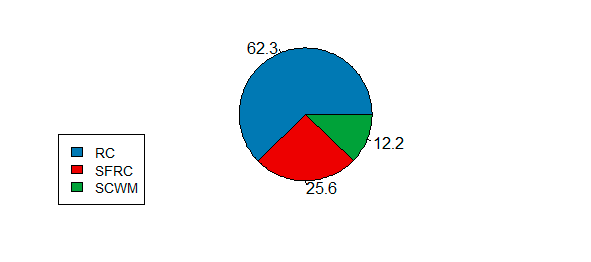
Based on the integrated results of the Life Cycle Assessment (LCA) and the Analytic Hierarchy Process (AHP), it is evident that the three lining design options exhibit substantial differences in both environmental impact and overall performance. The LCA results indicate that the SC + WM design option performs best in terms of energy consumption and emission indicators (CO2, NOx and SO2), followed by SFRC, while the RC option demonstrates comparatively weaker environmental performance. However, when environmental indicators are considered together with engineering factors such as cost, construction feasibility, material availability, and maintenance frequency within the AHP framework, the comprehensive evaluation shows that the RC lining design option achieves the highest overall score (62.3%) and becomes the preferred alternative. SFRC ranks second (25.6%), whereas SC + WM receives the lowest comprehensive score (12.2%) due to its higher cost and greater construction complexity.
Main | Introduction | Integration Context | Maintenance Strategies | Life-Cycle Analysis | Multi-Objective Optimization | Conclusion