Introduction:
Steel is a primary material for bridge construction due to its high strength and versatility across various truss types like deck and pony trusses. This report details a formal ontology developed to digitize the relationships between bridge components, materials, and design options.
Purpose:
The objective is to create a digital reasoning tool that supports knowledge-based modeling. It enables engineers to automatically classify bridge types, validate structural configurations, and assist in technical decision-making.
Scope:
The ontology is limited to the domain of steel truss bridges, covering physical decomposition (superstructure, substructure, and bearings), core materials (steel, concrete, coatings), and functional categories (road, rail, and pedestrian use).
Intended Users & Intended Use:
Users: Bridge engineers and design teams involved in parametric bridge modeling. Use: To enable automatic classification of bridge types, support knowledge-based decision-making, and perform parametric reasoning to identify the suitability of specific bridge designs.
Class Hierarchy:
The hierarchy is built on three main categories:
- BridgeComponent: Subdivided into Superstructure (MainTruss, FloorSystem, Connections), Substructure (Abutment, Foundation, Pier), and Bearings.
- BridgeMaterial: Includes Steel, Concrete, and Coating materials.
- BridgeUse: Categorized by Road, Rail, or Pedestrian crossing.
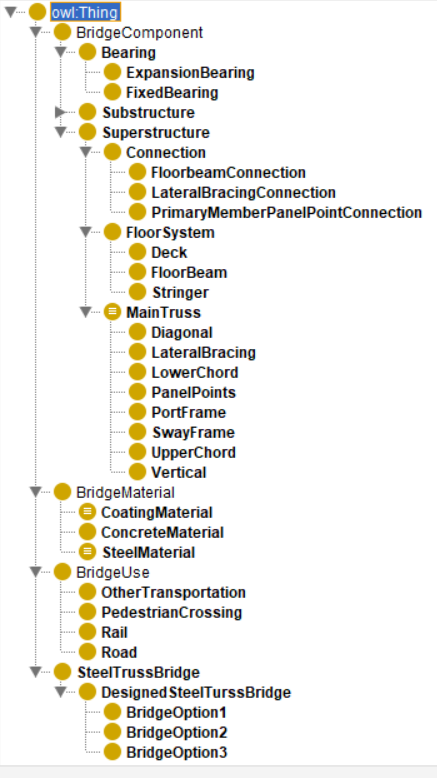
Figure 1: Class Hierarchy
Ontograf (Logical Axioms & Implementation):
The ontology uses OWL axioms to ensure structural integrity and logical consistency. Key relations include hasMaterial (connecting a bridge to its material) and inverse properties like hasSuperstructure ↔ isSuperstructureOf. Existential restrictions ensure every bridge contains necessary material and structural data.
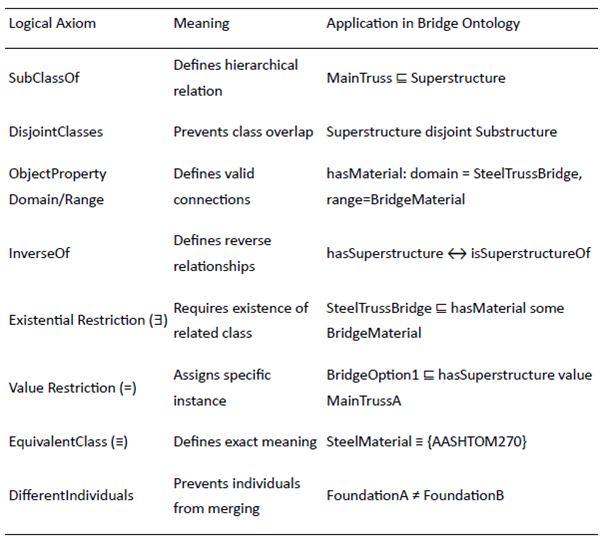
Table 01: Logical Axioms Applied in the Ontology
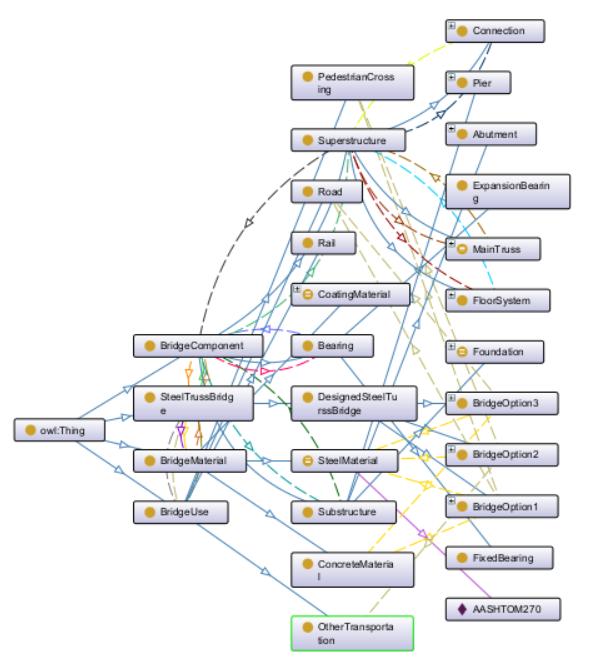
Figure 2: Ontograf
Engineering Examples:
- Double-Deck Truss Bridge: An innovative design with an upper pedestrian lane and lower vehicle traffic lanes.
- Modular Emergency Footbridge: A lightweight, prefabricated structure for quick assembly during emergencies.
- Standard Truss Bridge: A conventional single-deck highway bridge using standard AASHTO steel.
References:
1.Pal, G. D., Patel, A., Meshram, N., & Hussain, S. A. (2021). A review study on different truss type railway steel bridge. International Journal of Scientific Research and Engineering Development, 4(3), May–June 2021.
2.AASHTO/NSBA Steel Bridge Collaboration. (2025). Guidelines for steel truss bridge analysis (G13.2–2024). American Association of State Highway and Transportation Officials.
3.Zayed, T. M., Chang, L. M., & Fricker, J. D. (2002). Life-cycle cost based maintenance plan for steel bridge protection systems. Journal of Performance of Constructed Facilities, 16(2), 55-62.
4.Xiong, Z., & Tao, C. (2014). Emergency steel truss pedestrian bridge (Chinese Utility Model Patent No. CN 203625761 U). China: China Harzone Industry Corp. Ltd. Retrieved from https://patents.google.com/patent/CN203625761U/zh
5.Leeco Steel. (2020, October 13). AASHTO M270 vs. ASTM A709: Grade comparison [Blog post]. https://www.leecosteel.com/news/post/m270-a709-grade-comparison/