For Maintenance Strategy 4, maintenance parameters were defined based on the structural role of each subsystem rather than on coordination efficiency. The primary objective is to preserve the stability of the overall system by ensuring that safety-critical components are maintained strictly in accordance with their original design intent and durability requirements.
Maintenance intervals associated with the two retaining walls were therefore fixed and treated as non adjustable reference values. All inspection, repair, rehabilitation, and replacement actions for these components follow predefined schedules derived from established engineering practice and literature guidance. No temporal flexibility is introduced for retaining wall interventions, as any deviation could compromise the global stability of the system.
For all remaining subsystems, maintenance intervals were assigned with limited tolerance margins that allow minor temporal adjustments. These ranges are not intended to optimize efficiency or logistics, but to enable system-level integration while respecting the dominance of the retaining walls. Adjustments are constrained to remain within technically acceptable bounds and do not alter the type, extent, or performance objective of the maintenance of actions.
In this strategy, maintenance parameters function as a hierarchical control mechanism rather than flexible coordination ranges. The retaining wall schedules define fixed anchors within the life-cycle timeline, while non-critical subsystems adapt around these anchors. This approach ensures that integrated maintenance planning is achieved without weakening the structural backbone of the system.
| Subsystem | Surface Repair | Major Repair/ Rehabitation | Replacement |
| Gravity Retaining Wall | 10-22 | 35-45 | 45-50 |
| ETICS | 20-60 | – | 55-65 |
| Cantilever Retaining Wall | 10-25 | 20-50 | 40-50 |
| Hardwood Flooring | – | – | 55-65 |
| Concrete Beam with Hollow Floor Slab | – | 20-25 | – |
In Strategy 4, time-impact parameters are introduced to represent the consequences of maintenance execution on overall system availability, with explicit differentiation between structurally critical and non critical subsystems. Rather than serving as a coordination metric, these parameters are used to evaluate how maintenance activities interact with structural safety constraints at the system level.
For the retaining walls, activity durations are treated as fixed and non-negotiable values. The associated time impacts reflect the necessary execution periods required to safely inspect, repair, rehabilitate, or replace components that govern global stability. These durations are preserved without modification, ensuring that structural integrity is not compromised by attempts to reduce or redistribute interruption time.
For non-critical subsystems, representative activity durations are assigned to characterize localized service disturbances that do not threaten system stability. While the execution timing of these actions may be adjusted within predefined bounds, their duration and technical scope remain constant. This allows non-critical maintenance activities to adapt to the fixed retaining wall schedule without altering their intervention intensity.
By keeping the total maintenance demand of each subsystem unchanged, Strategy 4 isolates the effect of structural prioritization on system-level interruption behavior. The resulting analysis highlights how fixing safety-critical interventions and redistributing non-critical actions influence overall system performance, without introducing changes to maintenance frequency, duration, or technical content.
| Subsystem | Surface Repair | Major Repair/ Rehabitation | Replacement |
| Gravity Retaining Wall | 2 | 10 | 5 |
| ETICS | 3 | – | 5 |
| Cantilever Retaining Wall | 3 | 10 | 20 |
| Hardwood Flooring | – | – | 25 |
| Concrete Beam with Hollow Floor Slab | – | 25 | – |
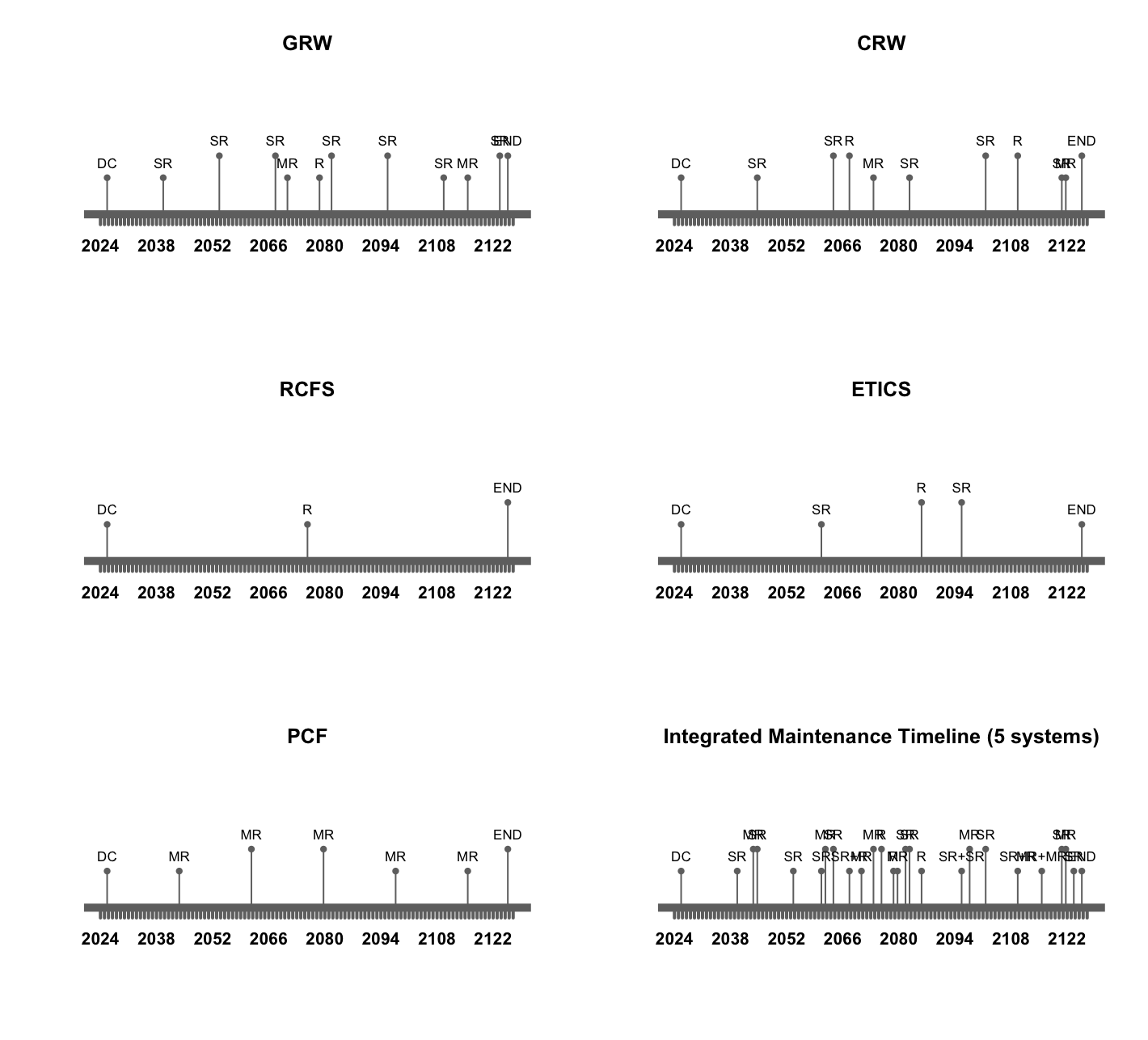
The figure 4.a presents the maintenance timelines for the five subsystems (GRW, CRW, RCFS, ETICS, and PCF) over the 100-year service life and their combination into a single integrated schedule. At the subsystem level, interventions are distributed according to nominal inspection, repair, and rehabilitation intervals, resulting in distinct and unevenly spaced timelines.
When the timelines are combined, the dominance of the two retaining walls becomes evident. The gravity retaining wall (GRW) and cantilever retaining wall (CRW) exhibit the highest density of interventions and define several recurring reference points across the service life. These events remain fixed in the integrated timeline and are not shifted or merged. Their temporal positions effectively structure the system-level maintenance sequence.
Maintenance actions associated with RCFS, ETICS, and PCF show significantly lower intervention frequencies and wider spacing. In the integrated timeline, these actions appear clustered around retaining wall interventions, not because of intentional coordination, but because of being positioned relative to the fixed retaining wall schedule. The clustering therefore reflects constraint-driven alignment rather than optimization.
The integrated timeline highlights clear asymmetry between subsystems. Retaining wall interventions dominate both the frequency and temporal structure of system-level maintenance, while non-critical subsystems adapt passively around them. This results in periods of increased maintenance intensity that are dictated by structural requirements rather than by efficiency considerations.
In contrast to Strategy 3, where overlapping interventions are actively used to reduce logistics-related disruption, Strategy 4 demonstrates how system-level maintenance patterns are governed by structural necessity. The figure shows that integration does not smooth or consolidate interventions uniformly; instead, it reinforces the role of safety-critical components as the primary drivers of maintenance timing across the entire system.
Home | System Definition | Scenario 1 | Scenario 2 | Scenario 3 | Scenario 4 | Discussion | Appendix