Introduction
This project explores the development of a parametric solar facade system using Autodesk Dynamo. The core challenge was to design a flexible and adaptive
geometric system capable of responding to environmental conditions while supporting panelsation and performance-oriented exploration. The solar facade concept was selected because it bridges
architecture, renewable energy, and computational modeling. The goal was to build a dynamic modelmdriven by user-defined parameters such as subdivision density, panel geometry, deformation behavior, and material thickness.
High Performance Criteria
High-Performance Criteria and Parameters The project was guided by criteria related to solar gain optimization, geometric flexibility, fabrication efficiency, and visual clarity. Key parameters identified in Dynamo included sampling ranges for UV coordinates, panel spacing, subdivision steps, and panel thickness values. These parameters allowed effective control over how the surface was divided and how each panel responded to the model’s logic.
Parametric Model Logic
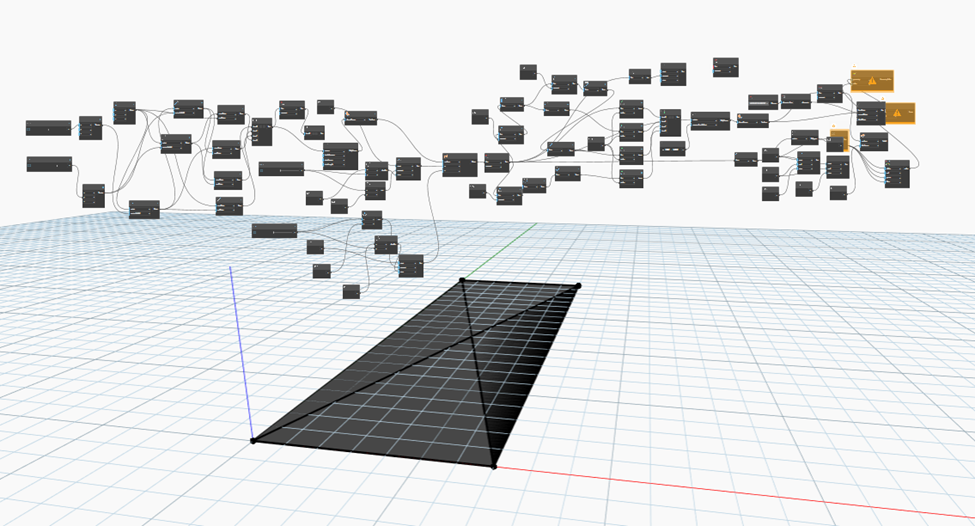
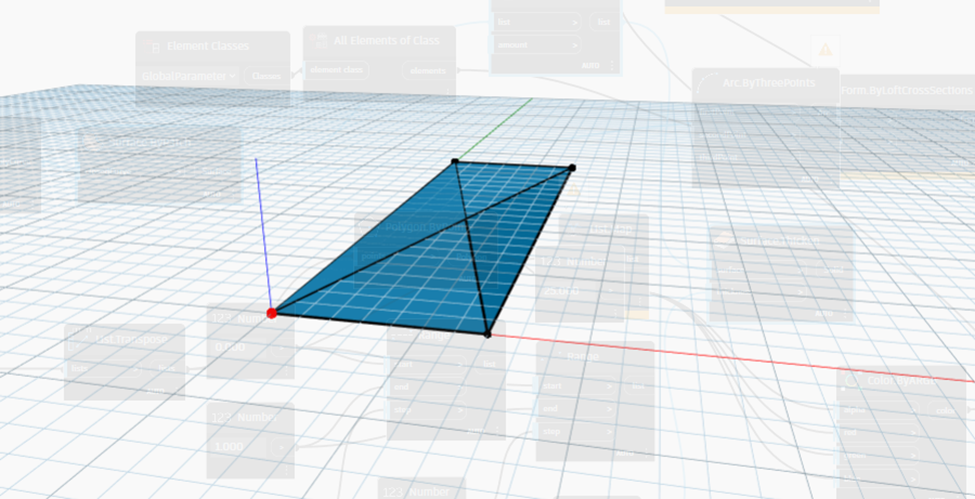
The model begins by defining four adjustable corner points, which form the base surface. The surface is subdivided through UV sampling using Range nodes, creating a grid of points. These points are reorganized using List.Transpose to ensure correct ordering along the surface.
Polygon. ByPoints is then used to generate individual panels from these subdivided points. Additional deformation and thickness operations, such as Surface.Thicken and color assignments, were applied to explore variations in material and geometry. The overall structure remains clean and easy to modify due to a clear dataflow and node organization.
Design Space Exploration
The design space includes variations in: – Panel density, controlled by the number of UV subdivisions. – Panel deformation through geometric shifts applied to grid points. -Surface thickness, allowing simulation of different material behaviors. – Surface color or shading values to represent performance-driven alternatives.
At one extreme, the system produces a very dense grid suitable for detailed solar studies. At the
opposite extreme, the model can generate large, expressive panels that behave more as architectural surfaces than as functional solar elements.
Evaluation of Alternatives
The best-performing alternatives balanced geometric clarity with
adaptability. Configurations with moderate panel density and controlled deformation were the most successful. These alternatives offered: – Smoother panel transitions – Clear panel boundaries -Structural feasibility – Reliable solar-oriented geometry
These solutions demonstrate an effective integration of architectural logic with computational control, making them strong candidates for further development.
Conclusion
This project demonstrates how parametric modeling in Dynamo can support the creation of performance-oriented facade systems. Through adjustable parameters and clear logic, the solar facade model enables flexible experimentation, geometric refinement, and a deeper understanding of design-performance relationships.
Main | Introduction | Individual Systems | Integration Context | Combined Ontology | Combined Parametric Model | Analysis and Conclusions | References