Ontology Scope
The main objective of this ontology is to provide a structured and conceptual framework for modelling, analyzing, and integrating the water system developed within the group project. The ontology focuses on representing the physical, functional, and system-level relationships among water system components in the form of an integrated engineering system.
The scope of this ontology is explicitly centered on the project’s water system and includes its key components, such as:
- Drainage Channels,
- Solar Panels
- Gutters,
- Storage Basins,
- Pumps,
- Culverts,
- and Water Transfer Paths.
These components are modelled as distinct and hierarchically organized classes. For each designed component, corresponding individuals are defined to represent the actual design instances used in the project. Design parameters such as flow rate, storage capacity, geometric dimensions, and functional characteristics are assigned to these individuals through Data Properties. In this way, the ontology captures not only the conceptual structure of the system but also the engineering data relevant to the project design.
The ontology is developed using Description Logic within the Protégé environment, following formal ontology modelling principles to ensure explicit definition of logical relationships between concepts. This enables consistency checking and supports structured reasoning about the water system and its internal dependencies.
In addition to the water system ontology, several ontologies developed by other group members—such as structural systems, solar façade systems, culvert design, and parking structure maintenance—were created independently. These ontologies were imported solely for the purpose of identifying conceptual similarities and potential system-level connections with the water system model. The internal structure of the water system ontology remained unchanged during this process.
Based on this analysis, selected shared concepts and functional overlaps between subsystems were examined and evaluated in relation to the water system design scenario. Only those relationships that were relevant to the objectives of the water system project were considered. The outcome of this process is illustrated through selected examples, presented in the form of a mapping table that highlights representative conceptual correspondences between the water system and other subsystems.
This example-based comparison demonstrates how the water system ontology can serve as a central conceptual reference within the group project, while maintaining a clear separation between subsystem-specific models.
The intended users of this ontology include civil and environmental engineers, water system designers, researchers in building system modelling, and developers of BIM-based and performance analysis tools. The ontology supports engineering decision-making during system design, integration, and functional analysis by providing a formal and extensible knowledge representation of the water system.
To illustrate the conceptual alignment between the water system ontology and other subsystem ontologies developed within the group, a limited number of representative examples are presented in Table 1. These examples do not aim to provide an exhaustive mapping but instead demonstrate how shared functional and structural concepts can be identified and related across different subsystem models.
| Subsystem Ontology | Concept in Subsystem | Corresponding Concept in Water System | Type of Relation | Purpose of Mapping |
| Parking Structure Maintenance | FloorDrain | Drainage Channel | Functional similarity | Water collection and transfer |
| Structural Roof System | Roof Surface | Gutter | Functional dependency | Rainwater collection |
| Culvert System | Culvert | Culvert | Direct conceptual equivalence | Water conveyance |
| Solar Façade System | Panel Support Structure | Pump Power Supply / Control Unit | System-level interaction | Energy support for water system components |
Objective and Methodology
The objective of this study is to develop an engineering ontology that represents the integrated water system of the group project in a structured and formal way. The ontology focuses on modeling the main water-related components, their functional roles, and their interaction within a unified system.
The model is implemented in the Protégé environment using Description Logic. It is designed to support system-level understanding and reasoning about water collection, conveyance, storage, reuse, and overflow protection under different environmental conditions.
As shown in the class hierarchy, the ontology is organized into several core conceptual layers. DesignedComponent represents engineered system elements such as drainage channels, gutters, culverts, pumps, overflow channels, storage basins, and solar panels. These components are integrated at system level through the DesignedWaterSystem class.
Environmental influences are captured using the EnvironmentalContext class, including rainfall scenarios such as normal and heavy rainfall. Functional behavior is modeled through the FunctionalRole class, linking components to roles such as water collection, water conveyance, water storage, water reuse, and overflow protection. Physical grounding is provided by the PhysicalComponent layer, which represents real-world elements such as roofs, drainage channels, culverts, pumps, and storage basins.
The methodology follows a systematic process of defining system components, organizing them into hierarchical classes, and assigning object and data properties to represent functional relationships and design parameters. This approach enables a clear and consistent representation of the project’s water system within the group ontology.
The developed ontology is designed to represent the main components of the project’s water system—such as drainage channels, gutters, culverts, pumps, storage basins, and runoff conveyance paths—within a coherent and structured framework. In addition, the functional roles of the components (e.g., water conveyance, storage, overflow protection, and water reuse) as well as their relationships with different rainfall scenarios are explicitly captured in the model.
The key objectives of this model can be summarized as follows:
- to provide a coherent conceptual representation of the project’s water system at the level of an engineered system,
- to enable the analysis of interactions between system components under different rainfall scenarios,
- to establish a conceptual interface with other subsystems of the group project without altering the core structure of the water system, and
- to support analysis, documentation, and structured presentation of the system through an ontology-based model.
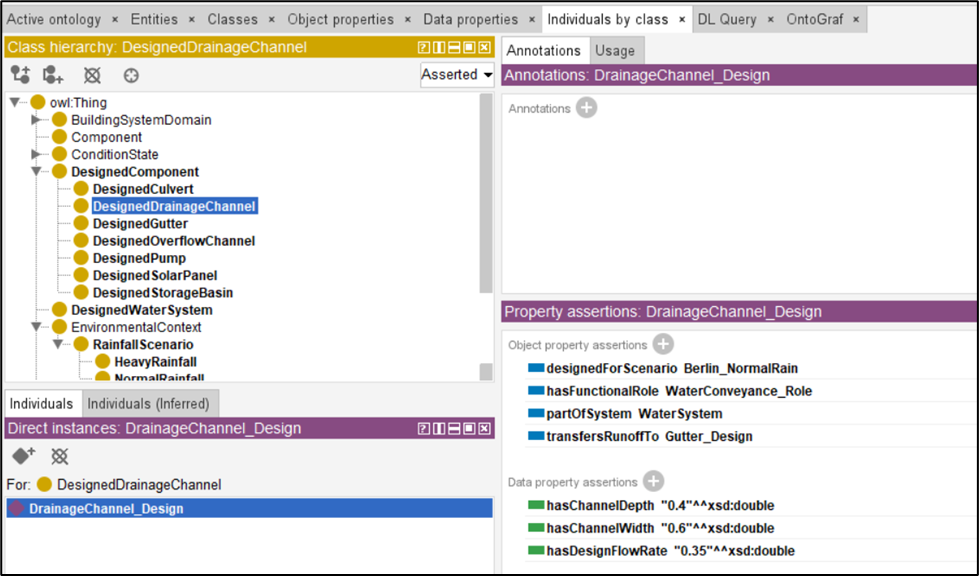
To achieve these objectives, systemic and functional relationships between components are defined using Object Properties, while design-related attributes of each component are represented through Data Properties. This approach enables semantic analysis and logical reasoning about the structure and behavior of the project’s water system.
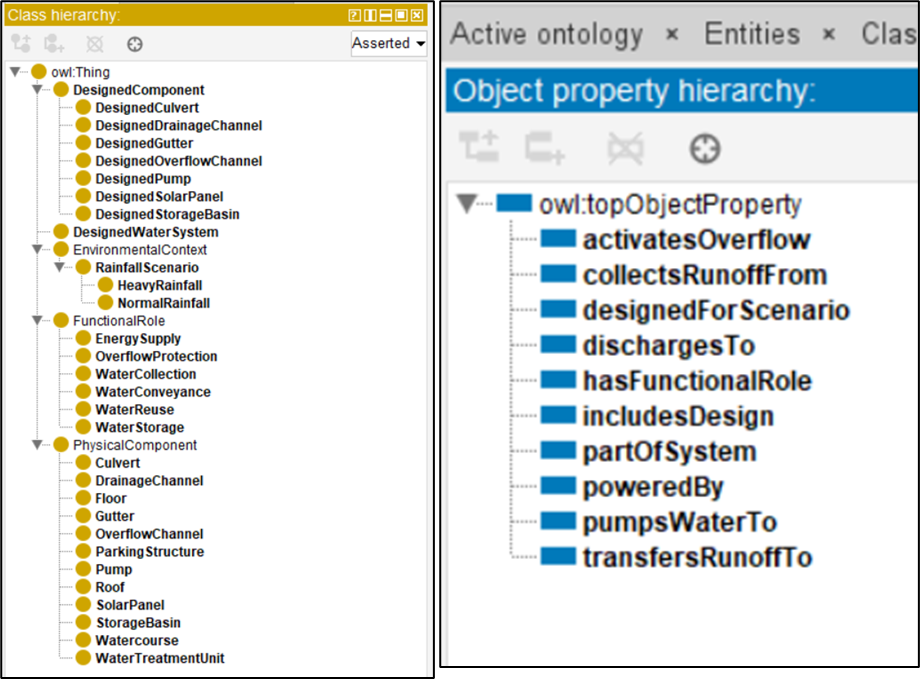
Table x. Example of an object property definition
| Property | Domain | Range |
| designedForScenario | DesignedWaterSystem | RainfalScenario |
Analysis and Results
The developed water system ontology was validated using the reasoning mechanism in Protégé to ensure logical consistency and correct classification of system components. The reasoning results confirmed that all designed components are properly linked to the main water system, functional roles, and rainfall scenarios.
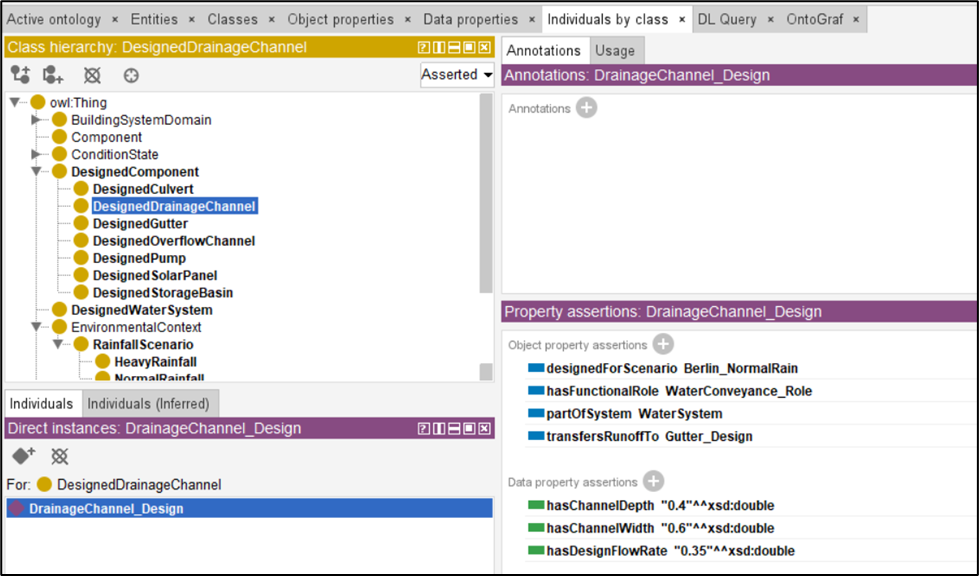
In addition to the class structure, the model explicitly represents design-level information through Individuals. For each designed component, such as DesignedDrainageChannel, individual instances were defined to store real design parameters of the project. These parameters include design flow rate, channel width, and channel depth, which are represented using data properties. This approach allows the ontology to reflect not only the conceptual structure of the system, but also its actual engineering design data.
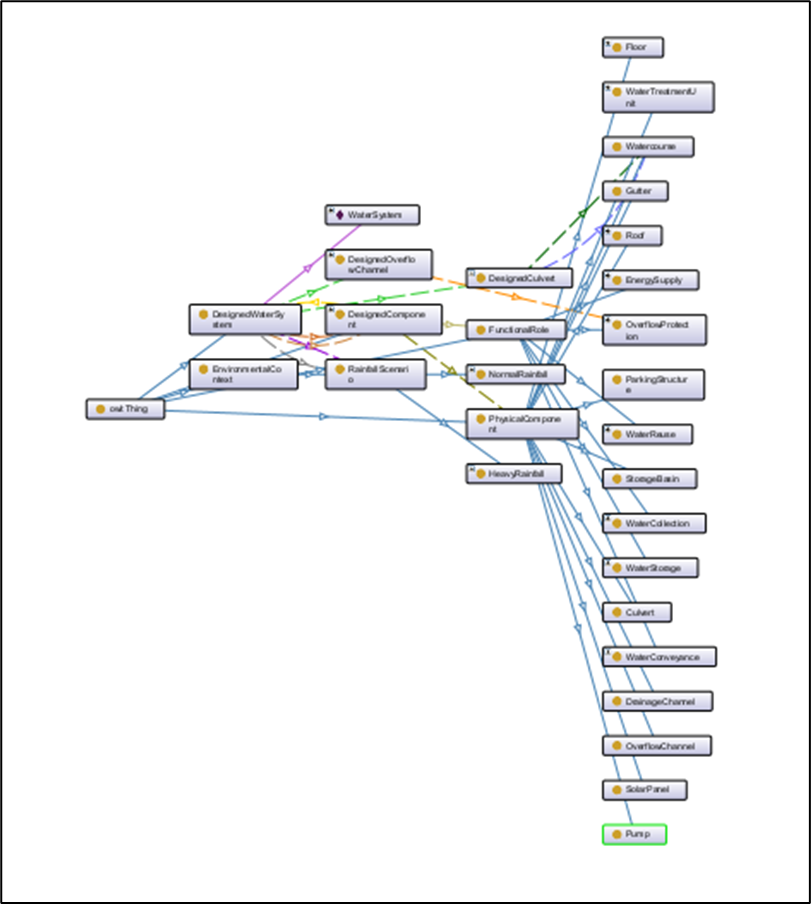
The OntoGraf visualization presents an integrated view of physical components, designed components, functional roles, and environmental contexts. It demonstrates how individual design elements are connected within the overall water system and how their functional behavior can be analyzed under different rainfall scenarios.
Overall, the results show that the ontology successfully integrates structural modeling and component-level design information, providing a coherent and practical representation of the project’s water system.
Main | Introduction | Individual Systems | Integration Context | Combined Ontology | Combined Parametric Model | Analysis and Conclusions | References