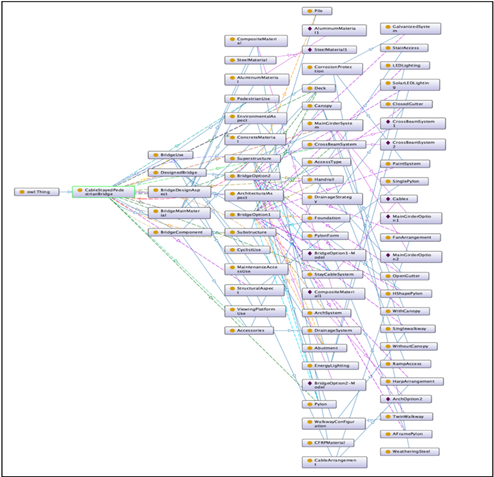
Ontology (Protégé) for a cable-stayed pedestrian bridge.
This project develops a formal ontology to address a key engineering challenge in conceptual bridge design: design knowledge is typically fragmented across drawings, standards, and discipline-specific documents, making component definition, terminology, and design rationale inconsistent and difficult to reuse or validate. To mitigate this, a compact, machine-interpretable knowledge model was implemented in Protégé for a single-pylon cable-stayed pedestrian bridge. The ontology defines the core entities (bridge system, superstructure/substructure, deck, pylon, stay-cables, anchorage, foundation, and accessories) and connects them through explicit semantic relations (e.g., hasComponent, hasMaterial, hasUse, hasDesignAspect). Logical constraints were introduced to improve engineering consistency—so that a bridge instance must contain the essential component groups and maintain coherent component membership—supporting structured querying and basic validation of the conceptual configuration. The ontology was tested using representative individuals and checked with standard reasoners (e.g., HermiT) to ensure internal consistency and enable inference. The resulting ontology provides a disciplined framework for traceable design knowledge, reducing ambiguity and facilitating integration with parametric/BIM workflows. The developed ontology graph is shown in Figure 1.
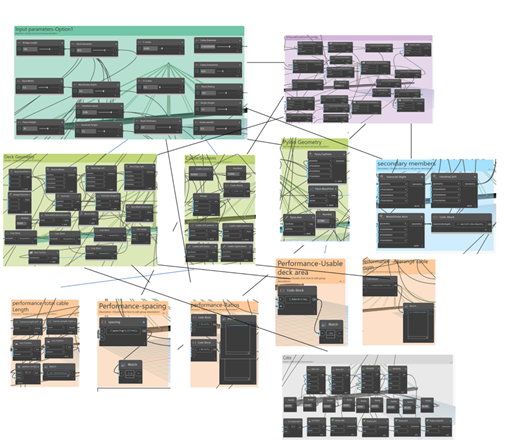
Project 2 – Dynamo BIM parametric modeling (workflow-focused design process).
This project implements a node-based Dynamo workflow in the Revit environment to translate the bridge concept into a controllable parametric model and enable rapid generation of design variants. The script was structured as a clear pipeline: (1) input parameters define the main geometric and configuration variables (e.g., overall deck layout, pylon position/height, cable arrangement logic, and spacing rules); (2) geometry generation nodes create and update the primary bridge elements (deck alignment and cross-section, pylon geometry, cable lines, and connection points/anchor locations) through reference points and curves; (3) automation and dependencies ensure that any change in key inputs propagates consistently across the entire model, preventing manual remodeling and reducing coordination errors; and (4) output and comparison extract comparable indicators (such as geometric quantities, layout characteristics, and material-intensity proxies) to support option screening.
Rather than producing a single static BIM model, the workflow functions as a design exploration tool: it enables systematic iteration across alternative configurations and makes the trade-offs transparent—typically between a more economical option (simpler configuration and lower structural demand), a balanced baseline solution, and a higher-capacity/stronger architectural option (greater functionality and visual impact with higher structural/material requirements). The Dynamo node graph and its computational structure are presented in Figure 2, showing the visual programming script used to generate and compare the parametric bridge alternatives.