This work presents an integrated ontology-based and parametric modelling framework for a Smart Pedestrian Bridge System (SPBS). The aim was to combine traditional civil engineering knowledge with smart infrastructure concepts, while maintaining semantic clarity, logical consistency, and direct compatibility with parametric design models.
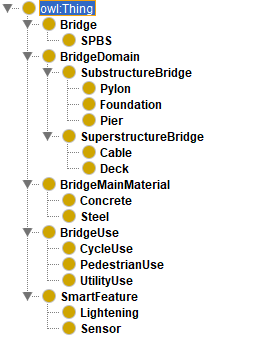
An ontology was developed to structure the bridge system into well-defined domains, including superstructure and substructure components (deck, pylon, pier, foundation), materials (e.g., steel, concrete), usage types (pedestrian and cycling), and smart features such as sensors and lighting. Physical components were clearly separated from abstract design concepts by introducing design domains and design aspects (environmental, structural, and architectural), preventing logical conflicts during reasoning.
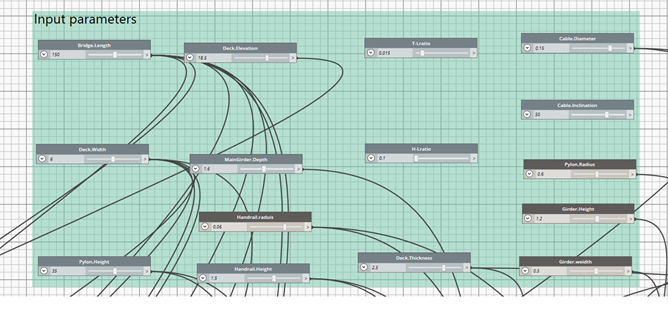
Concrete individuals were instantiated to represent a smart bridge option and its main components, demonstrating how real bridge designs can be described and compared within the ontology. Key geometric and structural parameters—such as bridge length, deck width and thickness, deck elevation, pylon height, and cable properties—were defined as data properties.
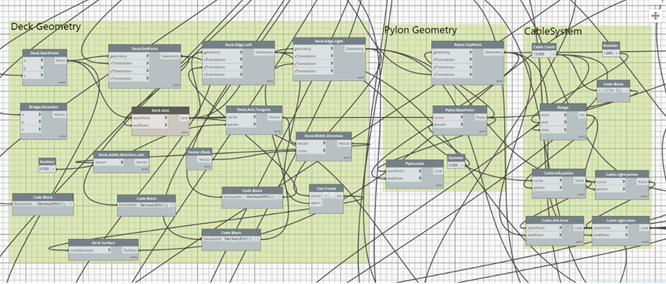
In parallel, a parametric model in Dynamo was developed using the same parameters to generate deck geometry, pylon geometry, and the cable system. This ensured consistency between the semantic model and the geometric representation.
Overall, the work demonstrates how ontology-based modelling and parametric design can be effectively integrated to support smart pedestrian bridge design, enabling design validation, comparison, and future extension toward smart city applications.