Ontology
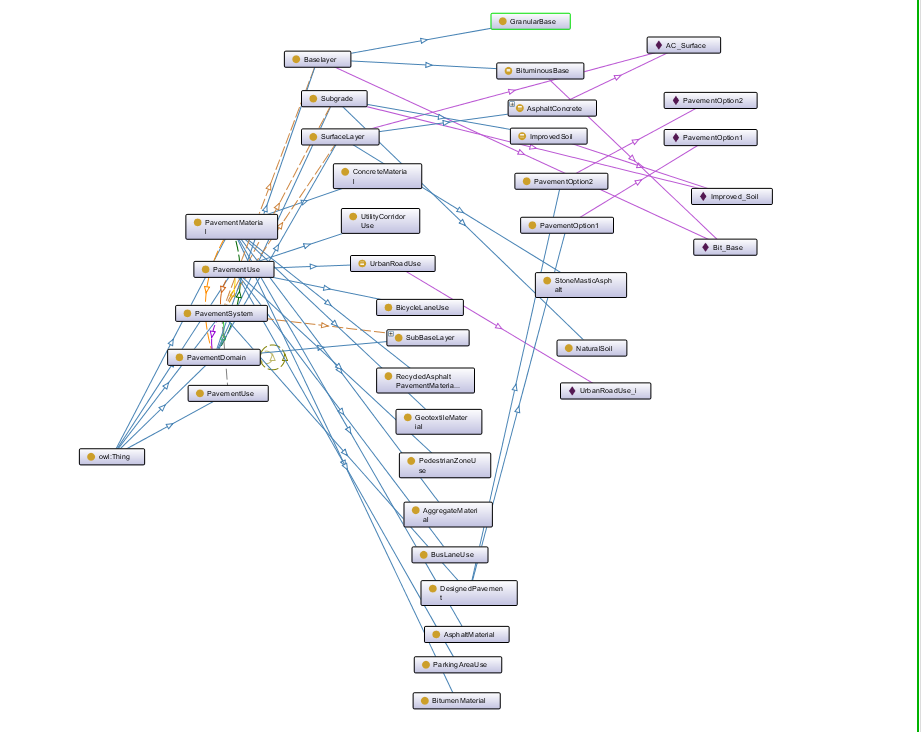
The present study developed a comprehensive ontology for urban asphalt pavement systems using the OWL 2 language within the Protégé environment. The developed ontology seeks to provide a structured and machine-readable representation of pavement knowledge for the purpose of digital and sustainable pavement design. The developed ontology provides a description of pavement systems in terms of three fundamental dimensions: the physical components of the pavement system, which include the surface, base, subbase, and subgrade layers; the materials used in pavement construction, which include conventional asphalt, bitumen, aggregates, geotextiles, recycled asphalt pavement, etc.; and the usage type of the pavement system, which includes urban roads, bus lanes, pedestrian areas, etc. Some of the fundamental object properties of the developed ontology include hasLayer, hasMaterial, hasUse, etc., along with their respective inverses, while the data properties include layer thickness, density, CBR value, surface temperature, traffic load, design life, etc. Two pavement design alternatives are developed in the present study for the purpose of demonstrating the applicability of the developed ontology in the description of conventional and sustainable pavement designs.
Parametric Modelling
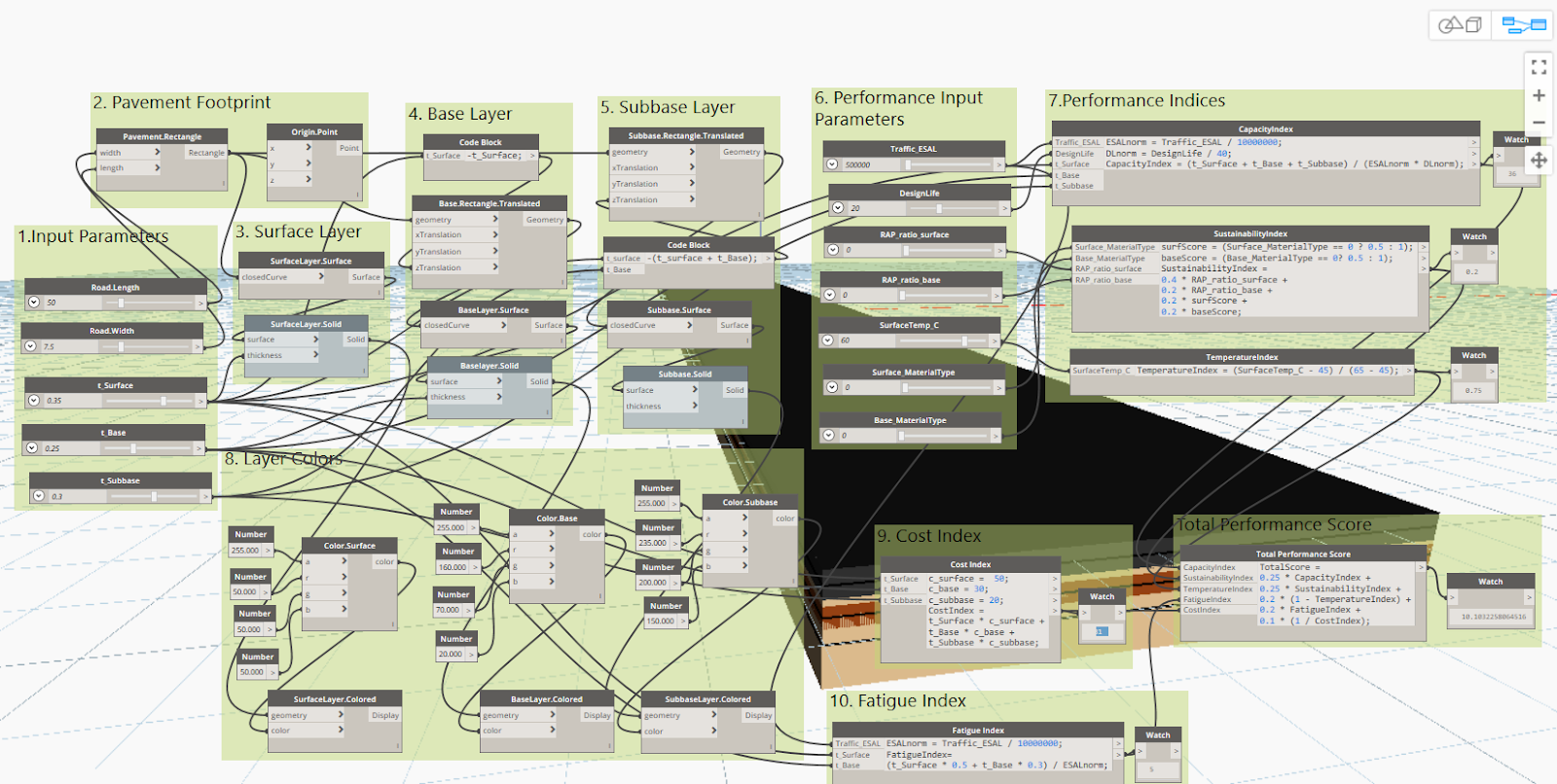
This project uses the concepts that go into pavement design and translates that into a flexible, parametric BIM using Dynamo. It also attempts to test how a flexible pavement will behave under different geometric, material, traffic, and climate conditions. It models a three-part flexible pavement, where each part consists of a surface, a base, and a subbase, and where all knobs can be fully controlled, such as thickness, road width, material, percentage of recycled asphalt, ESAL, design life, and surface temperature. It uses Dynamo to create a flexible pavement where each part is built sequentially, where changes in thickness will affect the position of each part, and where different materials will be color-coded. It also uses performance calculations to obtain various results, such as structural, sustainability, temperature, fatigue, cost, and a total performance score. It also attempts to test three different options, such as conventional, sustainable, and temperature-resistant pavements, where trade-offs between different factors such as durability, sustainability, and resistance can be made. It attempts to show how important parametric modeling is as a decision-making tool in early-stage pavement design.