Introduction
Decisions made during the design phase of civil infrastructure determine the environmental and economic performance of the system throughout its lifetime. For longlived urban assets such as sidewalks, maintenance and operation often cause greater impacts than the initial construction. Therefore, a life-cycle assessment (LCA) combined with multi-criteria decision analysis (MCDA) provides a systematic framework to evaluate design options and support sustainable decision-making.
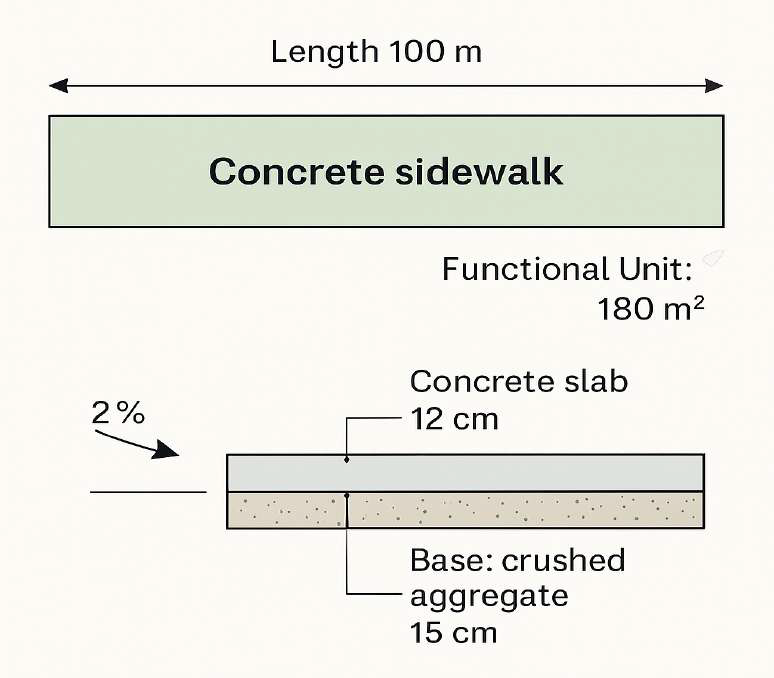
The present study focuses on the winter service system of an urban sidewalk in Berlin, where recurring freeze–thaw cycles and de-icing practices significantly influence surface durability and maintenance demand. The analyzed section measures 1.8 m × 100 m (180 m²), representing a typical pedestrian path exposed to urban winter conditions. The reference period is 40 years, assuming approximately 25 winter events per year based on the DWD Berlin-Tempelhof climate data.
Objective and Scope
The objective is to identify the most sustainable and policy-compliant winter maintenance
strategy by assessing:
- Environmental impact (CO₂-equivalent emissions),
- Life-cycle cost (LCC),
- Diesel fuel consumption,
- Transport intensity (ton·km), and
- Policy-fit according to Berlin regulations.
The functional unit (FU) is defined as the maintenance of 180 m² sidewalk for 40 years. The system boundary covers production and transport of de-icing materials, operational fuel use for spreading and plowing, periodic sweeping or collection (if applicable), and surface interventions caused by each strategy. Pavement end-of-life is excluded.
Goal and Scope of Assessment
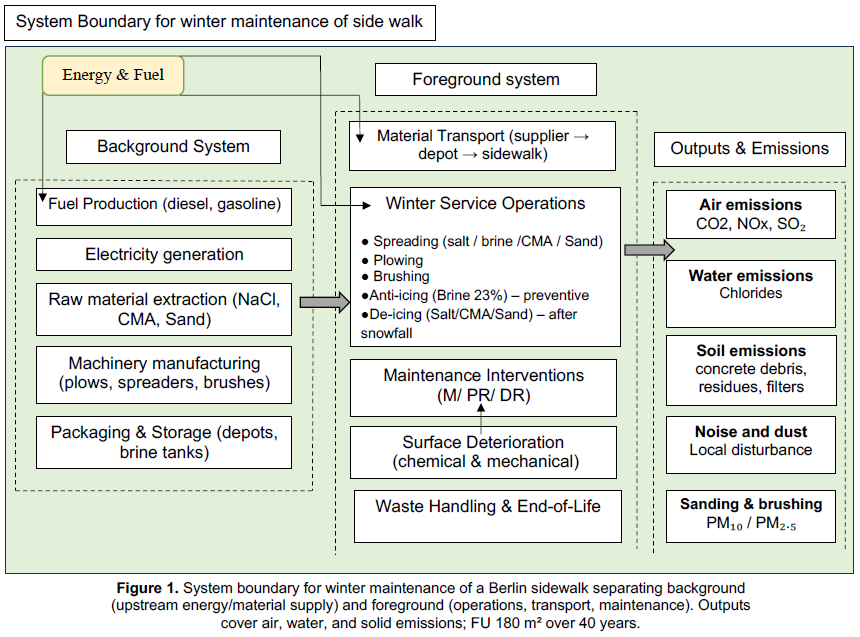
The goal of this assessment is to quantify and compare the environmental and economic impacts of alternative winter maintenance strategies for a 1.8 m × 100 m sidewalk (180 m² functional unit) over a 40-year service life. The assessment focuses on both direct impacts (material and fuel consumption, transport) and indirect effects (surface deterioration and maintenance frequency). The ultimate objective is to recommend the most sustainable and policy-compliant strategy for Berlin’s pedestrian network. The scope of the analysis covers all life-cycle stages relevant to winter service, as illustrated in Figure below. The system boundary includes:
- Extraction and processing of raw materials (NaCl, CMA, sand),
- Manufacturing and delivery of de-icing products to municipal depots,
- Fuel use and operational activities for spreading, plowing, or brushing,
- Seasonal sweeping and collection of abrasives, and
- Periodic maintenance interventions (M, PR, DR) influenced by each strategy
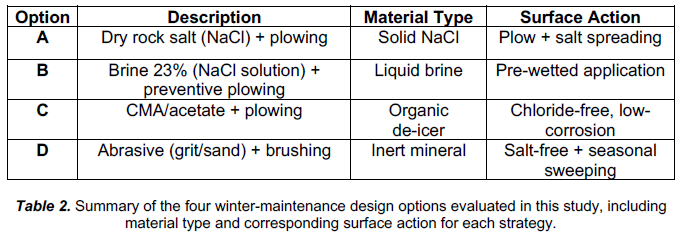
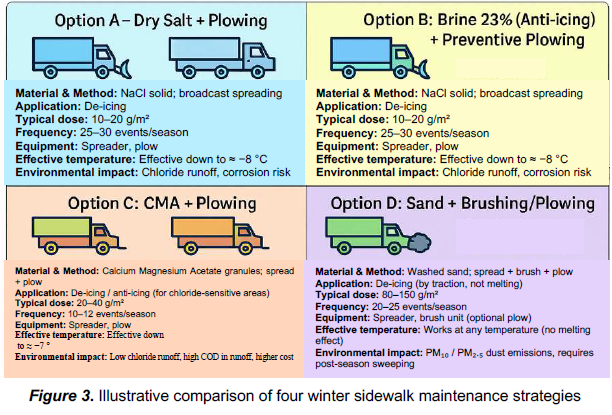
Design Options
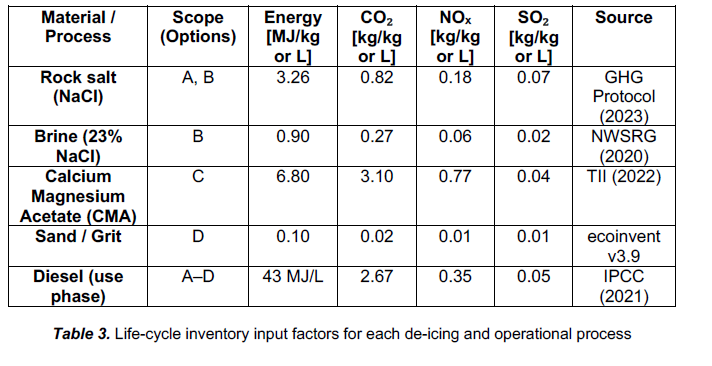
Life Cycle Timeline
A life-cycle timeline provides a structured overview of how maintenance and renewal activities are distributed across the 40-year service period of the analyzed sidewalk segment. Understanding the frequency and timing of these interventions is essential for evaluating cumulative material demand, operational energy use, and long-term environmental impacts across the four winter maintenance strategies. For the 100 m × 1.8 m concrete sidewalk considered in this study, the timeline includes
the main winter service activities as well as periodic surface-related interventions that result from long-term deterioration. Four categories of interventions are defined, consistent with municipal winter service practices in Berlin:
- SDO – Seasonal de-icing operation: spreading, plowing, or brushing during winter events.
- M – Minor maintenance: seasonal sweeping, removal of residual abrasives, and minor surface cleaning.
- PR – Partial repair: localized patching or surface treatment in response to scaling or small-area abrasion.
- DR – Deck replacement: full renewal of the concrete surface once deterioration exceeds serviceability limits.
The sidewalk is assessed over a 40-year service life, and intervention frequencies are assigned based on the relative aggressiveness of each de-icing strategy, supported by Berlin municipal guidelines and literature on chloride-induced deterioration.
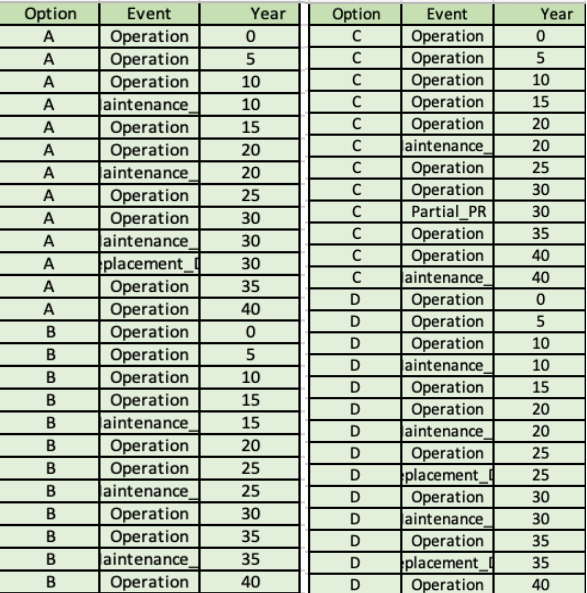
Life Cycle Inventory and Analysis


The table reports total material demand, fuel consumption, transport effort, environmental
impacts, maintenance counts, and life-cycle cost.
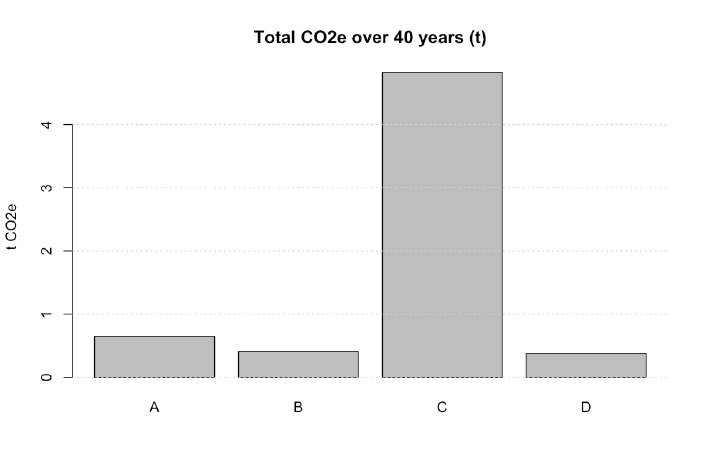
Total CO₂e emissions for Options A–D over the 40-year service period. Option D (abrasive + brushing) exhibits the lowest emissions due to minimal upstream impacts and reduced chemical deterioration. Option C shows the highest emissions driven by the energy-intensive production of CMA and one deck-replacement intervention.
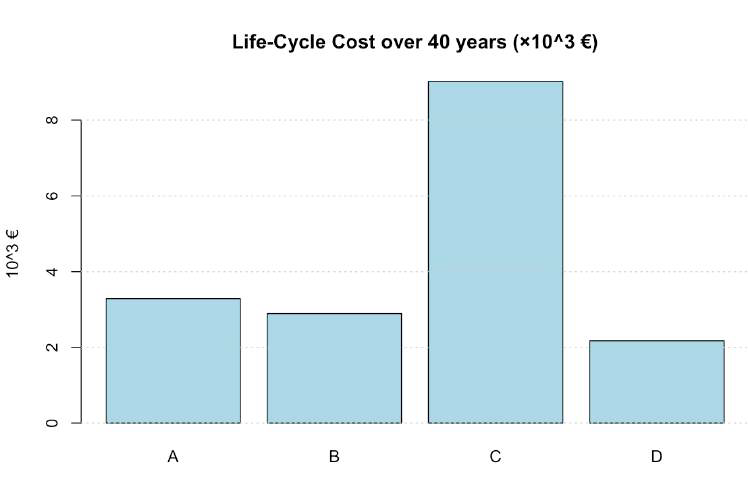
Life-cycle cost comparison of the four maintenance strategies. Option D is the most cost efficient due to the low price of abrasive materials. Option C results in the highest cost, dominated by CMA unit price and repair expenditures.
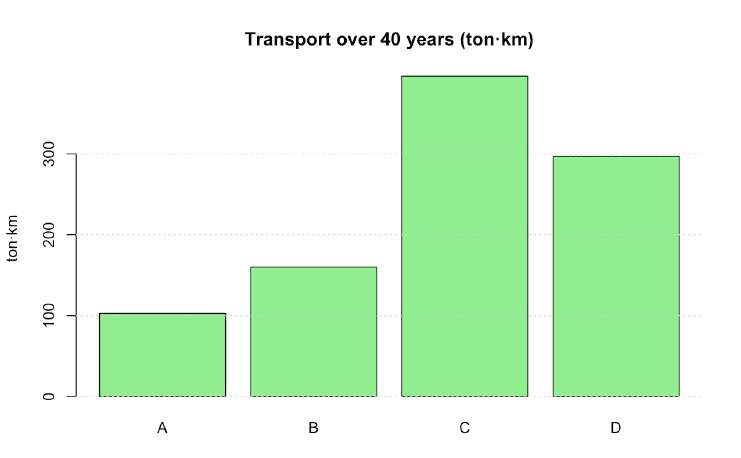
Transport effort associated with material delivery and operational logistics. Option C shows the highest ton·km because of greater material mass and longer supplychain routes. Options A and B have approximately similar transport profiles.
AHP Analysis
Interpretation
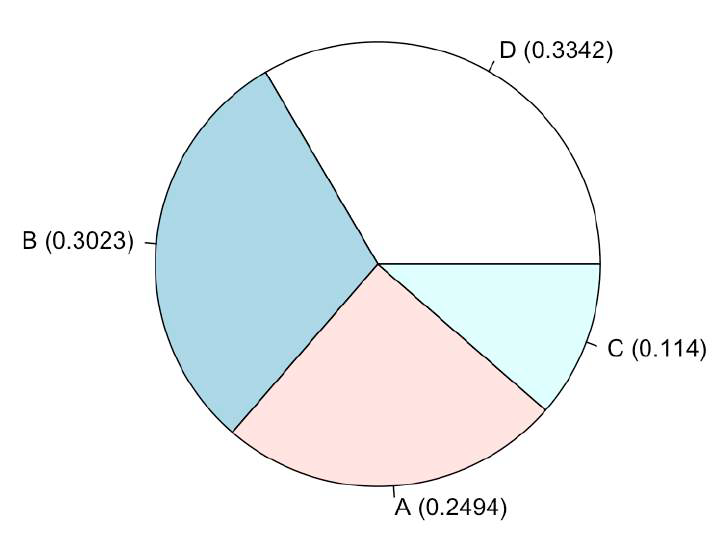
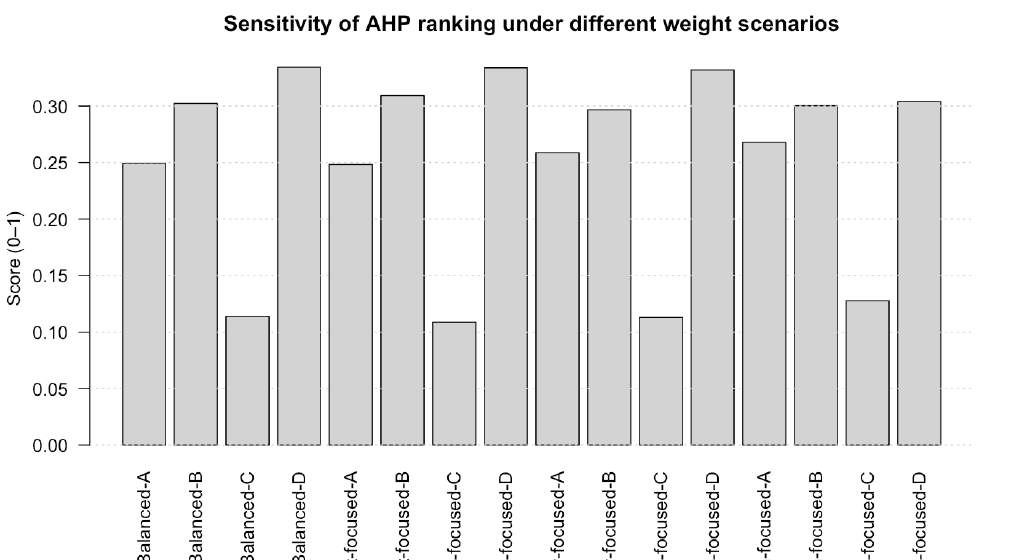
The AHP analysis reinforces the conclusions drawn from the LCA/LCC assessment:
- Option D (abrasive + brushing) consistently outperforms all alternatives across environmental and policy-related criteria.
- Option B (brine) performs better than conventional salt treatment due to reduced NaCl mass and smoother operational profiles.
- Option A (NaCl) remains viable but environmentally inferior due to higher salt loads and chloride-related impacts.
- Option C (CMA), while chemically benign, is dominated by its excessively high life-cycle cost, making it the least efficient option.
Overall, the AHP model provides a structured, transparent decision-making framework
confirming that Option D is the most sustainable winter-maintenance solution for longterm
operation of the sidewalk system.
Main | Introduction | Integration Context | Maintenance Strategies | Life-Cycle Analysis | Multi-Objective Optimization | Conclusion