In this third test scenario, the previous idea is pushed further by modifying the frequency of all surface repair interventions (VI) across the four subsystems. Instead of each system following its original interval, all VI interventions are standardized to occur every 3 years.
| Intervention | Initial Interval (years) | Modified Interval (years) |
| VI.s | 3 | 3 (unchanged) |
| VI.n | 4 | 3 |
| VI.t | 5 | 3 |
| VI.p | 6 | 3 |
This modification significantly increases the number of individual VI interventions for some subsystems, particularly those that originally had long intervals such as VI.n and VI.p. From a subsystem perspective, this may appear inefficient, as maintenance actions become more frequent over the 80-year service life.
However, the objective of this scenario is not to reduce the number of individual interventions, but to maximize synchronization between systems. By aligning all VI activities on the same 3-year cycle, a large proportion of these interventions can be performed during the same plant shutdown periods, creating strong opportunities for maintenance bundling.
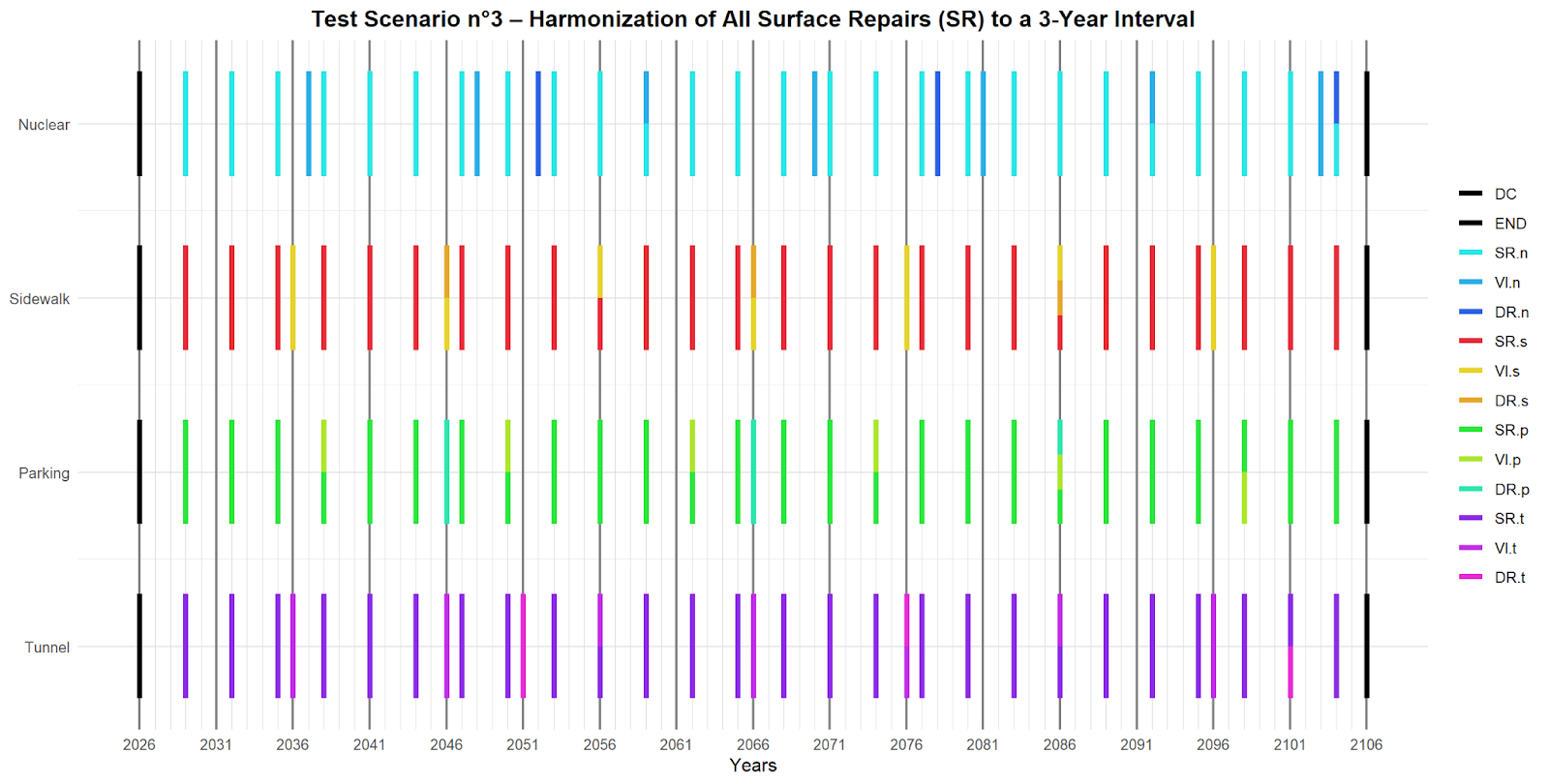
After applying this harmonized strategy, the total number of maintenance intervention days over the 80-year service life drops to 475 days, compared to 550 days in the initial uncoordinated strategy. This represents 75 fewer maintenance days, corresponding to a reduction of approximately 13.6% in total intervention time.
This result is particularly striking: despite a clear increase in the number of individual maintenance actions, the total downtime of the plant decreases substantially. The explanation lies in the improved temporal alignment of interventions, which allows multiple systems to be maintained simultaneously during shared outages.
This scenario strongly illustrates a key principle of multi-system maintenance optimization:
synchronization can be more impactful than reduction. In other words, coordinating when maintenance occurs may be more beneficial than simply trying to minimize how often it occurs.
Main | Introduction | Integration Context | Maintenance Strategies | Life-Cycle Analysis | Multi-Objective Optimization | Conclusion