In this second test scenario, we again modify only one parameter compared to the initial maintenance plan. This time, the interval of the most frequent intervention, VI.s, is shortened.
| Intervention | Initial Interval (years) | Modified Interval (years) |
| VI.s | 3 | 2 |
This change means that maintenance of the urban sidewalk is performed more frequently, reducing the time between two consecutive interventions by one year. At first glance, this decision may appear inefficient, since it significantly increases the number of VI.s interventions over the 80-year service life.
Indeed, the number of VI.s occurrences rises from 27 interventions (every 3 years) to 40 interventions (every 2 years), representing 13 additional maintenance actions over the plant lifetime.
However, many other maintenance operations across the different subsystems follow even-numbered intervals (for example, VI.n every 4 years, VI.p every 12 years, etc.). By shifting VI.s to a 2-year cycle, more interventions naturally occur in the same years, creating additional opportunities for maintenance bundling while the plant is already shut down.
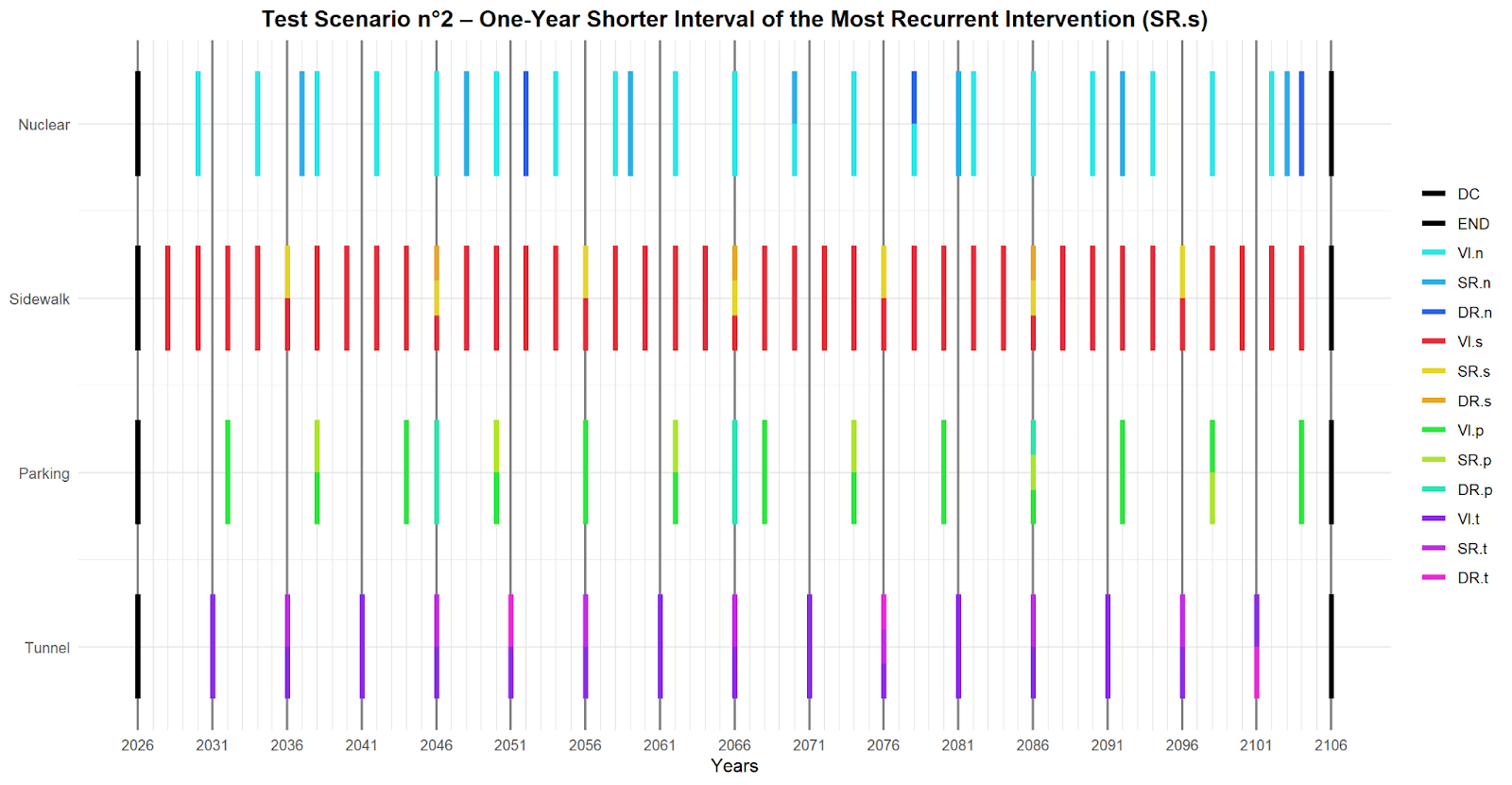
After applying this modification, the total number of maintenance intervention days over the 80-year service life becomes 545 days, compared to 550 days in the initial uncoordinated strategy. This corresponds to 5 fewer maintenance days, representing a reduction of less than 1% in total intervention time.
Main | Introduction | Integration Context | Maintenance Strategies | Life-Cycle Analysis | Multi-Objective Optimization | Conclusion