The first maintenance planning strategy adopted consists in combining the maintenance strategies of the four systems while treating them independently. In practice, each system is therefore managed separately, without any coordination with the others. This approach reflects a common real-world situation, where no prior planning effort is undertaken to align maintenance activities across systems.
As a result, this strategy is applied by default. It is generally perceived as a saving of time and cost, since it avoids preliminary coordination and synchronization between teams, thereby simplifying the planning process.
In the context of a nuclear power plant, this issue becomes particularly critical. Each day of maintenance intervention corresponds to a day of production shutdown, resulting in significant economic losses, increased organizational constraints, and additional safety challenges. Minimizing the total number of intervention days is therefore essential to ensure efficient operation, long-term reliability, and sustained nuclear safety.
Over the entire plant life cycle, estimated at 80 years, this strategy leads to a total of 550 days of maintenance interventions.
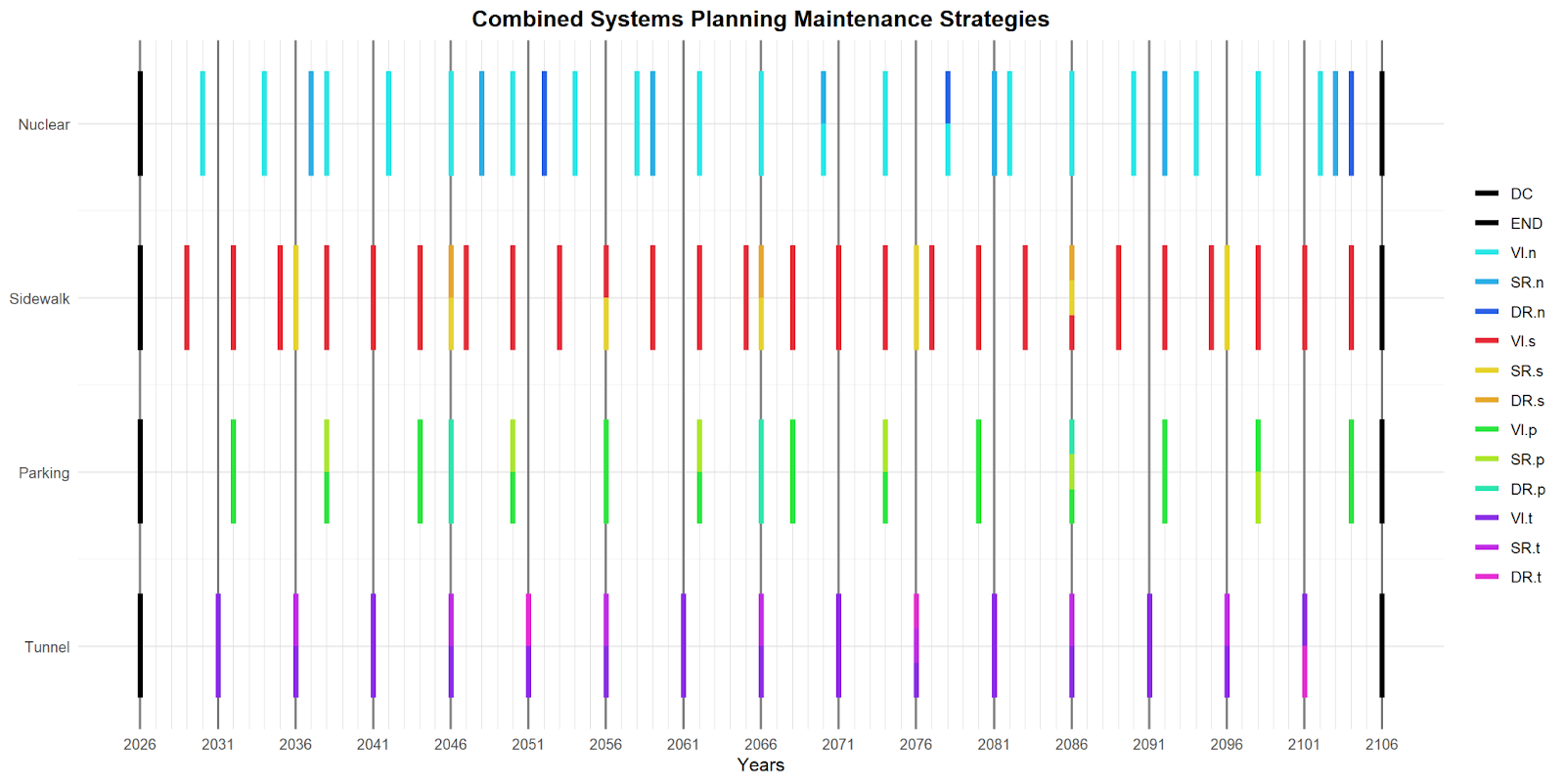
This result motivates the investigation of alternative planning approaches based on the coordination and grouping of interventions, in order to assess whether better performance can be achieved. Indeed, although isolated maintenance management provides an immediate organizational and economic advantage, it raises a fundamental question: at what cost is this apparent gain achieved in the long term?
In order to better understand how maintenance frequency influences the overall performance of the system, we begin by manually adjusting selected intervention intervals and observing the impact on the total number of maintenance days over the 80-year service life.
Main | Introduction | Integration Context | Maintenance Strategies | Life-Cycle Analysis | Multi-Objective Optimization | Conclusion